

Reiki Incense: Scents, Blends, and How to Use Them

You've got a quiet room, a client on the way, and a small decision to make before the session begins, which scent belongs in the space, and whether it should be there at all. Reiki incense works best when you treat it as a sensory cue, not a magic ingredient. It can help mark the start of focused time, soften the transition out of ordinary life, and support attention, but it's still just one part of the room, not the source of the work.
That mindset matters because incense can also irritate some people, especially in tight or shared spaces. If you want a practical frame for boundaries around scent, smoke, and personal comfort, the guide on self-care boundaries for sensitive people is a useful companion read. Keep that balance in mind as you choose scent, format, and airflow.
Table of Contents
What Reiki Incense Really Is and Why People Use It - A simple way to define it
A Short History of Incense in Energy Work - Why the pairing makes sense
Best Incense Scents for Reiki Sessions - Common scent families and what they tend to evoke
Sticks, Cones, and Resins Compared - How the main formats differ
How to Use Incense in a Reiki Session - A simple session routine
Pairing Incense With Meditation and Crystals - Pair scent to the work, not the myth
Safety, Smoke, and Sensitive Spaces - Ventilation is part of the ritual - Know when to switch formats
Buying and Storing Quality Reiki Incense - What to look for at purchase - How to keep it fresh
What Reiki Incense Really Is and Why People Use It
A practitioner might light a stick of incense five minutes before a client arrives, not because the smoke itself heals anything, but because the room feels different the moment the scent begins to spread. That shift is the main reason people reach for Reiki incense, it turns an ordinary room into a session space. It gives both the practitioner and the client a clear cue that the work has started.
A simple way to define it
In plain terms, Reiki incense is any incense burned during a Reiki session to support the sensory environment. It can be a stick, cone, resin, or loose blend, and the goal is usually the same, to create a steady background scent that helps people settle, focus, and slow down. The incense is not the healing agent. It's the ritual accessory that frames the session.
Practical rule: If the scent distracts, overwhelms, or lingers too strongly, it's doing too much.
That's why I teach incense in three parts. First, scent selection, which means choosing a fragrance that fits the mood of the session. Second, incense form, which means deciding whether sticks, cones, or resins suit your room and time window. Third, ritual steps, which means setting up, burning, and closing the session in a way that's calm and safe.
People use it in meditation preludes, alongside crystal layouts, and in shared client sessions where a gentle sensory anchor helps the space feel intentional. Some practitioners like a light scent before hands-on work, then keep it subtle once the session begins. Others use incense only at the start and end, which is often the cleaner choice for sensitive clients.
If you want to think clearly about incense, start here, scent first, then format, then room fit. That order keeps the product grounded in actual use instead of vague spiritual language.
A Short History of Incense in Energy Work
Incense is much older than Reiki, and that's part of why the pairing feels natural. One historical source traces incense burning back roughly 6,000 years, with use in ancient Egypt and Babylon for rituals, purification, and offerings, while later Japanese traditions developed whole schools of incense appreciation tied to meditation and ceremony (Stonebridge Imports). The point isn't that smoke is mystical by itself. The point is that people have long used scent to mark sacred time.
Why the pairing makes sense
Reiki as a modern healing system was developed in Japan in the early 1920s by Mikao Usui, who lived from 1865 to 1926, and Britannica notes that the practice was first developed and popularized in early 20th-century Japan (Britannica). That timing matters. Reiki emerged in a culture where incense already had a deep role in temple and contemplative life, so the two fit together easily in modern wellness settings.
A later historical account notes that Usui taught about 2,000 students and 16 Reiki masters during his final years, and that Hawayo Takata brought Reiki to Hawaii and the U.S. mainland in 1937 (Britannica). That helped move Reiki into broader wellness markets, especially in the United States.
For incense, the useful lesson is simple. It doesn't need to be “mystically correct” to feel appropriate. Scent reliably signals focus, quiet, and ritual, which is exactly what a Reiki room needs.
Best Incense Scents for Reiki Sessions
The best scent depends on what you want the room to feel like, not what a generic list says is spiritually superior. A client coming in for a long, quiet session may respond better to warm woods. A morning meditation might feel better with a cleaner, brighter note. The fragrance should support the session's tone, not dominate it.
Common scent families and what they tend to evoke
Sandalwood is the classic grounding choice. It has a warm, woody note that sits well in longer sessions because it feels steady without turning sharp. If you want one fragrance that rarely feels out of place, sandalwood is a reasonable starting point, and this frankincense overview can help you compare resinous options with a similar ceremonial feel.
Lavender reads as soft and calming. It often fits closing rituals, bedtime meditations, or any session where you want the room to feel gentler at the end than it did at the start.
Frankincense brings depth and a more ceremonial tone. In smaller rooms, it can feel substantial very quickly, so a little goes a long way. That makes it a good choice when you want the room to feel marked off from ordinary time.
Nag Champa is a blended scent many studios treat as a familiar default. It often feels slightly sweet and balanced, which is why so many practitioners keep it on hand for general use.
Palo Santo gives a dry, bright wood note that many people like when they want a lighter smoke profile. It's often chosen for shorter sessions or a quick opening.
Cedar and hinoki lean clean and forest-like. Those notes can work well for morning sessions, especially if you prefer something less floral and less sweet.
Scent | Dominant Note | Best Session Fit |
|---|---|---|
Sandalwood | Warm woody | Long grounding sessions |
Lavender | Soft floral | Closing rituals, rest-focused work |
Frankincense | Resinous depth | Ceremonial openings, small-room use |
Nag Champa | Sweet blended profile | General studio use |
Palo Santo | Dry bright wood | Short sessions, lighter openings |
Cedar | Clean forest wood | Morning work, reset-focused sessions |
The easiest way to choose is to rotate by intent. Use grounding woods for heavier days, floral scents for closing, and brighter woods for an opening cue. Personal preference still wins, especially when a client is sensitive to fragrance.
Sticks, Cones, and Resins Compared
The format matters almost as much as the scent. A beautiful fragrance can still be the wrong choice if it throws too much smoke, burns too fast, or leaves ash where you don't want it. Think of format as the practical part of the decision, the part that tells you whether the product fits your room, your schedule, and your cleanup routine.
How the main formats differ
Stick incense is the easiest format for most Reiki practitioners. It burns steadily, is simple to place in a holder, and gives you a predictable background scent for a sit-down session. It's the most convenient option when you want low fuss and a calm, even burn. A practical guide to incense stick uses is helpful if you're setting up your first routine.
Cone incense burns more compactly and usually feels better for shorter sessions or quick room resets. The smoke tends to feel denser in a small burst, which can be useful if you want a stronger opening note without a long burn.
Resin on charcoal gives the deepest ceremonial feel. It needs a proper burner and a little more attention, but it offers strong scent throw and a more traditional temple-like atmosphere. A resin incense guide can help you understand why it's often chosen for slower, more deliberate rituals.
Loose powder or coil incense gives the most control over blend and burn rate. It's useful if you want to shape the session very precisely, but it also asks for more setup and care.
Decision rule: choose sticks for convenience, cones for short intensives, resins for ceremonial depth, and loose incense when you want more control.
Format | Burn Time | Smoke Level | Scent Strength | Best Session Fit |
|---|---|---|---|---|
Stick | Moderate, steady | Moderate | Balanced | Everyday Reiki sessions |
Cone | Shorter, compact | Moderate to strong at first | Noticeable | Quick openers, short cleansings |
Resin | Variable, depends on amount | Strong | Deep | Ceremonial use, spacious rooms |
Loose | Variable, user-controlled | Adjustable | Adjustable | Custom blends, tailored rituals |
The practical differences matter too. Sticks are stable and clean. Cones can leave more residue. Resin needs a heat-safe burner and can be messier. Loose incense offers flexibility, but it also demands more skill. If you're new, stick incense is usually the easiest place to begin.
How to Use Incense in a Reiki Session
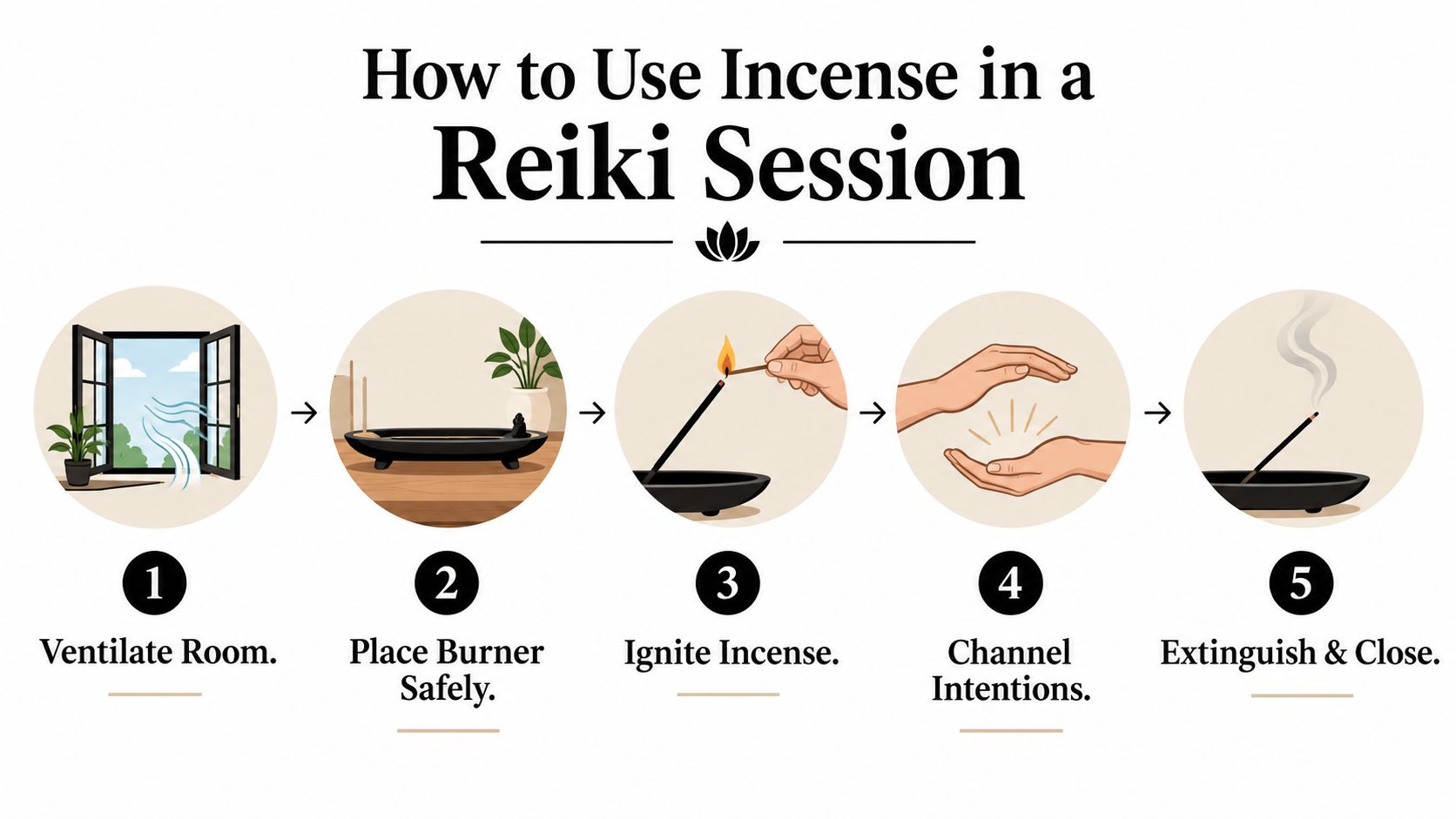
Set the room first, then light the incense. That order keeps the session calm and prevents you from handling a hot burner while you're trying to welcome a client. Open a window slightly, place the burner on a stable tray, and keep it away from linens, paper, and anything that can tip or catch ash.
A simple session routine
First, decide who the room is for. If a client has respiratory sensitivity, skip smoke or use a different format. If the space is shared with pets, make the choice before you light anything.
Second, light the tip, let the flame catch, then blow it out so the ember glows and smolders. Set the incense where it won't sit directly under someone's nose. A soft background presence usually works better than a strong plume.
Third, use a timer. For most sessions, a short burn window is enough to shape the room without turning it into a smoke-heavy environment. When the session is done, extinguish the ember in water or sand, then air out the room.
Good practice: the scent should support the session, not keep announcing itself after the client leaves.
The close matters too. Wash your hands, open the room back up, and take one slow breath before you move on to the next task. That final reset helps the space feel finished instead of left hanging.
If you want a practical reference for basic setup, this incense stick usage guide fits nicely with a first session. The whole process is less about performance and more about consistency. A clean setup, a short burn, and a deliberate close are enough.
Pairing Incense With Meditation and Crystals
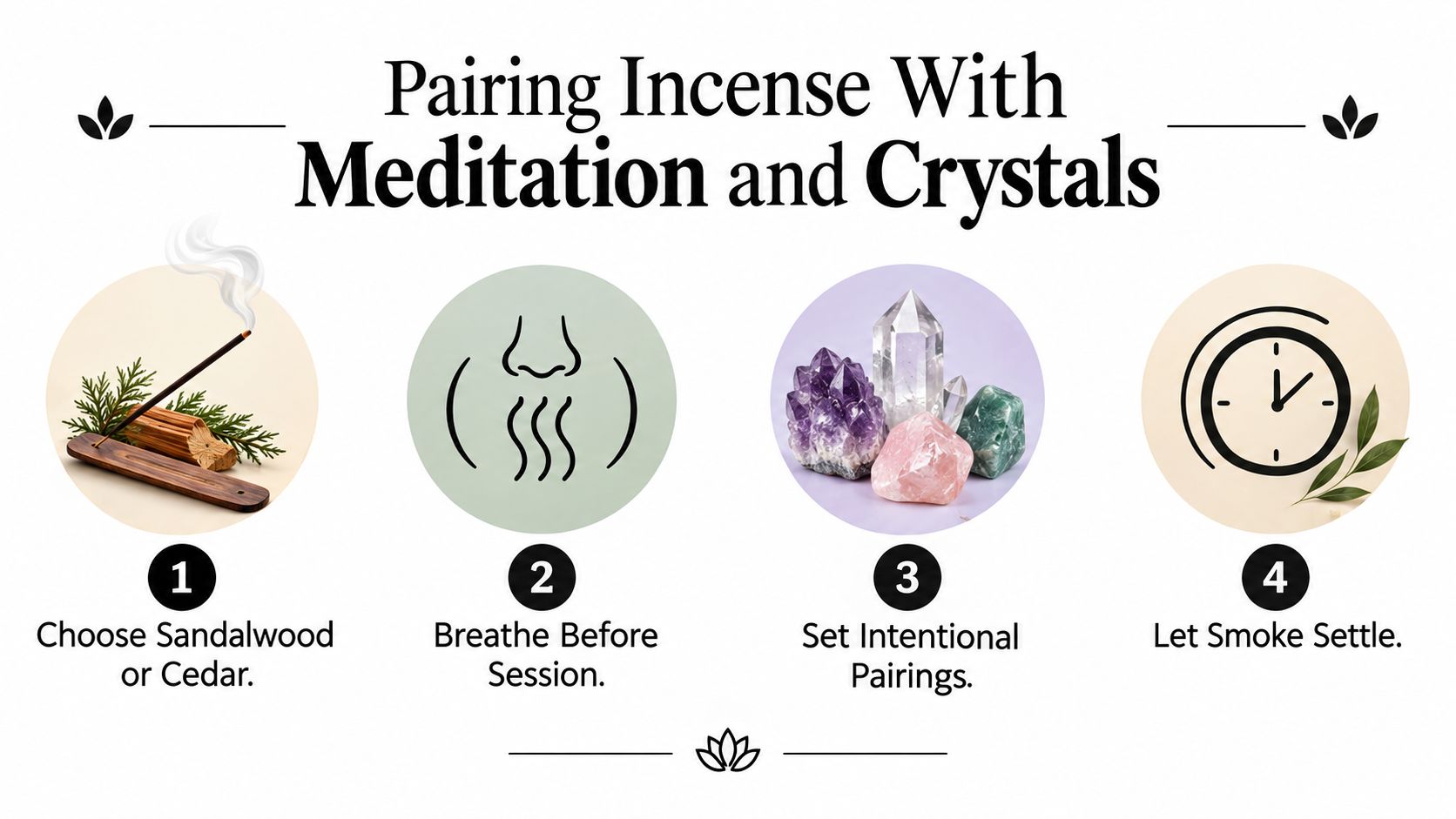
Incense works best when it sits inside a larger ritual instead of trying to do everything at once. A few minutes of breathwork, a simple crystal layout, and a short journaling pause can make the scent feel meaningful without making it the center of attention. That keeps the session grounded and easy to repeat.
Pair scent to the work, not the myth
A soft sandalwood or cedar stick can sit beside a short breathing meditation before a session, which helps the practitioner settle in before hands-on work begins. Once the work starts, keep the scent low so it doesn't compete with the client's attention. For a broader background on scent and meditation, this meditation-focused incense article is a useful companion.
Crystals can be paired by feel rather than doctrine. Smoky, grounding resins tend to sit naturally beside darker stones like hematite or smoky quartz. Floral lavender tends to feel compatible with rose quartz. Clear, bright scents often sit well with clear quartz or selenite because the overall effect feels cleaner and less cluttered.
After the session, journaling works well while the scent is still present in the room. That lingering aroma can help anchor the memory of the session so your notes feel connected to the experience, not detached from it.
If you're putting together a care package or client welcome set, promotional wellness gift bundles can be a practical way to combine incense with other ritual tools. For shared offices, hospitals, or asthma-sensitive clients, a smoke-free electric diffuser or a drop of oil on cloth is often the more respectful choice. The aim is a coherent sensory experience, not forcing smoke into every situation.
Safety, Smoke, and Sensitive Spaces
A thicker cloud of smoke doesn't make a session more effective. It just makes the room harder to breathe in. The better question is whether the scent fits the room, the people in it, and the length of time it'll stay enclosed.
Ventilation is part of the ritual
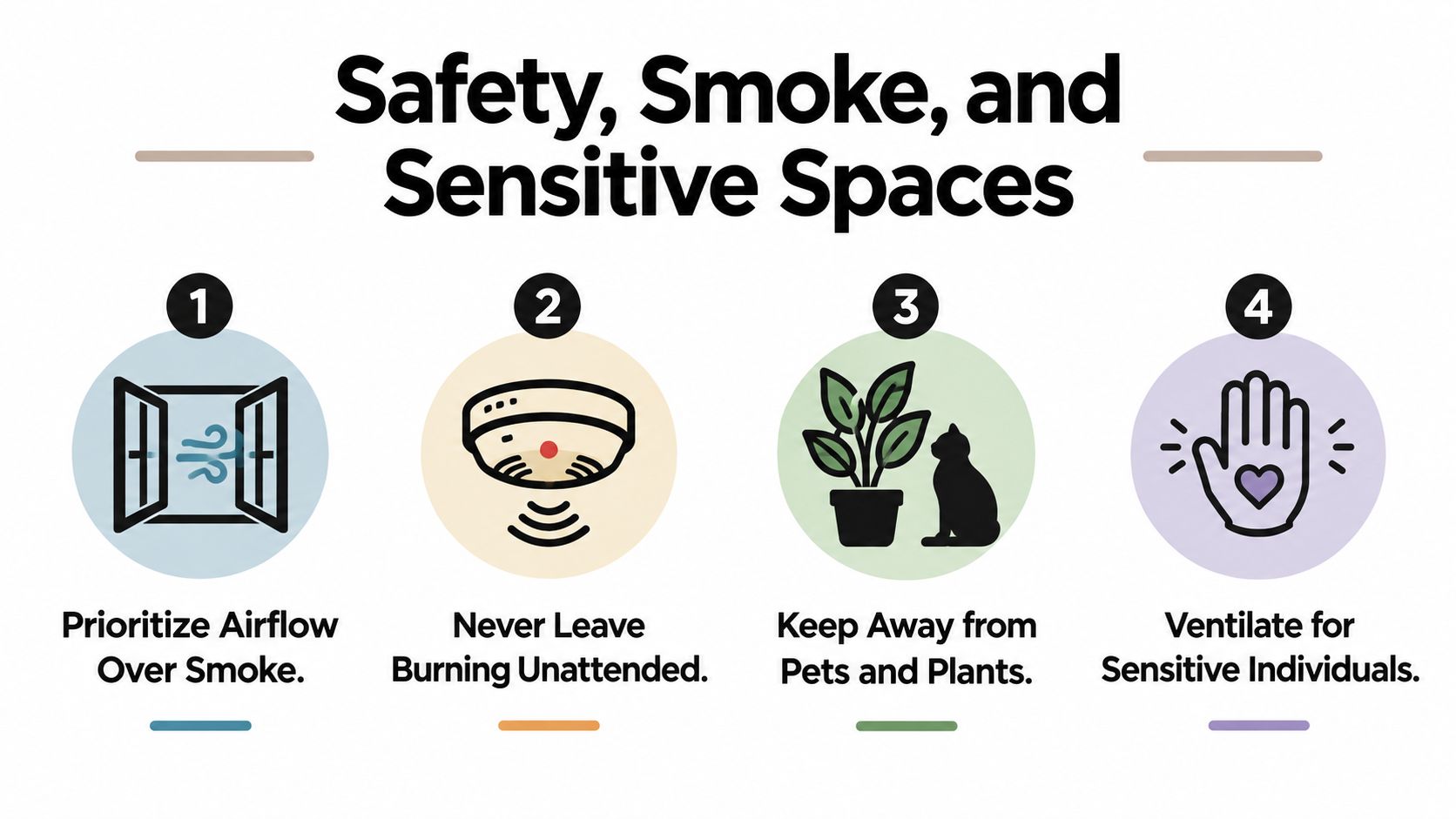
Open a window or door before you light anything, and keep airflow in mind during the session. Place the holder away from drafts, but keep the room from becoming stagnant. A stable, heat-resistant tray helps prevent ash from landing where it shouldn't, and it reduces the chance of tipping.
Incense smoke is not neutral. A major review found that incense smoke generates particulate matter, carbon monoxide, nitrogen oxides, sulfur dioxide, volatile organic compounds such as benzene, toluene, and xylenes, plus aldehydes and PAHs, and reported an average particulate output of more than 45 mg per gram burned, versus about 10 mg per gram for cigarettes, with particles capable of reaching the alveoli (PMC review). Controlled chamber testing of commonly used incense types also found particulate matter above indoor air quality objectives, carbon monoxide peaks above guideline in seven incense types, and formaldehyde above guideline in six types, with the highest level reaching roughly 2× the standard (EPA HERO reference).
Know when to switch formats
Anyone with asthma, COPD, pregnancy concerns, allergies, or migraine sensitivity should consider smoke-free options such as essential oil diffusers, hydrosol sprays, or electric wax warmers. Pets, birds, and small children can be more sensitive to airborne particulates too, so schedule around their safety instead of assuming they'll tolerate the room. The idea that more smoke equals better cleansing doesn't hold up in a modern room.
A good rule is simple. Use one stick or a small resin amount in a small room, not multiple burning pieces. If anyone in the space reacts, switch immediately rather than trying to finish the ritual as planned.
For room-specific planning, this guide to incense in small apartments is a helpful reminder that the room size matters as much as the scent. Safety isn't separate from the practice. It's part of what makes the practice usable.
Buying and Storing Quality Reiki Incense
Good incense should smell clean before you light it. That's the first test. If the dry stick already smells harsh, chemical, or dusty in a way that feels off, it probably won't improve when burned.
What to look for at purchase
For retail buyers, smaller packs make sense when you're testing scent families for personal use. For studios, retreats, or resellers, wholesale bundles become more practical once you know what your clients like. Aroma Warehouse carries retail and wholesale incense options, so you can choose between a session kit and a larger restock without changing suppliers.
Look for clean, even color on sticks, intact bamboo cores, and an aroma that feels pleasant rather than sharp. Transparent product information matters too. You want to know whether the fragrance relies on essential oils, synthetic fragrance, or a blend, and where the incense was made. That's especially useful when you're comparing sandalwood-style or resin-inspired blends with very different burn profiles.
How to keep it fresh
Store incense in airtight tins or glass jars, then keep those containers in a cool, dark cabinet away from humidity and direct sunlight. Heat and moisture flatten scent quickly, and they can make even a good stick burn unevenly. If the incense still throws a clear scent when cold and burns without crackling or sputtering, that's a good sign the batch is still fresh.
Storage rule: buy small until you know the scent, then scale up only after you've tested the burn.
For practitioners who keep a session cart or retail shelf, this is the simplest system. Buy a small batch first, store it well, and only then commit to a larger case. That keeps the experience predictable for both home practice and client work.
Frequently Asked Questions
Can Reiki incense be used before a distance Reiki session?
Yes. Even when the session isn't held in the same room, a practitioner may use incense as part of their own preparation routine. The scent can serve as a consistent cue that it's time to transition into focused practice.
How far should an incense burner be from a Reiki treatment table?
Keep the burner far enough away that smoke isn't drifting directly across the client's face or breathing zone. The exact distance depends on room airflow, burner design, and the amount of incense being burned.
Can different Reiki incense scents be blended together?
They can, but combining fragrances can quickly create a stronger or less predictable aroma. If experimenting with combinations, test a small amount first and avoid mixing scents when working with clients who prefer minimal fragrance.
Should Reiki practitioners ask clients about fragrance preferences before a session?
Yes. A brief scent preference question can identify sensitivities, dislikes, allergies, or fragrance-free preferences before anything is burned. This is particularly useful when incense is used in a professional practice.
How long should Reiki incense be allowed to scent a room before a session?
There is no universal timing requirement. A short period before the appointment may be enough to establish a background aroma, while longer pre-burning can make the scent more noticeable. Room size, ventilation, incense type, and client preference all affect the result.
If you're building a Reiki room, restocking a studio shelf, or choosing incense that fits real session conditions, Aroma Incense Warehouse has retail and wholesale incense options along with the burners and accessories that go with them. Browse with your room size, scent preferences, and ventilation in mind, then pick the pieces that make your practice easier to set up and safer to use.


