

Online Counselling Canada: The Complete Guide
You've probably been there already. You search for help after a hard week, open a few tabs, and suddenly online counselling in Canada looks simple on the surface, but the more you read, the more confusing it gets. One site says video therapy is the answer. Another talks about licensing. Someone else mentions privacy laws, and now you're wondering who is qualified to see you, where they're allowed to practice, and what happens if something goes wrong.
That confusion is normal. In Canada, online counselling isn't just a video call with a therapist, it's a mix of clinical care, provincial regulation, privacy rules, and emergency planning. The good news is that the system has matured a lot. Virtual mental health care moved from a niche option to a mainstream service during the pandemic, and it has stayed there because many people found it useful, accessible, and effective.
Table of Contents
What Is Online Counselling in Canada - More than a video call - What people usually mean by it
How Online Therapy Differs From In-Person Care - Same profession, different setup - What changes on a screen - Who tends to prefer which format
Navigating Provincial Licensing and Jurisdiction Rules - Why location matters more than the video link - What to ask before you book - Why this protects you, not just the provider
Privacy, Security, and PHIPA Considerations - What secure practice should look like - Questions worth asking before the first session
Costs, Insurance, and EFAP Coverage Options - What usually gets covered and what doesn't - A useful way to compare your options
Safety, Crisis Support, and Accessibility Challenges - When virtual care isn't enough - Accessibility is still uneven - What to expect from a safer service
What Is Online Counselling in Canada
A first session can feel like a relief. You're at home, you've got a laptop or phone, and you're hoping the person on the other side understands what you're dealing with. Then the questions start. Are they a therapist, a counsellor, a psychologist, or a social worker? Are they licensed where you live? Is this the same thing as in-person care, just through a screen?
More than a video call
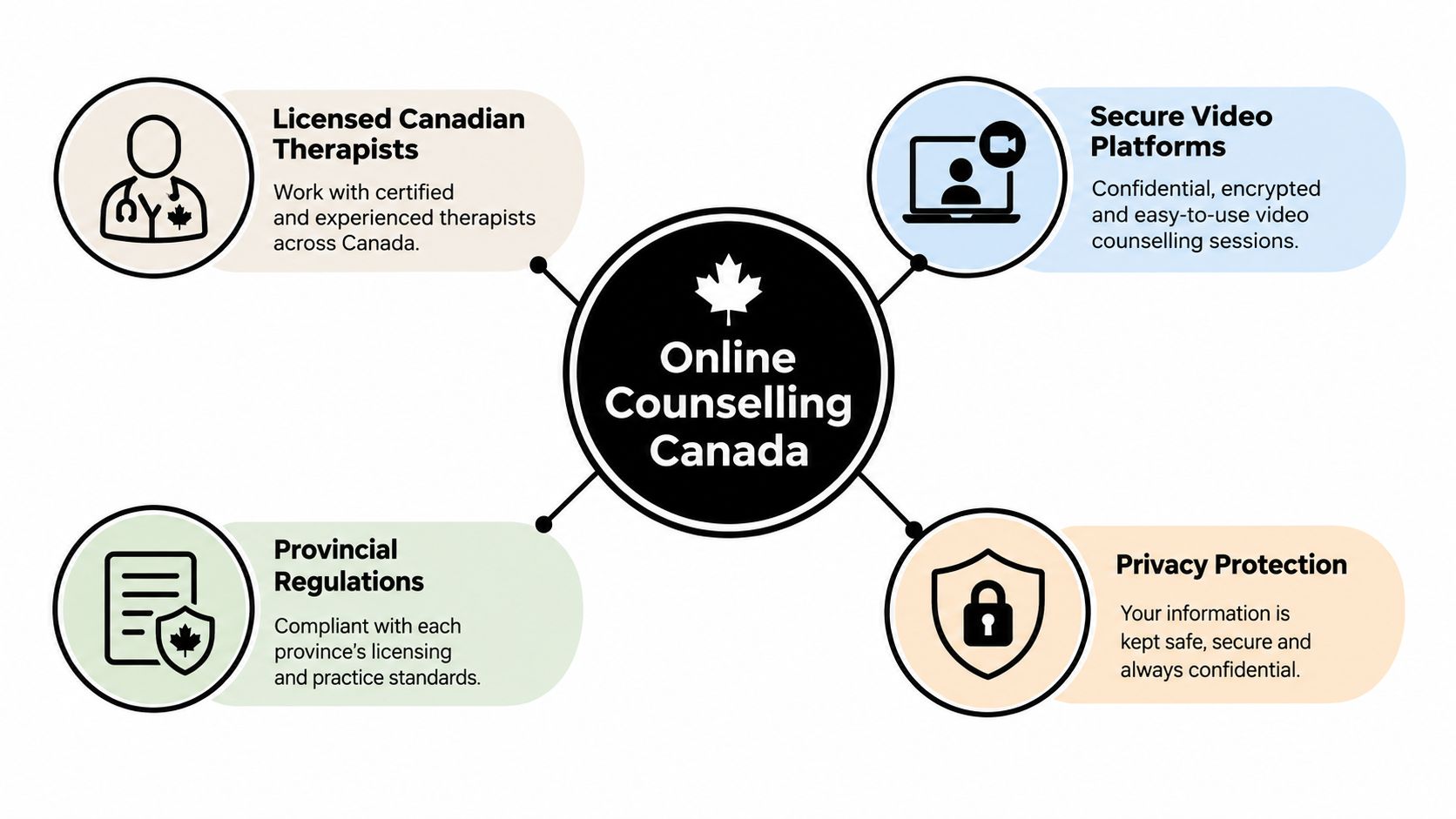
Online counselling in Canada usually means mental health support delivered through video, phone, or a secure platform, but the label hides a lot of important detail. The service can look simple from the client side, yet behind it are decisions about licensure, consent, record keeping, privacy, and what to do if someone is in crisis. That's why online counselling Canada should never be treated as a generic convenience feature.
The shift is real, though. In five provinces tracked by the Canadian Institute for Health Information, the share of physician mental health services delivered virtually rose from 4% in 2019–2020 to 57% in 2020–2021, and physician payments for those virtual services grew from $29 million to $621 million in the same period (CIHI virtual care report). That tells you online care didn't just appear as a temporary workaround, it became part of the system.
What people usually mean by it
In practice, people use the term for a few different formats. Some prefer live video sessions because they want to see facial expressions and body language. Others choose phone sessions because the connection is easier, or because video feels too exposing at first.
Practical rule: if a provider can't clearly explain how they handle intake, consent, privacy, and emergencies, you're not looking at a fully designed clinical service, you're looking at a video link.
It helps to think of online counselling as a delivery method, not a therapy style. A counsellor might use cognitive behavioural therapy, grief counselling, trauma-focused work, couples support, or a general supportive approach. The format changes, but the clinical method still matters.
If you're trying to understand where supportive self-care ends and formal care begins, even adjacent wellness content can help you sort out your own preferences. For a lighter comparison point, this guide on natural relaxation and calm sits in a very different lane from regulated counselling, which is exactly why it's useful to separate comfort tools from actual clinical care.
How Online Therapy Differs From In-Person Care
A person booking counselling online may expect the main change to be the commute. The shift goes deeper. The medium affects how trust builds, how a therapist reads risk, and how quickly support can be adjusted if a client needs more than a screen can safely provide.
Same profession, different setup
Canadian reviews describe comparable clinical effectiveness for virtual counselling and in-person care for several common concerns, including PTSD, depression, and anxiety disorders (Mental Health Commission of Canada summary). That does not mean every person will do equally well in every format. The match still matters.
A good analogy is the difference between a private office and a secure phone line. The conversation can still be therapeutic in both settings, but the environment changes what the clinician can observe and how the session unfolds.
For many adults, virtual care lowers friction. There is no transit, no childcare to arrange, and no long drive. That matters most where geography or mobility creates barriers, and Canadian guidance has recommended virtual mental health counselling as a first-line option for adults with mild depression and for anxiety reduction in older adults (CADTH review).
What changes on a screen
Online therapy changes the small cues therapists rely on. Eye contact can feel less natural, pauses can stretch out, and body language is harder to read if the connection is weak. For some people, that makes it easier to open up. For others, the session feels flatter and less grounded.

The digital format also brings practical limits. If the internet drops, the emotional flow can break. If the conversation turns toward suicide, self-harm, or another urgent risk, the therapist needs a clear escalation plan, not just a follow-up appointment. Service design matters as much as clinical skill.
Who tends to prefer which format
Some clients want the room, the pace, and the sense of being physically held by the session. In-person care can fit better when someone is highly distressed, needs coordinated support, or finds it hard to stay engaged through a screen.
Virtual care often works well when access is the main barrier. A simple way to compare the two is to ask whether your biggest need is connection, convenience, or containment. Online counselling often serves convenience best. In-person care often fits situations that are more complex and need direct coordination.
Online counselling is a distinct clinical setting with its own strengths and limits, and the best providers shape their approach around that reality.
Navigating Provincial Licensing and Jurisdiction Rules
A therapist licensed in Ontario cannot automatically see you if you are sitting in British Columbia. That catches many people off guard, because the video call may look simple while the legal rules behind it are not.
In Canada, mental health care is regulated province by province. The therapist's authority to treat you online can depend on where you are located, not only on where the therapist works from. So a provider saying they serve “clients across Canada” still needs to show how that service fits provincial rules.
Why location matters more than the video link
If you live in British Columbia and your therapist is physically in Ontario, the service may still be legitimate, but the provider has to know which rules apply to cross-provincial care. In plain English, they should be able to tell you whether they are licensed in your province, allowed to work with clients in your province from their home province, or using a model that covers practice in more than one jurisdiction.
The safest providers answer that question directly. They name the regulatory body or professional college that oversees them and explain how that oversight works. Licensing makes the therapist accountable to a professional standard, and it gives clients a clear path for complaints and oversight. If a provider cannot explain that clearly, keep looking.
What to ask before you book
Start with the basics and ask them straight:
Where are you licensed? Ask for the province or territory, not just the profession.
Can you legally see a client located in my province? This is the key jurisdiction question.
What happens if I move during treatment? Some services can continue, others can't.
Who handles complaints or professional standards? A regulated provider should have a clear answer.
What are your emergency procedures? This matters even more for online sessions than for casual support.
If the answer sounds like “we work with clients everywhere” but no one can explain the regulatory side, treat that as a warning sign.
Why this protects you, not just the provider
Licensed care gives you more than a credential on a website. It gives you a standard to measure the service against. Canadian reviews also note that there is no universal national law or best-practice standard for online counselling, which makes clear service protocols even more important (OHTN rapid response review).
That gap is why clients need to ask careful questions before booking. A good therapist will tell you what they do, what they do not do, and what happens if your needs change. A weak provider hides behind broad language and treats the video platform itself as if it were the safety plan.
How Interactive Counselling Can Help
The licensing and jurisdiction rules readers run into are often the first place online counselling gets confusing. A practice such as online counselling in Canada can help if you want a team-based clinic that makes those boundaries clearer from the start.
The practical value is easy to see. One clinic may offer in-person, phone, and secure virtual sessions in one place, which reduces the guesswork that comes with comparing separate providers for different needs. That matters when you need care that fits work, family life, and the rules tied to where you live.
A useful provider also makes its scope easy to understand. If you are looking for help with anxiety, depression, grief, parenting strain, relationships, or recovery after a car accident, a team-based model can match different concerns without forcing every issue into one specialist box.
Flexibility matters too. Daytime, evening, and weekend availability can make it easier to stay consistent with therapy, and consistency often matters more than a perfect schedule. A good comparison point is simple, who you will meet, what kind of support they provide, and how clearly they explain the limits of care.
Privacy, Security, and PHIPA Considerations
A client can feel safe on video and still leave a session wondering who can access the record, where the file is stored, or what happens if the platform fails. That is why privacy in online counselling needs a wider lens than the call itself. The provider's legal duties, the technology they choose, and the way staff handle records all shape the overall level of protection.
What secure practice should look like
In Ontario, PHIPA sets the privacy rules for personal health information, and the same basic question applies across Canada, who can see your information, and why? A trustworthy provider should explain how they store notes, how long records are kept, who has access, and what system is used for sessions. If those answers stay vague, the service is asking you to trust a process you cannot inspect.
A good test is simple. Ask, Where does my information go after I click join? Clear answers matter because privacy failures often happen in the ordinary steps around care, not only inside the session itself.
Providers also need a plan for triage, consent, and urgent situations. The OHTN review highlights the need for intake screening, informed consent, and emergency routing because online care is not a fit for every crisis. That point belongs in a privacy discussion too. If a service cannot respond safely when risk rises, the client's information and wellbeing can both be exposed.
Questions worth asking before the first session
Ask these before you book, not after:
What platform do you use? A secure system is better than a general consumer app picked for convenience.
Do you record sessions? If yes, ask why and where the recording is kept.
Who can see my file? Front desk staff, therapists, supervisors, and outside vendors may all matter.
How do you handle emergencies? Privacy rules still apply when someone is in distress.
What happens if I'm in a different province? Cross-border care can change how records and obligations are handled.
Useful test: if the provider can explain privacy in ordinary English, they usually understand it. If they only speak in platform names and policy buzzwords, keep asking.
For a plain-language example of how organizations describe data handling, see this privacy policy page. The page is not a clinical example, but it shows the kind of clear disclosure people should expect before sharing personal information.
Strong privacy practice goes beyond encryption. It requires a service designed to protect you before, during, and after every session.
Costs, Insurance, and EFAP Coverage Options
A first session can feel straightforward until the receipt arrives and the benefit rules start to matter. Online counselling may save travel time, but the actual cost depends on the therapist's credentials, the provider's billing setup, and whether your plan recognizes the service.
What usually gets covered and what doesn't
Many people assume public coverage pays for any mental health appointment. In practice, coverage is uneven, and much online counselling is paid privately or through employer benefits. Checking your own plan before booking saves time and avoids surprises.
Some private sessions are reimbursed when the therapist is recognized by your insurer. A few plans also cover Employee and Family Assistance Programs, or EFAPs, which can make short-term support easier to access. EFAPs often come with limits on session count or provider choice, so confirm whether you can keep seeing the same person after the first block ends.
A useful way to compare your options
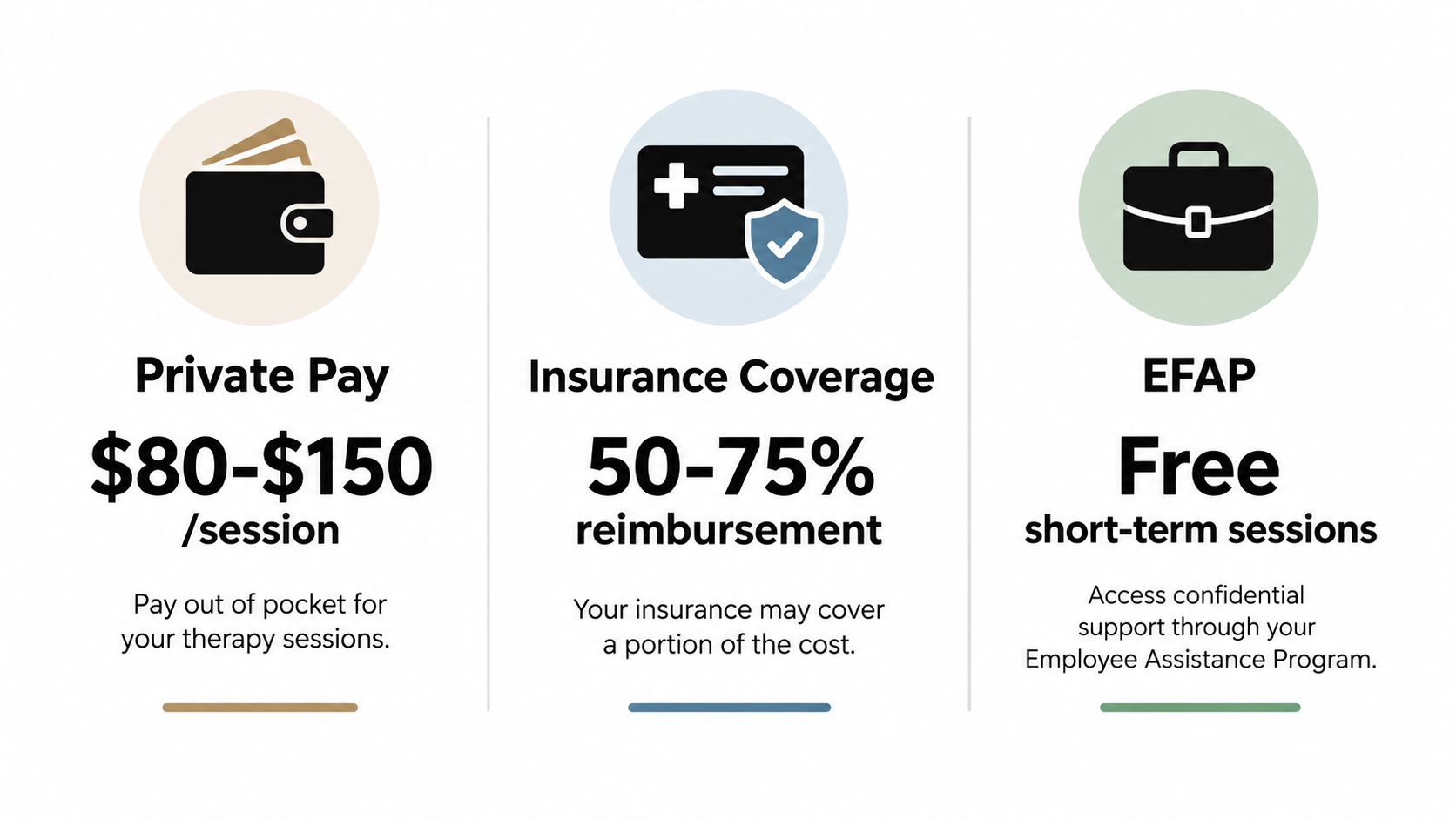
The payment choice matters, but price alone does not tell the full story. A lower-cost service without clear licensure, crisis procedures, or a good fit can cost more over time, because you may need to start over with someone else. That risk grows when your concerns are complex or change over time.
The Canadian evidence base makes one limit clear. Online counselling is not appropriate for crisis support, and service design has to account for escalation and safety routing (community review). That affects budgeting too, since the central question is not only what one session costs, but what happens if your needs move beyond routine support.
Before choosing a provider, calculate your total out-of-pocket costs with this guide on product cost calculations. That same habit helps you compare private pay, insurance reimbursement, and EFAP coverage with fewer guesses.
For readers in remote areas or communities with fewer local options, online care can be the most realistic starting point. Access gaps still exist, and strong providers are honest about where virtual care helps and where it falls short.
How to Evaluate Providers and Credentials
Choosing a therapist online can feel a lot like hiring a professional while reading a dozen profiles at once. The website may look polished, but one question matters more. Is this person properly licensed, and are they allowed to treat your concerns from where you live?
Start with the person, not the platform.
A therapist's training has to match the problem you are trying to solve. Someone who does strong couples work may not be the right fit for trauma, and a clinician who mainly works with adults may not be the best choice for teens or children. Read the profile for a clear title, a provincial licence, and a plain description of the issues they handle. If those basics are missing or vague, that is a warning sign.
Then check the practical details the way you would review any professional service. The same careful approach used in product sourcing, checking credentials, scope, and transparency, applies here too.
A useful shortlist usually comes down to a few questions:
Do they list a real licensure body? That should be easy to confirm.
Do they name their specialties clearly? Anxiety, grief, trauma, relationships, or family work should be stated in plain language.
Do they explain how sessions run? Video, phone, or a mix of both can change the experience.
Can they support your language needs? Good communication is part of good care.
Do they mention boundaries and emergency handling? That shows they have thought beyond the first appointment.
If you want one more check, look at how they describe privacy, cross-border practice, and who they serve. In Canada, those details matter because online care can cross provincial lines in ways that are not obvious at first glance. A provider who explains their limits clearly is usually safer to trust than one who tries to sound broad and convenient.
The best choice is usually the one that passes three tests at once. It is licensed where it should be, it treats your concern seriously, and it explains its online setup without making you guess what is included.
Safety, Crisis Support, and Accessibility Challenges
Online counselling works best when the situation is stable enough for a planned session. It gets much shakier when someone is in acute distress, needs immediate intervention, or can't reliably stay connected. That's why the smartest providers don't oversell virtual care as a catch-all solution.
When virtual care isn't enough
The most important limit is simple. Online counselling is not appropriate for crisis support (community review). If someone is in immediate danger, the response needs to be faster and more coordinated than a routine virtual appointment can provide.
That also applies to more complicated situations. If a client needs in-person coordination with family members, doctors, or emergency services, a screen can slow things down. Good providers acknowledge that and route people to the right level of care instead of trying to keep everyone inside the same virtual funnel.
Accessibility is still uneven
Virtual services can help people who live far from major centres, but they also depend on internet access, private space, and comfort with technology. Those aren't small details. For some rural, northern, and Indigenous communities, the digital divide can make “virtual-first” care feel less like access and more like another barrier.
A careful provider will ask where you are calling from, what your environment looks like, and what backup plan exists if the session gets interrupted. That kind of planning isn't bureaucratic. It's what makes the service safe.
If you're looking at wellness tools alongside therapy, keep the boundaries clear. This guide on stress relief scents may be useful for relaxation, but it isn't a substitute for assessment, triage, or crisis care.
What to expect from a safer service
A responsible online counselling setup should include:
A clear emergency pathway if a client is at risk.
A real local contact plan if the therapist can't stay on the call.
Screening at intake so the provider knows whether virtual care is appropriate.
A willingness to refer out if your needs require more intensive support.
A backup communication method in case the video platform fails.
Canadian data show that virtual care is now firmly embedded in the mental health system, but broad use doesn't erase the need for judgment. The best services are the ones that know when to step back, bring in another level of care, or say that an in-person option is safer.
If you're comparing providers today, start with three things: confirm the therapist's provincial licensure, ask how they handle privacy and emergencies, and check whether your insurance or EFAP plan will reimburse the service. If you want a practice that offers flexible access and a clear service description, explore a Canadian provider like Interactive Counselling through its online counselling page, then use the checklist above to see whether it fits your situation.


