

Diffuser Base Oil Guide for Every Diffuser Type
If a diffuser lasts longer, does that mean it's better for the room, or just that less liquid has left the bottle? Choosing diffuser base oil means thinking about both: how fragrance travels through the device and what people breathe once it reaches the air.
The confusing part starts with the name. A bottle sold as a base, carrier, or cutting oil might contain a glycol solvent rather than a botanical oil. Match that material to the device first, then judge scent strength, room comfort, and labeling together.
Table of Contents
What Diffuser Base Oil Actually Is - Why fragrance-grade DPG is common - What the name doesn't promise
Which Base Fits Each Diffuser - Reeds need transport as well as dilution - Water tanks and nebulizers are different jobs
Dilution Ratios That Stay Clear - Run a small compatibility test - Diagnose before adding more fragrance
Evaporation Fire Risk and Room Air - Low odor doesn't mean no exposure - Use the room as the test environment
Home Studio and Shop Examples - At home, change the reeds before the formula - In a yoga studio, change the schedule - In a gift shop, change the placement
Labels Resellers Get Wrong - Collect documents before making claims - Match the label to the finished bottle
Choose a Base and Test a Small Batch - Build a device-specific shopping list - Scale only after the trial earns it
What Diffuser Base Oil Actually Is
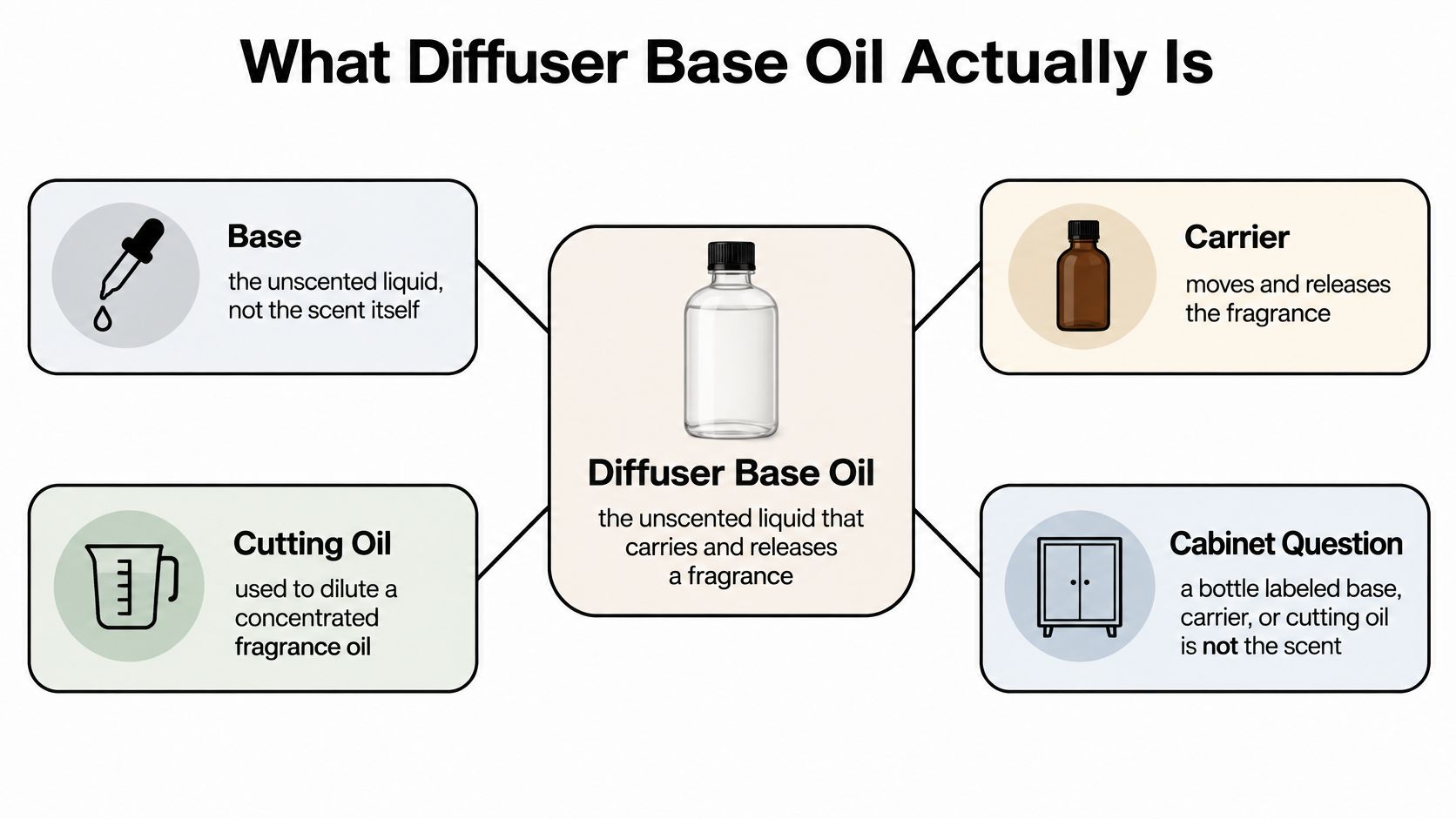
Open a fragrance-making cabinet and you might find bottles labeled base, carrier, and cutting oil beside a concentrated lavender fragrance. Those labels describe jobs, not necessarily ingredients. The unscented bottle isn't the scent itself, and the word oil doesn't tell you exactly what's inside.
Diffuser base oil is the unscented liquid used to carry and release fragrance in a compatible device. In a reed diffuser, it must keep the fragrance mixed and allow the liquid to travel through the reeds. Making the concentrate less strong isn't enough.
Think of fragrance oil as the spice and the base as the broth. The spice supplies the character; the broth distributes it throughout the dish. A skin carrier oil belongs to another recipe, where spreading on skin matters more than traveling up reeds.
This diagram separates the names you'll encounter on the shelf.
Why fragrance-grade DPG is common
Dipropylene glycol, usually shortened to DPG, is a functional solvent rather than a plant oil. The LyondellBasell dipropylene glycol safety summary identifies fragrance-grade material as a low-odor carrier with broad solvency, helping fragrance ingredients remain evenly distributed.
That combination matters. You don't want the base's own smell competing with a delicate fragrance, and you don't want different portions of the bottle carrying noticeably different mixtures. Fragrance-grade DPG, sometimes called DPG-F, is selected for that low-odor, consistent-quality role.
DPG can accommodate water and many organic materials, but that doesn't make every possible fragrance blend compatible. It's also slightly hygroscopic, meaning it absorbs moisture from the atmosphere. Keep the supply bottle tightly capped so moisture uptake doesn't introduce another variable into your formula.
What the name doesn't promise
Before using an unfamiliar bottle, separate these questions:
Identity: Is it DPG, a botanical oil, mineral oil, or a proprietary solvent blend?
Intended use: Is it supplied for fragrance formulation, skin products, or another application?
Compatibility: Does its documentation support your fragrance and device?
The plain-language guide to what DPG is can help decode that ingredient name. Don't treat diffuser base oil as an essential oil, an automatically skin-safe product, or an air-quality guarantee just because it smells faint in the bottle.
Which Base Fits Each Diffuser
Diffuser base options by device
Base | Best device | How scent is carried | Evaporation | Main watch-out |
|---|---|---|---|---|
Fragrance-grade DPG | Compatible reed and passive diffusers | Fragrance concentrate dissolved in the base | Slow carrier loss | Moisture uptake; use a documented fragrance grade |
Fractionated coconut oil | Topical carrier blends; warmers only when approved | Fragrance diluted in a fatty carrier | Carrier largely remains behind | Poor reed performance is possible; don't assume compatibility |
Light mineral oil | Commercial reed formulas designed around it | Concentrate incorporated into a tested formula | Slow carrier loss | Check the exact grade and finished-product safety documents |
Isopropyl myristate | Purpose-designed reed blends | Used as part of a solvent system | Assess the complete blend | Check container, seal, and device compatibility |
Water | Ultrasonic or mist diffusers designed for water | Approved aromatic material dispersed during operation | Released through mist and evaporation | Ordinary oil doesn't become water-soluble when stirred |
No base, undiluted oil | Nebulizers designed for essential oil | Oil dispersed directly by the device | Controlled by oil composition and device output | Don't add a carrier unless the manufacturer permits it |
Choose by the device's instructions, not by the word diffuser on the packaging. A reed bottle, an ultrasonic tank, and a nebulizer move fragrance in different ways. They don't share a universal refill recipe.
Reeds need transport as well as dilution
For reeds, the important question is whether the complete blend can wet the reeds, travel upward, and release a balanced scent. Fragrance-grade DPG is a familiar option, but a clear mixture in the bottle isn't proof of good reed performance.
Fractionated coconut oil illustrates the common mix-up. It can be useful in a properly formulated skin product, yet that doesn't establish it as a suitable reed solvent. A carrier chosen for skin feel may move poorly through your reeds or leave much of the scented liquid behind.
Light mineral oil and isopropyl myristate belong in the same cautious category: formula ingredients, not casual substitutions. If you're following a tested commercial formulation that specifies them, preserve the ingredient grade and packaging specifications. Don't replace another base by matching the volume and assuming the outcome will stay the same.
Buying rule: A familiar ingredient name is less useful than documentation showing that the ingredient works in your particular application.
Water tanks and nebulizers are different jobs
An ultrasonic diffuser uses its tank and mist-producing mechanism as a system. Filling it with reed diffuser liquid changes what that system has to handle. Use the water type and aromatic products its manufacturer approves, and clean it as directed rather than trying to correct residue with another solvent.
Water also doesn't dissolve an ordinary fragrance oil just because you shake the mixture. A product described as water-compatible needs its own directions. The aroma ultrasonic diffuser guide offers useful context for distinguishing these devices from passive fragrance bottles.
A nebulizer designed for undiluted essential oil generally doesn't need a base at all. Adding a fatty carrier can interfere with the intended operation rather than soften the fragrance in a predictable way.
Warmers require a separate check. Use fragrance approved for the warmer, and distinguish an electric appliance from equipment involving a flame. Never assume a reed refill is also a suitable heated refill.
The practical sequence is simple: identify the device, confirm permitted liquids, then select the fragrance system. Adjusting strength comes after compatibility, not before it.
Dilution Ratios That Stay Clear
Starting dilutions by device
Use | Starting mix | If too weak | If too strong or cloudy |
|---|---|---|---|
Reed, everyday room | Supplier-approved DPG and fragrance proportions | Check reed wetting and placement before increasing fragrance | Reduce output; remake a cloudy trial within compatibility guidance |
Reed, small bathroom | Approved reed blend with a restrained reed count | Add reeds cautiously before changing the formula | Remove reeds or discontinue use |
Oil warmer | Fragrance specifically approved for the warmer | Adjust only within the device directions | Stop heating; dilute only if both product and device permit it |
Ultrasonic mist | Water and the manufacturer's approved aromatic dose | Check settings, cleanliness, and permitted dosing | Use less aromatic material; never replace water with reed base |
Nebulizer | Undiluted essential oil when specified by the manufacturer | Check output settings and the oil's suitability | Lower output or stop; don't improvise a carrier dilution |
There isn't a universal ratio that guarantees clarity and good scent throw. The LyondellBasell DPG safety summary describes the broad solvency that makes DPG useful as a fragrance carrier, but compatibility still needs testing with the actual concentrate.
Start with the base supplier's formulation guidance and the fragrance supplier's permitted use level. If those documents don't establish a compatible reed application, don't turn a popular online recipe into a production formula.
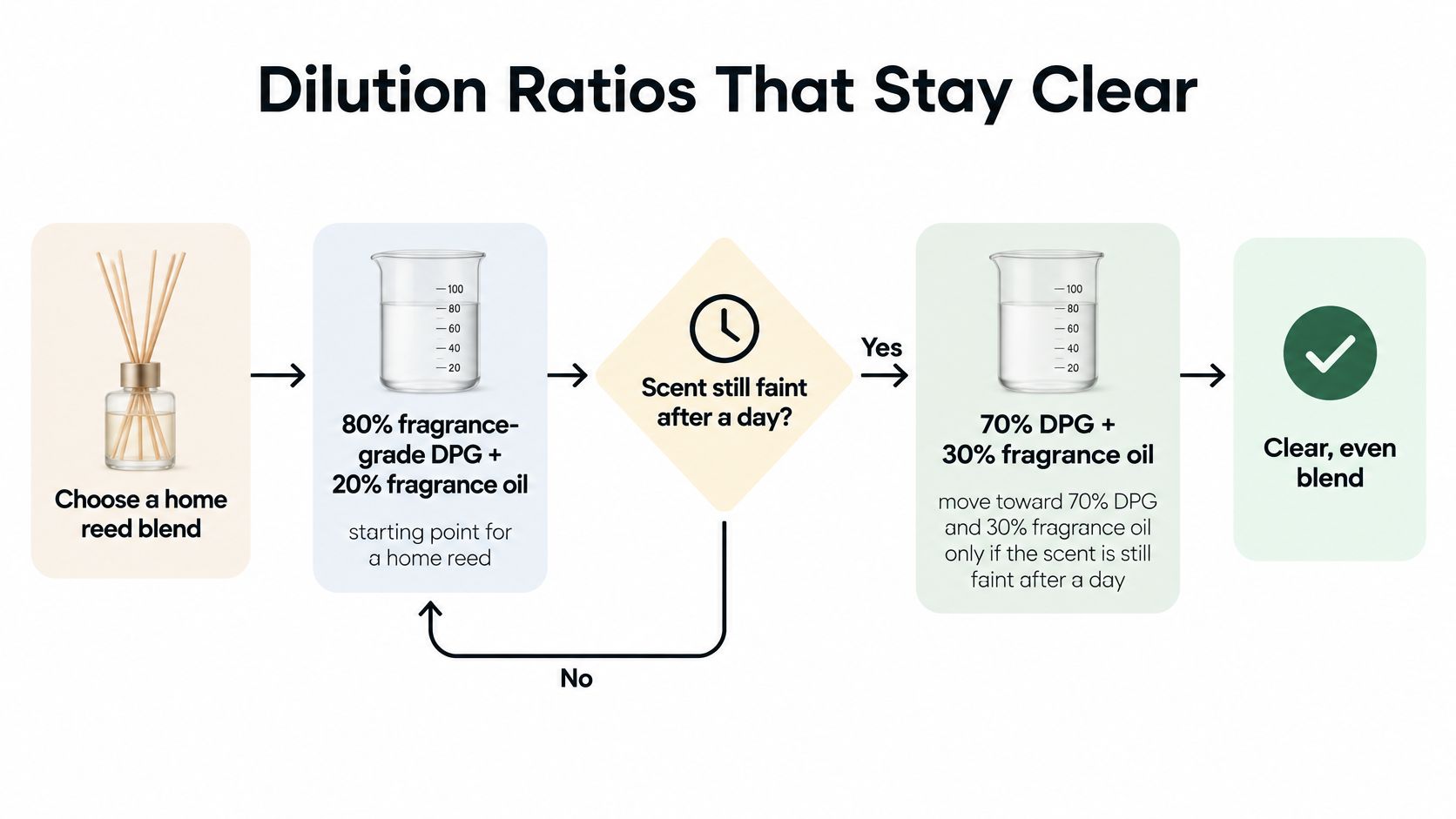
The visual below illustrates a proposed adjustment path, not a universal recommendation. Use its proportions only when your ingredient documentation supports them, and don't treat faint scent alone as permission to increase the fragrance load.
Run a small compatibility test
Use a clean glass sample bottle, a suitable balance, a stirring tool, and a written batch sheet. Weigh ingredients rather than alternating between weight and volume measurements, and record which basis the supplier specifies.
Record the materials. Write down the base grade, fragrance name, supplier, lot identifiers, and intended proportions.
Mix a small trial. Add the ingredients to clean glassware and stir thoroughly. Keep a sample without reeds so you can distinguish storage changes from device performance.
Inspect the liquid. Look for haze, floating droplets, sediment, or a separate layer. Don't confuse temporary mixing bubbles with persistent cloudiness.
Allow it to rest. Check again after standing, then assess controlled warm and cool storage conditions appropriate to the product. Don't heat fragrance mixtures over a flame or use food-storage equipment.
Test the application. Insert the intended reeds and observe wetting, scent character, and room comfort over time. Keep retained samples capped and continue monitoring before scaling.
Diagnose before adding more fragrance
Weak throw can come from poor reed transport, unsuitable placement, or an incompatible blend. More concentrate may worsen those problems. Cloudiness deserves investigation rather than another splash of fragrance or water.
The guide to fragrance oil uses helps distinguish applications that need different handling. Approval for a warmer, for example, doesn't establish approval for a water tank or skin use.
For an additional visual reference on fragrance handling, watch the demonstration with your own product documentation beside you.
Evaporation Fire Risk and Room Air
The longest-lasting bottle isn't automatically the best diffuser. Slow carrier loss can make a reed product convenient, but it doesn't tell you whether the room has an appropriate fragrance level or whether everyone can tolerate it.
Representative DPG specifications place its closed-cup flash point around 130–149 °C, with the exact value dependent on the material and test method, according to the Redox safety data sheet. That handling characteristic is not permission to place finished diffuser oil beside a candle: the fragrance concentrate changes the mixture, and DPG itself can burn.
Keep the finished product away from ignition sources. Assess its actual safety documentation rather than transferring the base ingredient's classification to the whole bottle.
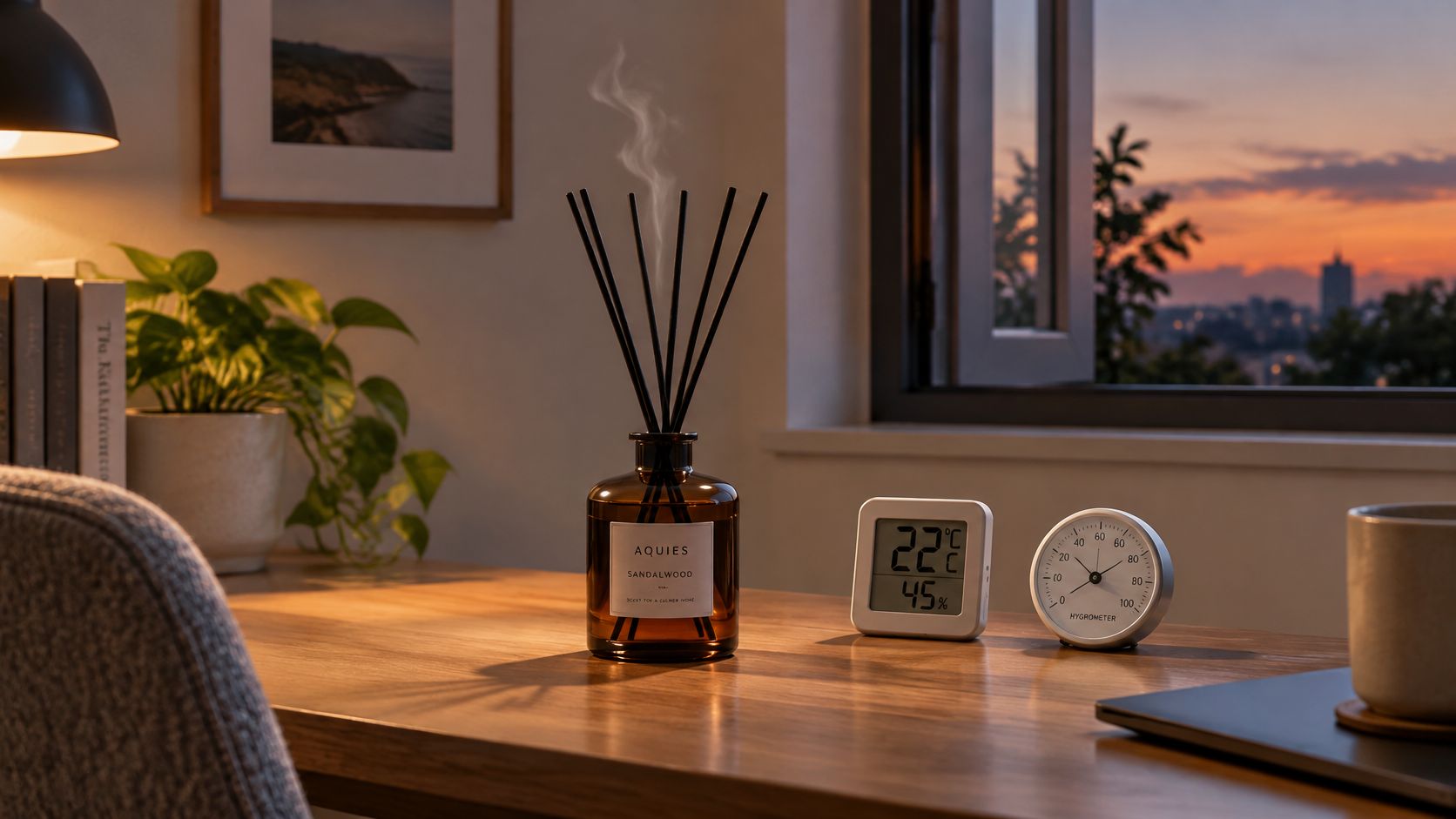
The room setting matters as much as the bottle's appearance.
Low odor doesn't mean no exposure
The American Lung Association's fragrance guidance explains that fragrance chemicals evaporate into indoor air and may cause headaches, eye and airway irritation, coughing, wheezing, or shortness of breath, particularly for people with asthma, allergies, or chemical sensitivities.
The breathing zone is where a diffuser's performance ultimately matters. A pleasant smell at the bottle opening doesn't establish comfort for someone sitting nearby throughout a workday.
Slower release may reduce how quickly material enters the air, but it doesn't establish a safe indoor concentration. Ventilation, room volume, use duration, and the complete formulation all affect exposure. You can't calculate that exposure from bottle life alone.
Judge a diffuser by the room people occupy, not just by how much liquid remains.
Use the room as the test environment
Start with restrained output: Use fewer reeds or a lower device setting, then assess the occupied space.
Limit duration: For a passive bottle, intermittent use means removing it from service and capping it appropriately, not merely deciding it's off.
Bring in outdoor air: Ventilate enclosed rooms when practical. A recirculating fan alone doesn't remove fragrance emissions.
Respect symptoms: Stop diffusion if someone develops discomfort; don't try to cover the problem with another scent.
Offer an unscented option: Shared workplaces and wellness settings need a way to participate without fragrance exposure.
The safe air freshener guide provides further context for choosing room fragrance thoughtfully. Aim for a comfortable occupied room, not maximum throw.
Home Studio and Shop Examples
At home, change the reeds before the formula
Say a bedroom diffuser smells faint from the doorway, but the liquid remains clear and the reeds are wet. The owner is tempted to pour fragrance concentrate straight into the bottle.
A better experiment is to adjust the exposed reed area while leaving the formula unchanged. Assess the scent from the bed and seating area, not just beside the vessel. If the room already feels noticeable where someone rests, there may be nothing to fix.
Change one variable at a time. Otherwise, you won't know whether a stronger result came from the reeds, the added fragrance, or a new location.
In a yoga studio, change the schedule
Consider a studio where staff enjoy the scent but a student asks for an unscented class. Increasing or changing the fragrance won't address that student's need.
The useful lever is time in service, paired with a fragrance-free session. Remove the source in advance and ventilate rather than assuming that taking the bottle out as students arrive immediately clears the room.
A larger room also isn't an invitation to keep increasing output. People may spend an extended session near the source even when someone at reception barely notices it.
In a gift shop, change the placement
A shopkeeper puts a reed diffuser near a drafty entrance, then decides the product is too weak. Moving it to a stable location may be a more useful test than reformulating the liquid.
Choose a spot away from candle displays, direct heat, customer traffic, and surfaces vulnerable to spills. If using a warmer, choose a location that also meets its operating and clearance instructions. Don't put the strongest source beside the register, where staff can't easily move away.
A private-label maker faces a different problem. Suppose a base substitution produces haze after cool storage and slower reed wetting. The correction is to hold the batch for compatibility assessment, not sell it under the previous formula's label.
Troubleshooting habit: Write down the symptom, change a single controllable factor, and keep the original sample for comparison.
Each setting needs a different decision: reed exposure at home, scheduling in the studio, placement in the shop, and formula validation before resale.
Labels Resellers Get Wrong
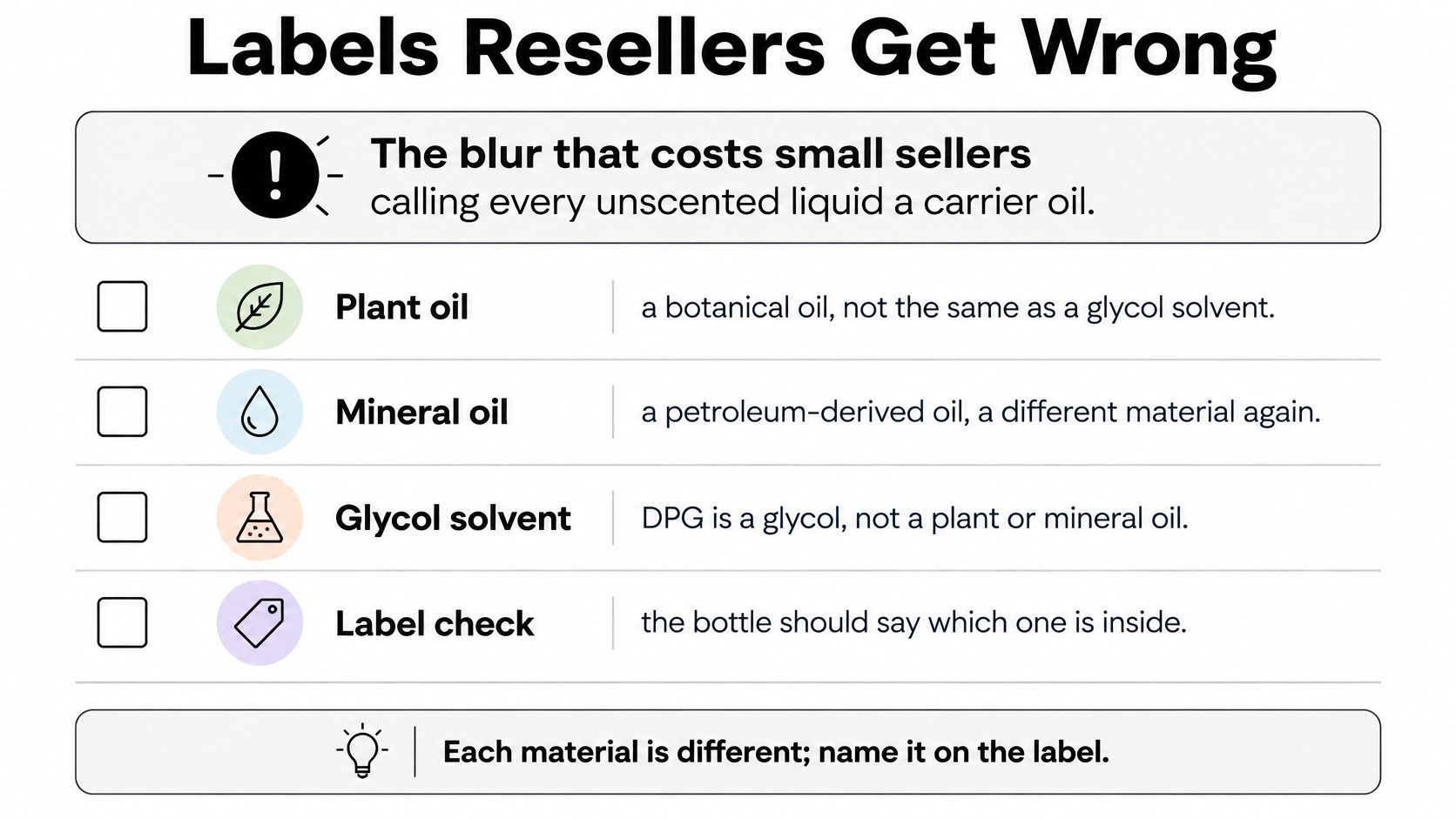
Calling every unscented liquid a carrier oil creates avoidable confusion. A plant oil, a petroleum-derived mineral oil, and a glycol solvent aren't interchangeable materials. A customer should be able to understand which type of base they're buying without guessing from the product name.
The distinction is commercial as well as chemical. A generic diffuser-base description doesn't establish skin suitability, device compatibility, or the safety classification of the finished fragrance blend.
Use this identity check before designing the label.
Collect documents before making claims
The Massachusetts-hosted public-health guide on removing fragrances identifies potential concerns involving solvents, petroleum distillates, terpenes, and other fragrance ingredients. Natural doesn't automatically mean non-irritating, and synthetic doesn't by itself establish danger.
Collect the paperwork needed to describe the actual product:
Composition and grade: Obtain a clear ingredient identity or an adequate description of a proprietary base.
Safety documentation: Keep current safety data sheets for the ingredients and obtain an appropriate finished-product assessment.
Traceability: Connect each production batch to its ingredient lots and working formula.
Application guidance: Retain recommended fragrance loading, intended uses, storage conditions, and compatibility information.
Market review: Check the labeling rules that apply where you sell, including hazard and allergen disclosures where required.
Match the label to the finished bottle
Use plain composition language alongside required regulatory wording. Don't imply that a DPG-based reed product is a botanical carrier oil, and don't borrow skin-use claims from a different product containing the same ingredient.
The fragrance labeling requirements guide is a useful starting point for organizing that review. A safety data sheet isn't a substitute for checking the consumer label.
Treat a base change as a formula change. Review packaging compatibility, stability, directions, and claims before releasing the revised product. A successful first sniff doesn't establish shelf stability, and an unchanged fragrance name doesn't justify keeping outdated documentation.
Choose a Base and Test a Small Batch
Buy the smallest practical quantity that lets you test the complete system: base, fragrance, vessel, reeds or device, and intended room. A large supply of the wrong carrier is less useful than a modest trial you can evaluate properly.
Build a device-specific shopping list
For reeds: Choose a documented fragrance-grade base, a compatible fragrance, fresh reeds, clean glass sample bottles, a balance, and suitable closures.
For warmers: Choose fragrance approved for the appliance. Don't buy a glycol solvent just because other fragrance makers use one.
For ultrasonic units: Buy the aromatic material the manufacturer permits, not a reed refill. Follow the tank's water and cleaning instructions.
For nebulizers: Select oil suitable for the device and leave out carriers unless its directions explicitly allow them.
Our fragrance oils at Aroma Warehouse are poured fresh upon order. Before selecting ingredients, check the relevant product descriptions for intended use and formulation guidance; don't infer fragrance-grade status or a permitted loading from a broad product category.
Scale only after the trial earns it
Use the small-batch compatibility procedure rather than mixing directly in your final retail bottles. Keep notes that another person could follow: ingredient identity, measured amounts, mixing method, storage observations, and the device used for evaluation.
Look for more than clarity. Check whether the reeds transport the blend, whether the scent remains balanced, whether the packaging holds up, and whether occupants find the room comfortable. Continue storage assessment before committing to a retail batch.
Choose a base for the device, choose an output for the room, and describe the finished product. Those decisions are more useful than chasing the strongest smell or the longest possible bottle life.
FAQs about diffuser oil base
1. Does diffuser base oil have an expiration date?
Diffuser base oil can have a limited shelf life depending on its ingredients, manufacturing date, and storage conditions. Check the manufacturer's recommended shelf life and avoid using material that has developed an unusual odor, discoloration, or visible contamination.
2. Can you use diffuser base oil to make homemade room spray?
Not automatically. Reed diffuser base oil is formulated for a different application than room sprays. Room sprays require ingredients that are compatible with water or the selected spray formulation, along with appropriate solubilizers and product testing. Always use a base specifically approved for room spray applications.
3. Can you add fragrance dye or colorant to diffuser base oil?
Some colorants are compatible with fragrance formulations, but not all dyes dissolve properly in diffuser base oil. An incompatible colorant can cause cloudiness, separation, sediment, or staining. Use only colorants approved for the intended diffuser application and test a small batch before production.
4. Can you refill an empty reed diffuser bottle with a different fragrance?
Yes, provided the bottle and reed system are suitable for the new formulation. Thoroughly clean and dry the vessel according to the manufacturer's guidance, and replace the old reeds. Used reeds can retain the previous fragrance and may affect the scent of your new blend.
5. How should leftover diffuser base oil be disposed of?
Disposal depends on the ingredients and safety classification of the particular base oil. Consult its safety data sheet and follow applicable local disposal requirements. Avoid pouring leftover fragrance mixtures down household drains or disposing of them in ways prohibited by the product's safety instructions.
We offer Dipropylene Glycol, glass bottles, eye droppers, and fragrance oils for building a documented small-batch trial. Visit Aroma Fragrance Warehouse to compare supplies and intended uses before choosing your base, then test your blend in the device and room where it will be used.


