

Pine Scented Incense Cones: Scent, Safety and Buying Guide

Does a pine scented incense cone smell like a forest, a Christmas tree, or a cleaning product? Most buyers answer with a guess, because the label rarely says. It also rarely says what the cone puts into the air once you light it. The scent and the smoke are two separate questions, and treating them separately makes the whole category easier to buy, store and burn.
Pine is one of the most traditional fragrance families in incense, and one of the least explained on packaging. What follows is how the cone is built, what a pine label can and can't promise, what measured emissions look like, and a burn routine you can repeat in a normal room.
Table of Contents
What a Pine-Scented Cone Is and Where Its Scent Comes From

A cone reads one way on the shelf and another in the air. Cold, it gives you a top note. Lit, it gives you the full recipe. A pine scented incense cone is a small molded piece of combustible material with three jobs built into it: a base of plant powder or fine wood dust that carries the burn, a binder that holds the cone shape, and a fragrance layer built to suggest conifer needles, sap or cold forest air. The scent travels on smoke, which means smoke output is part of what you are buying every time you light one.
That format is older than the packaging suggests. Resins were burned as incense in Minoan and Mycenaean societies between roughly 2000 and 1050 BCE, and Greek communities used resinous materials for religious and domestic fragrance, as documented in research on resin and pine tar in ancient Greece. Across the ancient Mediterranean and Near East, aromatic resins were widely traded goods, tapped from living trees or produced by heating resinous wood to make tar.
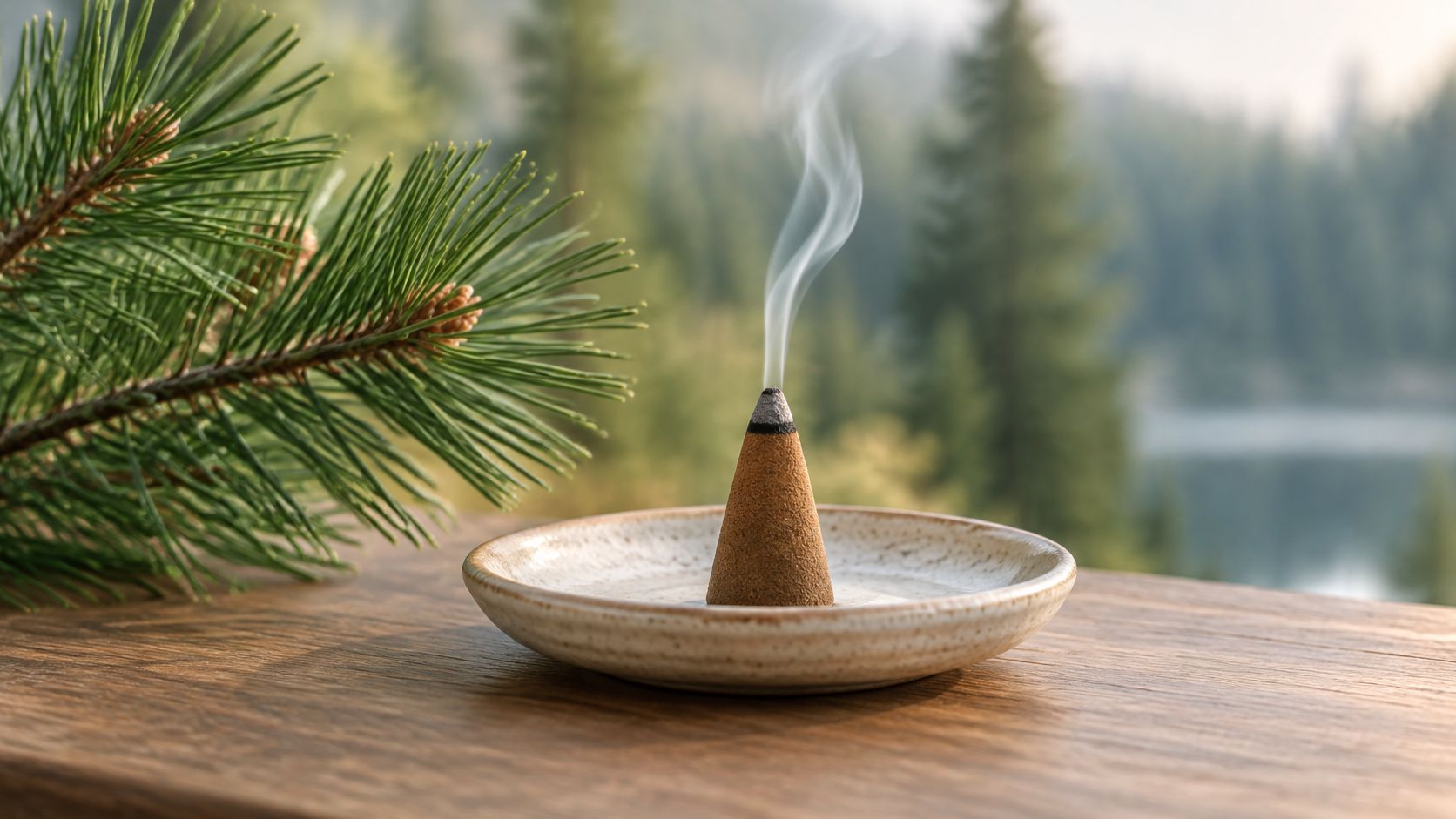
What you get in a modern package is that resin-and-wood tradition compressed into a cheap, consistent format. Pine fragrance belongs to the same family of conifer materials those societies burned, though a labeled cone today draws on modern blending rather than any ancient recipe. If your taste runs more toward fir than pine, our notes on balsam fir scent explain where the two families part company.
Expect change across the burn. The first minute is sharp and resinous, the middle is the fullest, and the last third turns drier and smokier as the cone shortens.
That arc matters for one reason: a sniff test on the shelf only samples the opening note.
What you're buying: a carrier that burns, a binder that holds the shape, and a scent that rides the smoke. Everything else is description.
What a Pine Label Tells You About the Scent
"Pine" on a package describes a smell, not an ingredient. The aroma can come from a ground conifer botanical, a fragrance-oil blend built to mimic conifers, a resin note, or a mix of all three, and most listings never say which. Match the cue you smell or want to the likely source before you spend anything.
Scent cue | Likely source | What to check on the label |
|---|---|---|
Sharp green needles | Conifer botanical or a fragrance blend | Whether botanicals are named at all |
Christmas tree | Fir or balsam-style fragrance blend | Whether the label says fragrance oil |
Resinous sap | Pine resin or a resin-type fragrance | Whether a resin is listed as an ingredient |
Cedar-like woodiness | Cedar or a wood-note fragrance | Whether cedar or a wood note appears in the ingredients |
Piñon pine | A piñon botanical cue in some listings | Whether the botanical is named in the ingredient list |
Chemistry explains why a cue is only a clue. A 2025 study of incense emissions in California homes identified a compound associated with pine species in a product whose ingredients highlighted piñon pine, which shows a botanical cue can sometimes be traced in the smoke. It doesn't prove that every pine product contains pine material. The same work found that fine particles generated by incense can pull semivolatile fragrance compounds onto themselves, so scent may hang in a room well after the flame is out.
Judge the cone by how the scent and smoke behave in your own space, not by how loudly it smells on the shelf. A sharp, room-filling cold throw is a formula decision, not a measure of quality or botanical content.
A scent-family description ("resinous conifer with a dry wood base") tells you more than any "pure" or "natural" claim on the front of the box.
How to Compare Pine Cone Listings by Price
Package price is the least useful number on a listing. Three 2026 German pine-incense listings show why, because the same shelf price buys very different amounts of product.
Listing | Price | Quantity |
|---|---|---|
Large pine-incense package | $5.95 | Quantity not stated |
German pine-scent incense cones | $8.50 | 24 cones |
Small pine-incense package | $4.50 | 24 cones |
The Knox pine-scent German incense cones at $8.50 for 24 cones work out to about $0.35 per cone. The small pine-incense package at $4.50 for 24 cones comes to roughly $0.19 per cone. The large package listed at $5.95 states no count, so its per-cone cost stays unknown until you confirm how many cones are inside.
Cheapest per cone isn't automatically best value. A listing that names a botanical and gives burn instructions hands you something to test; a listing that hides both makes any comparison guesswork. Run this check before you order:
Do the division. Compare price per cone, never price per package.
Confirm the count. A pack that doesn't state quantity can't be compared at all.
Read the scent source. Botanicals named, fragrance blend named, or nothing.
Look for burn guidance. Ventilation notes and a stated burn time signal a seller who has thought about use.
Note origin and packaging. Country of manufacture and whether cones ship protected from crushing.
For more on balancing cost against quality across formats, see choosing affordable incense without sacrificing quality. Buy a small pack of any new scent first, and write the listing details on the container so the cone you test is the one you reorder.
How to Store Cones So the Scent Lasts
Cones are porous and lightly sealed, which makes them sensitive to four things: heat, light, moisture and moving air. Leave a pack open on a sunny shelf and the fragrance layer migrates out of the cone and into the room before you ever light one.
Seal them properly. A jar or tin with a tight lid beats a folded cardboard box, because aroma escapes through every gap.
Pick a cool, dry cupboard. Not the bathroom, not above a radiator, not a windowsill. Warmth drives the fragrance off and humidity softens the cone body.
Keep flame sources away. Store cones clear of lighters and matches, and out of children's reach.
Separate strong scents. Aromas transfer through a shared container, so keep pine away from mild or unscented stock.
Label and rotate. Write the purchase date on the container and burn older stock first, so the cone you tested is the cone you're burning.
Damp or crumbling cones should be discarded rather than burned. A cone with a soft, uneven body smolders badly, throws more smoke and can collapse out of its holder. Our guide to whether incense expires or goes bad covers how to spot stock that has turned. A sealed, labeled container is the single habit that keeps a collection usable.
What Burning Releases Into the Air and Who Should Be Careful
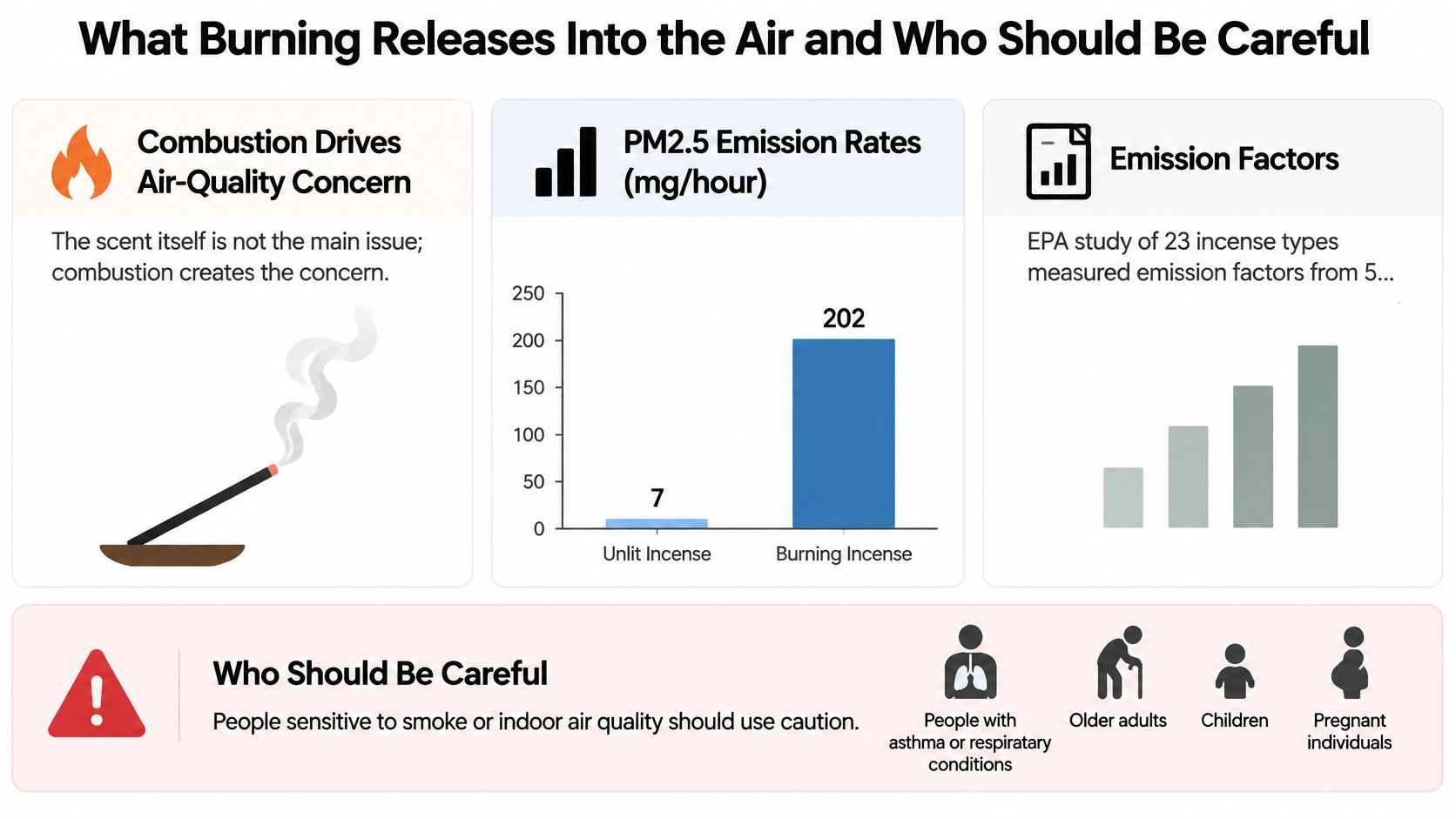
Everything about air quality comes down to combustion. The scent on the label is a fragrance decision, while the smoke is a chemistry outcome, and the two do not move together. A lit cone works like a tiny campfire: its wood and herb base smolders, and the pine aroma rides along in the plume.
Measure | Reported range | Study context |
|---|---|---|
PM2.5 emission rate | 7 to 202 mg per hour | |
PM2.5 emission factor | 5 to 56 mg per gram burned | Same study, measured per gram |
The two rows answer different questions. Per hour tells you how fast a burning cone loads a room; per gram tells you how much particulate a given amount of incense produces. Those figures cover incense generally rather than cones specifically, and the same EPA work modeled indoor concentrations that could exceed national ambient air-quality standards under some conditions, especially where ventilation is limited. Read them as a baseline for what burning does to a room, because a pine label alone says nothing about particulate output.
Particulates are only part of what the smoke carries. An analytical study in Atmospheric Chemistry and Physics identified 317 volatile compounds in incense smoke and found that intermediate-volatility organic compounds made up 19.2% of total emission factors yet roughly 40.0% of estimated secondary organic aerosol formation. The same source reports chamber work in which commercial incense raised benzene from 1.4 to 100 micrograms per cubic meter, with wood-core construction a major contributor.
Translate that into limits you can use:
Small rooms count more. A bathroom or bedroom concentrates smoke fast; a large, open living space dilutes it.
Duration adds up. One cone is a session. Three cones at once is a source.
Some people should leave the room. Children, older adults and anyone with respiratory sensitivity should not sit in incense smoke.
Ventilation is the control you own. Cross-airflow before lighting does more than any fragrance choice.
These habits cut exposure while the cone still burns. For the fuller picture on indoor use, read our incense safety guide.
How to Burn a Pine Cone Step by Step
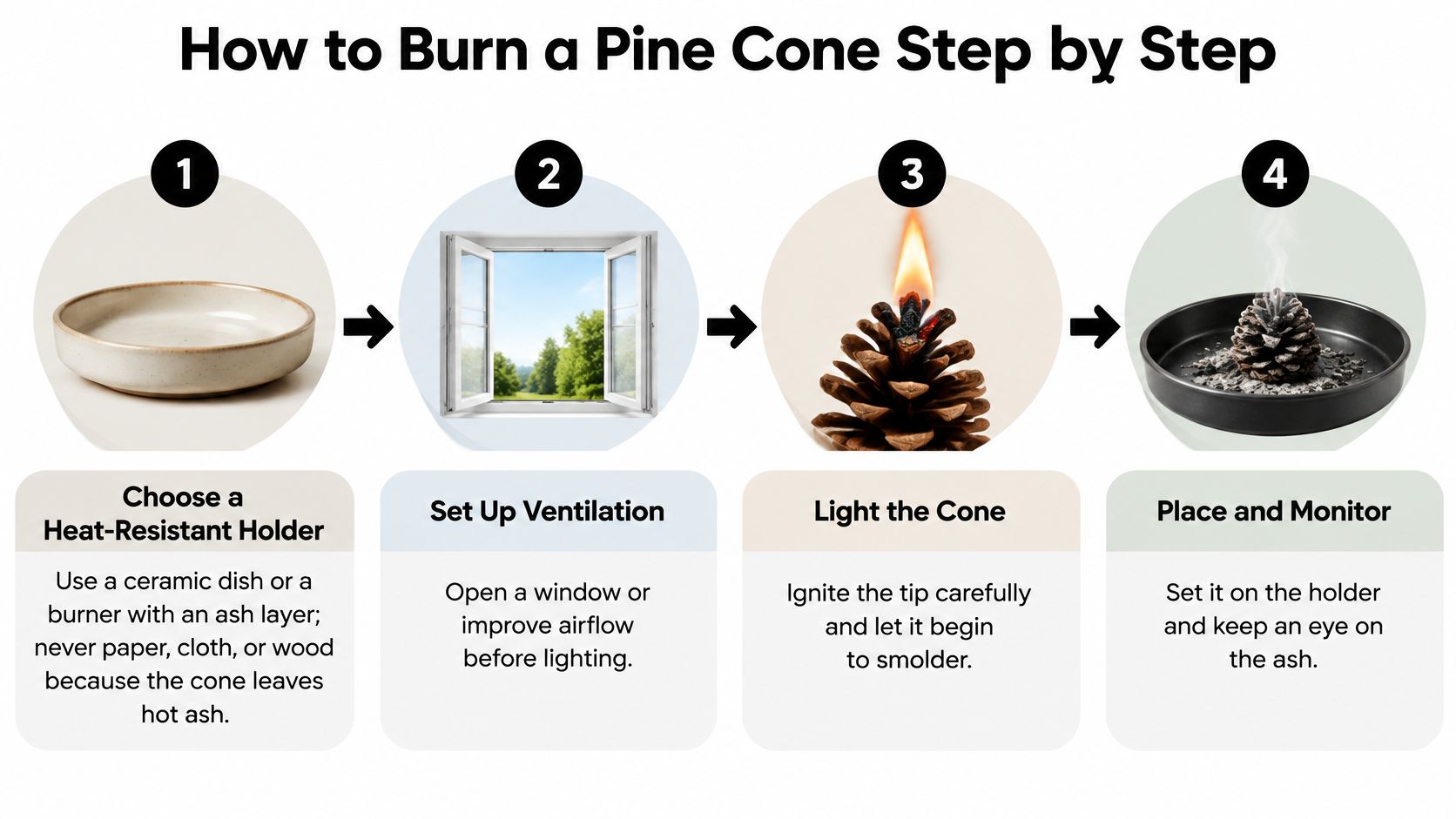
Choose a heat-resistant holder. A ceramic dish or a burner with an ash layer, never paper, cloth or wood, because the cone drops hot ash as it shortens.
Set ventilation before you light. Open a window or create cross-airflow, and move curtains and paper clear, since smoke builds quickly in still air.
Light the tip properly. Hold a flame to the top edge until it glows, then blow the flame out so the cone smolders rather than flares.
Burn one cone at a time. Most cones run somewhere between half an hour and an hour, and stacking them multiplies smoke for no gain in scent.
Keep the burner stable. A knock spills hot ash, so set the holder on a flat surface well back from the edge and clear of children and pets.
Watch the room, not the clock. If the smoke is heavy or your eyes and throat sting, put it out. Irritation is the early warning you get.
Extinguish in the dish and let it cool. A cone that looks dead can hold heat for several minutes.
The holder matters more than people expect. Our burner range includes cone holders, ash catchers and coffin boxes, and the right one is the one that fits the base of your cone and catches everything that falls. If you want a deep dive on matching holder to cone, see cone incense burner.
A healthy burn looks boring: thin, steady smoke, a scent you notice from across the room, and a cone that shrinks evenly without flaring or spitting.
Common Problems With Pine Cones and Fixes
The complaint that comes up most is a cone that dies after one puff. A tip that was only half lit, or a draft from an open door or a ceiling fan, puts it out. Relight the tip, hold the flame for about 30 seconds until a glowing ember cap forms, and shield the cone with your hand for the first minute.
Symptom | Likely cause | Fix |
|---|---|---|
Cone goes out after one puff | Tip not fully lit, or a draft | Relight the tip for about 30 seconds and shield it from airflow |
Heavy, stinging smoke | Too many cones, or a closed room | Burn one cone and open a window |
Scent fades within minutes | Room too large, or the cone was lit too small | Use it in a smaller room or let the tip glow longer before blowing out |
Harsh or chemical smell | Heavy fragrance load or a poor-quality base | Stop, ventilate, and try a different listing |
Cone crumbles or burns unevenly | Damp storage | Discard it and store the rest in an airtight container |
Notice which fixes are instant and which are buying decisions. Opening a window takes ten seconds. Switching to a listing that names its scent source takes a reorder. Sort your problem into one of those two buckets and you'll stop wasting cones on the wrong fix.
Some situations mean stop entirely, not adjust:
Persistent coughing or headaches during or after a burn.
A smoke alarm triggered by the cone, which tells you the room is over its limit.
Irritation that returns every time you burn, even with ventilation.
Test One Cone Safely Before Buying in Bulk
One cone tells you more than a page of reviews. Buy a single pack, the smallest the listing offers, and run one controlled test at home before you commit to a bulk order.
Set up in a ventilated room: a window open, a stable heat-resistant holder on the table, nothing flammable nearby. Light one cone and let it burn through, which takes about half an hour. While it burns, track three things: how the scent shifts from first light to burnout, whether the smoke stays thin and steady, and whether anyone in the room feels eye, throat or chest irritation.
Jot a few notes at the start and again at the end. That record works like a receipt for your senses: it lets you compare what the cone delivered against what its listing promised, and it tells you whether the scent suits a small study or needs a larger open room.
If the test feels comfortable, plan regular use in a space ventilated to the same standard. If the smoke stings, or anyone in the household has respiratory sensitivity, stop burning and keep that person out of the room, because a milder scent does not reduce the smoke. Keep the package and label so you can match the tested cone to its listing when you reorder.
The decision this week stays small: pick one pine scented incense cones listing, buy the smallest pack, and burn a single cone with a window open before you buy anything larger.
Frequently Asked Questions
1. Can pine scented incense cones be used in a backflow incense burner?
Only if the cones are specifically manufactured for backflow burners. Backflow cones have a hollow opening through the center that allows smoke to travel downward through the burner. Standard incense cones are designed to release smoke upward and will not produce the same visual effect.
2. Are pine incense cones the same as burning real pine needles?
No. Pine incense cones are manufactured using combustible materials and fragrance ingredients designed to produce a pine-like aroma. Burning actual pine needles involves natural plant material and produces a different combustion profile, scent and smoke output.
3. Can you combine pine incense with other fragrance scents?
Yes. Pine pairs nicely with complementary fragrance families such as cedarwood, sandalwood, frankincense and citrus. For a balanced experience, try different scents in separate sessions rather than burning multiple cones simultaneously.
4. Why does pine incense smell different from one manufacturer to another?
Manufacturers use different fragrance formulations, botanical ingredients, wood powders and binders. One pine incense cone may have a crisp evergreen aroma, while another leans toward warm resin, balsam or woody undertones. Ingredient selection and fragrance concentration contribute to these differences.
5. How can you tell whether pine incense cones are suitable for your burner?
Check the cone dimensions and the manufacturer's recommended holder type before purchasing. Standard cones generally have a flat base and require a heat-resistant holder that catches falling ash. Backflow cones have a hollow center and require a compatible backflow burner.
Aroma Warehouse stocks hand-dipped incense sticks and cones in a wide scent range, plus the holders and ash catchers that make a one-cone test easy to set up at home. If you are weighing pine against fir, cedar or resin profiles, the cone selection gives you the label detail to check before ordering. Visit Aroma Incense Warehouse to browse cones, holders and fragrance options, and start with a small pack you can test in your own room.


