

Dragon Fruit Scent: Profile, Variations and Pairings

Don't choose a dragon fruit scent because it promises an intensely sweet tropical aroma. That description may suit a fragrance, but it doesn't establish fidelity to the fruit. An analysis published in Chemosensors describes a broad volatile profile rather than a defining odor molecule, supporting a more useful distinction: dragon fruit fragrance is an interpretation, not a standardized botanical aroma.
A candy-like blend can be enjoyable without being especially realistic. For buyers, the better question is which interpretation they want, and whether it stays appealing in the product they'll use.
Table of Contents
Why Dragon Fruit Scent Is Hard to Pin Down - Recognizability Isn't Authenticity
The Typical Dragon Fruit Scent Profile - Freshness Before Syrup - Background Notes Need Careful Interpretation
How Variety and Ripeness Change the Scent - Maturity Doesn't Follow a Universal Direction
How Fragrance Format Changes What You Smell - Test the Application, Not Just the Ingredient
What Dragon Fruit Scent Pairs Well With - Build Around a Deliberate Contrast - Correct the Balance Before Adding More
Why Dragon Fruit Scent Is Hard to Pin Down
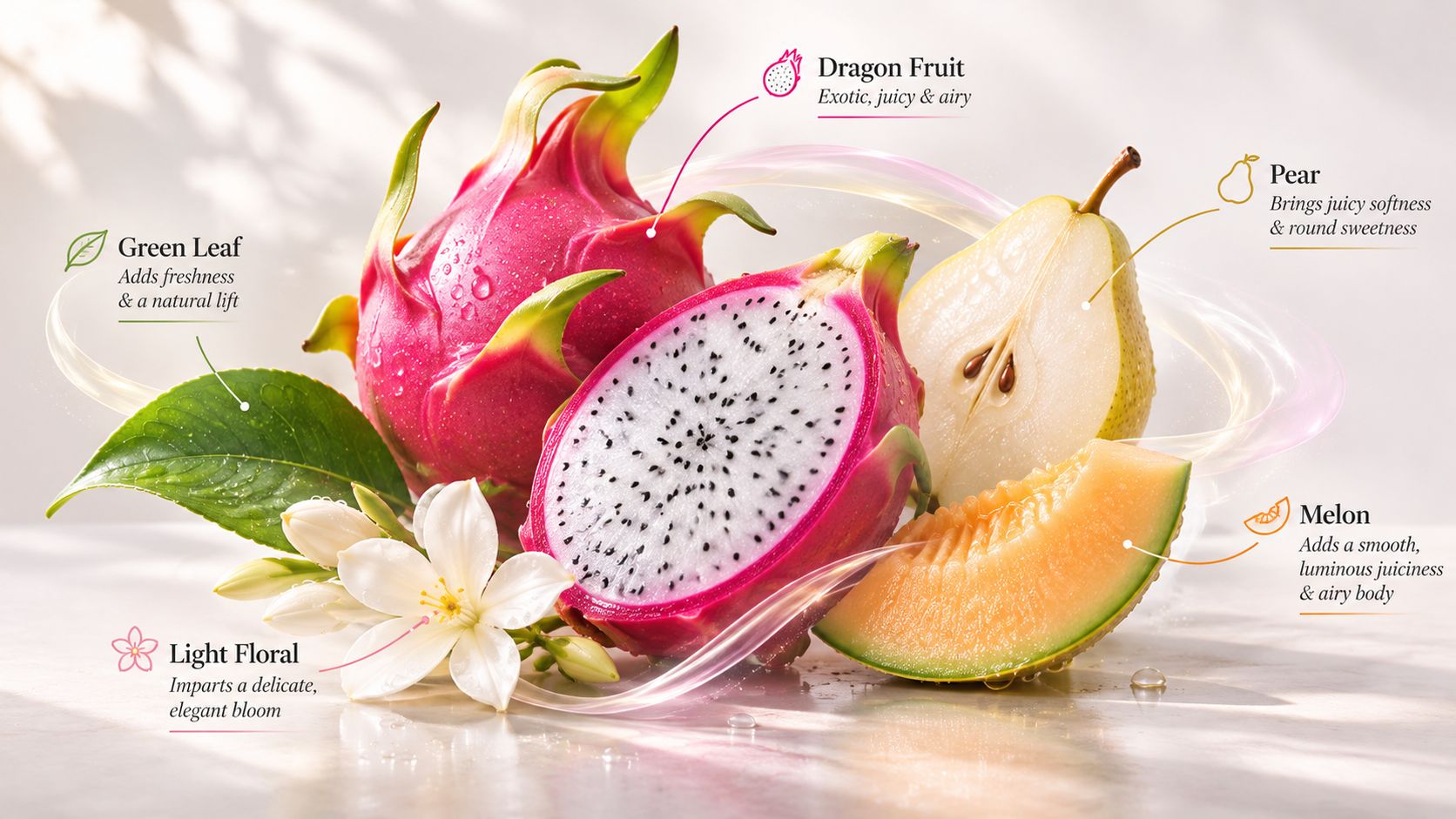
Dragon fruit scent is usually mild, fresh, green, fruity and melon-like, rather than intensely tropical. Treating it as a naturally syrupy fruit note sets an expectation that a fragrance maker may satisfy through creative formulation, not close botanical imitation.
A 2024 study published by the International Society for Horticultural Science identified 75 aroma compounds in dragon fruit, with alcohols and aldehydes the most abundant chemical groups. That's a mixture, not a single recognizable ingredient a perfumer can reproduce in isolation.
Think of a chord. Playing an individual note doesn't reproduce the whole chord, and increasing its volume doesn't make the result more accurate. A formulator likewise has to select and balance several impressions to suggest dragon fruit.
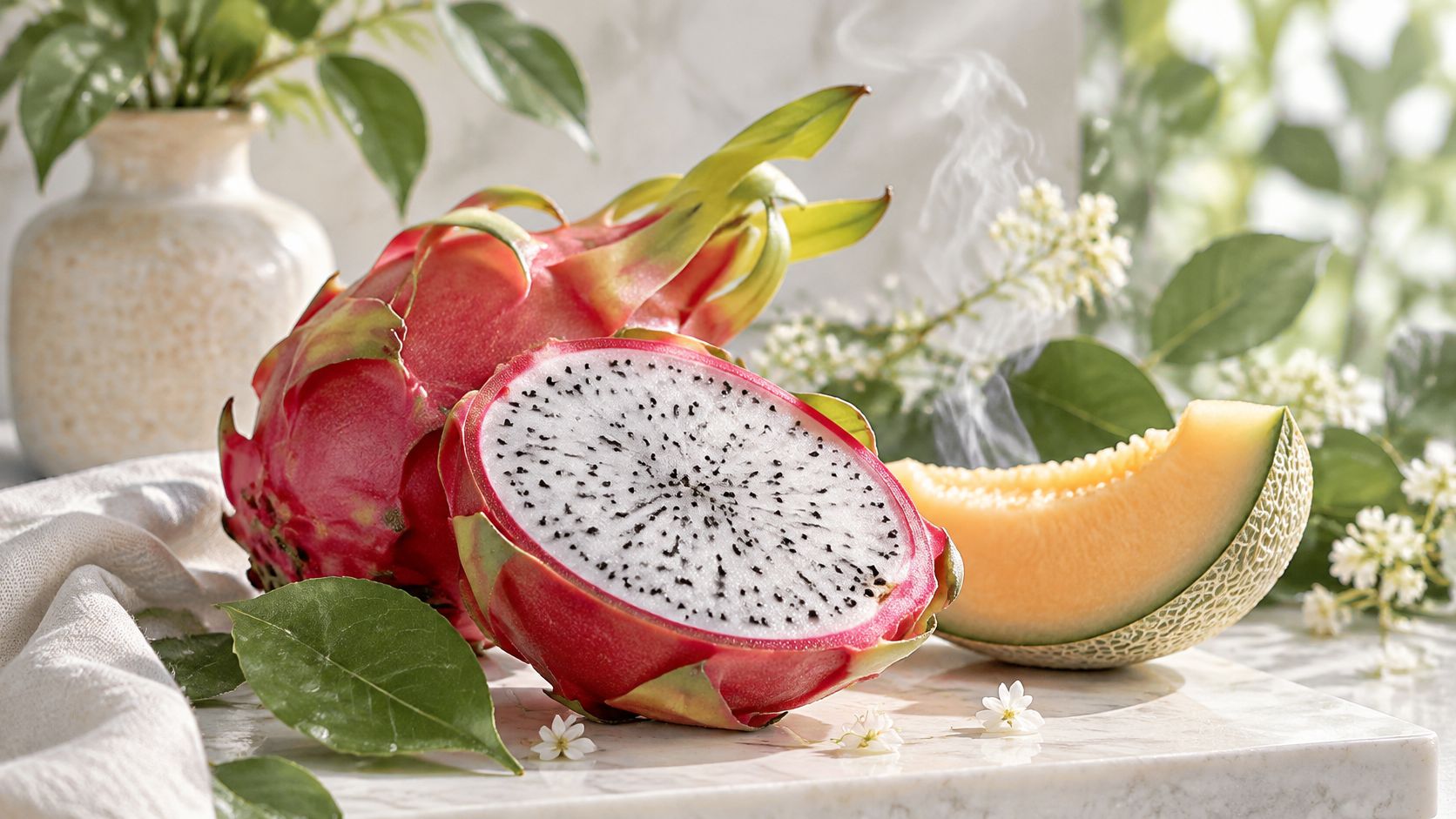
Recognizability Isn't Authenticity
A shop describing its oil as candy-sweet may be selling a deliberately amplified accord. Another describing green, grassy freshness may be aiming closer to the fruit. Those descriptions aren't necessarily contradictory, but they identify different sensory targets.
The loudest interpretation can be the less botanically faithful one, particularly when sweetness obscures the restrained green character. That doesn't make it a bad fragrance.
Buying principle: Judge whether the scent matches its promised profile, not whether its name sounds natural.
The distinction between an accord and an extracted material also matters. Our guide to fragrance oils and essential oils helps separate those product categories before you compare scent descriptions.
The Typical Dragon Fruit Scent Profile
Typical dragon fruit scent profile by note family
Scent note | Typical impression | Representative compounds | Chemical class |
|---|---|---|---|
Green and grassy | Fresh, leafy, cut-stem | Hexanal | Aldehyde |
Fruity and bright | Ripe, juicy, sweet-fruity | Ethyl hexanoate, methyl hexanoate, methyl octanoate | Esters |
Fresh peel and fatty-green | Bright, waxy, oily-green, sharp | (E)-2-Octenal, C6 aldehydes and alcohols | Aldehydes and alcohols |
Floral softness | Light, diffusive, perfumey | Farnesol in some samples, phenylethyl alcohol | Alcohols |
Soft ketone backdrop | Mildly sweet, creamy sensory interpretation | 6-Tridecen-2-one | Ketone |
Faint background | Low-impact background rather than a defining note | Undecane, pentadecane | Hydrocarbons |
Use these families as a sensory reference, not a recipe. The presence of a compound doesn't establish how strongly you'll smell it, and a creamy or waxy description is an interpretation of the overall impression rather than proof of a particular ingredient.
An aroma review in Food Research International identifies hexanal, methyl octanoate, ethyl hexanoate, methyl hexanoate, 6-tridecen-2-one, undecane and pentadecane among frequently abundant compounds. It associates hexanal with green, grassy impressions and the named hexanoate esters with fruity notes.
Freshness Before Syrup
Hexanal provides a useful reference for the leafy side of the profile. If a sample suggests cut stems or freshly handled produce before sweetness arrives, that impression is compatible with the fruit's chemistry.
The esters supply another part of the picture. Ethyl hexanoate and methyl hexanoate help explain fruity brightness, while methyl octanoate is another commonly reported component. Their presence supports a fruit impression, but doesn't establish that dragon fruit should smell like concentrated candy.
A 2026 study in the Asian Journal of Dairy and Food Research reported that aldehydes and alcohols accounted for approximately 83% of total detected volatile-compound peak area in fresh red and white dragon fruit. That makes fresh-green character an important reference point, although peak area isn't a direct measurement of perceived odor strength.
Background Notes Need Careful Interpretation
Alcohols and aldehydes can accompany fresh peel-like, fatty-green or sharper impressions. Don't assume every green facet will resemble a pleasant leafy perfume. Some fruit descriptions are closer to waxy produce than garden foliage.
Floral materials can soften that impression. Farnesol and phenylethyl alcohol are useful chemical names to recognize, but their detection in particular samples doesn't justify promising a universal floral heart.
Likewise, identifying 6-tridecen-2-one doesn't prove a creamy drydown, and detecting hydrocarbons doesn't establish a noticeable woody base.
For a fresh-fruit-inspired product, look for a green opening and restrained fruitiness. Treat an added floral or woody base as a formulation choice, not a botanical requirement.
How Variety and Ripeness Change the Scent
Flesh color alone isn't a complete scent specification. Origin, cultivar and maturity can change the materials available to the nose before anyone formulates a fragrance.
Exploratory comparisons summarized in a pitaya aroma scholar listing describe Northern Territory white-fleshed fruit as having the most diverse and distinctive profile among the compared samples, highlight distinguishing markers in Queensland fruit, and report 121 volatile compounds in earlier yellow-pitaya work. The regional observations below belong to those comparisons, not every fruit grown in those locations.
Variables that shift dragon fruit scent
Variable | What changes | Reported example |
|---|---|---|
White flesh from Northern Territory | Most diverse, distinctive profile among compared samples | Acetoin, phenylethyl alcohol, prenol |
Red and white flesh from Queensland | Distinguishing markers between samples | Farnesol, linoleic acid ethyl ester |
Yellow pitaya | Broad volatile range | Extensive compound diversity in the cited yellow-pitaya analysis |
Ripening stage | Direction of green-aldehydic development | Cultivar-specific changes in 2-pentylfuran and (E)-2-octenal |
Aging and oxidation | Loss of delicate opening notes | Aldehydic top notes can decline relative to heavier floral or fruity materials |
Maturity Doesn't Follow a Universal Direction
Integrated ripening and cultivar analyses describe contrasting developmental trends: 2-pentylfuran and (E)-2-octenal increased in Vietnamese White Heart pitaya but decreased in another cultivar. The same evidence supports evaluating aged samples because evaporation and oxidation can disproportionately reduce volatile aldehydic top notes.
The implication isn't that ripe fruit smells sweeter. A maker trying to reproduce a particular harvest stage needs to define which cultivar and which sensory endpoint they mean.
For a buyer, a description such as ripe fruity with green lift is more actionable than a claim of authentic dragon fruit without further explanation. It tells you what to evaluate, even if you've never smelled the specific cultivar.
Handling adds another distinction. A fragrance that has become sweeter after storage hasn't necessarily gained sweet ingredients, it may have lost some of the opening contrast.
The same naming caution applies to other fruit materials. Our discussion of mango essential oil is useful when deciding whether a fruit name describes an extraction or a fragrance concept.
How Fragrance Format Changes What You Smell
A bottle sniff is a screening step, not a finished-product test. Processing and release conditions can change the balance you perceive, so evaluate the accord in its intended carrier.
Metabolomic and processing work on dragon fruit supports assessing scent at room temperature, after dilution and under intended diffusion or incense conditions. Its practical lesson is that raw-material intensity alone doesn't establish authenticity or pleasantness in use.
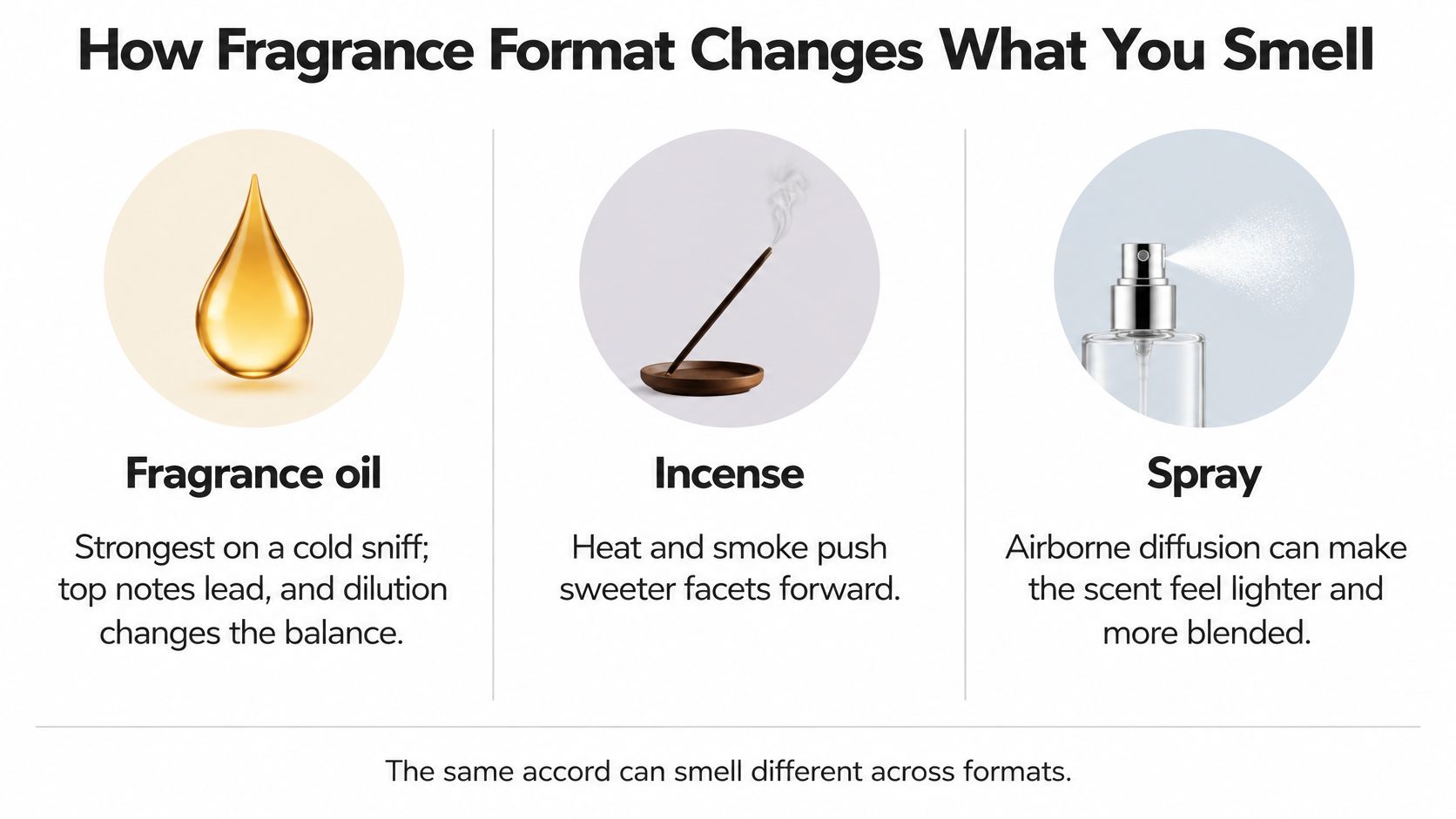
How dragon fruit scent presents by product format
Format | How the scent presents | What shifts it | Evaluation step |
|---|---|---|---|
Fragrance oil | Concentrated cold sniff can emphasize the opening | Dilution and carrier | Compare low and higher permitted dilutions |
Incense stick | Smoke can soften the green impression or suggest smoky sweetness | Heat, smoke and burn progression | Burn in a ventilated room and assess at intervals |
Candle | Warmed fragrance may differ from the unlit wax | Wax, fragrance load and wick | Assess after a stable melt pool develops |
Diffuser | Fruit may seem lighter in room air | Base solvent and airflow | Check near the device and at normal room distance |
Bath salts | Fragrance opens differently in warm water | Water temperature and suitable dispersal | Test the finished bath formulation in warm water |
These are evaluation expectations, not guaranteed outcomes. A carefully formulated incense may preserve more freshness than an overly sweet oil, and a diffuser won't automatically make a dense accord airy.
Test the Application, Not Just the Ingredient
Use only fragrance materials suitable for the intended application. Don't put an oil into bath water, a diffuser or a candle merely because it smells appealing on a blotter.
For candle shoppers considering decorative vessels, the Bridle Up Hope candle guide from Bridle Up Hope Shop offers a separate product-selection resource. Keep vessel choice separate from the warmed scent test.
Our comparison of perfume oil versus spray perfume also helps distinguish close-range oil evaluation from airborne presentation.
Record sweetness, green character, perceived tartness and lingering notes during each test. Keep the room and application conditions consistent when comparing candidates, and take breaks rather than repeatedly smelling the bottle. That gives you a more useful purchase record than a single judgment of strong or weak.
What Dragon Fruit Scent Pairs Well With
Choose a partner to support the effect you want, not because both names sound tropical. An already sweet dragon fruit accord needs a different companion from a restrained, leafy version.
A pitaya headspace GC–MS study in ACS Omega identifies diverse chemical classes and sensory descriptions including sweet, fruity, floral, green-leafy, fatty-green and plastic-green. It also emphasizes odor activity, meaning a compound's contribution depends on its detection threshold, not just its concentration.
That's why adding more of a seemingly minor partner can change the blend disproportionately. The table offers formulation directions, not pairings experimentally validated by the fruit analysis.
Common partner notes for dragon fruit scent
Pairing partner | Effect on dragon fruit scent | Best use | Watch out for |
|---|---|---|---|
Coconut | Adds creamy sweetness and a tropical frame | Warm, beach-style blends | Can tip toward suntan-lotion sweetness |
Lime and citrus | Brightens the green lift | Fresh, morning-style blends | Can sharpen green notes too far |
Vanilla | Softens sharp edges and rounds the fruit | Dessert-like or candy-style blends | Can hide the fresh green character |
Jasmine or ylang-ylang | Lifts the floral facet | Evening or romantic blends | Heavy florals can crowd the fruit |
Sandalwood | Adds a woody foundation and a longer-lasting impression | Meditation or incense blends | A dominant wood can mask the fruit |
Mint or eucalyptus | Adds cool green contrast | Refreshing or cooling blends | Strong minty or camphoraceous character can overwhelm |
Build Around a Deliberate Contrast
Coconut and vanilla both increase perceived richness, but they don't do the same job. Use coconut when you want a tropical setting; choose vanilla when you want a rounded confectionery effect. Combining them without restraint can erase the reason for including dragon fruit.
Lime is a more directional adjustment. It can make a soft accord feel brisker, but it may also exaggerate an already sharp opening. Mint and eucalyptus require particular caution because coolness can become the blend's main identity.
Jasmine or ylang-ylang suits a floral-fruity target. Evaluate whether you can still identify fruit once the floral impression develops, rather than assuming an attractive opening means the finished balance works.
Sandalwood provides a different contrast: wood beneath juicy freshness. Dragon fruit with lime and a restrained sandalwood accent is a useful trial concept for a fresh, fruity, grounded result. It's a proposed sensory target, not a guaranteed recipe.
For a deliberately sweeter direction, our blackberry vanilla fragrance guide provides a useful comparison with a berry-and-vanilla concept.
Correct the Balance Before Adding More
The fruit reads as generic sweetness. Keep a single sweet partner and lower its proportion. Compare the revision with the unmodified accord so you can identify what disappeared.
The opening becomes sharp. Reduce the added citrus or green material before trying to cover it with vanilla. Otherwise, you may create a blend that's simultaneously piercing and heavy.
The fruit vanishes during use. Reduce the wood or musk base before increasing the fruit. Test whether masking, rather than insufficient fragrance, caused the problem.
Start new pairings at a low proportion. Change one material at a time, and keep an unmodified sample beside each trial.
Choose a Dragon Fruit Scent Before You Buy
Choose the facet. Decide between fresh-green, sweet-fruity and floral-fruity before comparing product names.
Choose the format. Evaluate the version you'll burn, diffuse or wear, not an unrelated application.
Read the sensory target. Look for descriptions of the opening, sweetness and lingering character.
Request a small sample. Test under intended-use conditions before committing to a larger order.
For wearable fragrance, Cedar & Lily Clothier's perfume shopping guide for professional women is a separate shopping resource. Keep your own workplace and application preferences central rather than treating a fruit note as proof of suitability.
Our quality fragrance oils review guide can help organize the comparison. At Aroma Warehouse, our fragrance oil range includes sandalwood, lavender and nag champa alongside exclusive blends, giving buyers different scent directions to consider.
We pour our fragrance oils fresh upon order, a relevant process detail when evaluating delicate opening notes, though freshness alone doesn't establish botanical accuracy. We don't accept returns on fragrance, incense or perfume oils because of the possibility of contamination, so sample testing should precede a bulk commitment.
Frequently Asked Questions
1. Is dragon fruit fragrance suitable for everyday home fragrance?
Yes. Dragon fruit fragrance can work well for everyday home fragrance, particularly when formulated with fresh, light fruity notes. Its versatility makes it suitable for living spaces, bedrooms and other areas where a gentle fruit-inspired aroma is preferred.
2. Does dragon fruit fragrance smell similar to watermelon or passion fruit?
Dragon fruit fragrance can share some fruity characteristics with watermelon and passion fruit, but the impressions are different. Watermelon-inspired fragrances tend to emphasize watery sweetness, while passion fruit often has a sharper, tangier tropical character. Dragon fruit blends can lean toward softer, greener fruitiness.
3. Why do some dragon fruit fragrance oils smell stronger than others?
Fragrance strength depends on the formulation, fragrance concentration, carrier and intended application. Some blends emphasize sweet fruity materials, while others prioritize fresh or floral characteristics. A stronger fragrance does not necessarily mean a more realistic dragon fruit scent.
4. Can dragon fruit fragrance be used in handmade soap and body products?
Some dragon fruit fragrance oils are suitable for handmade soap and body products, but suitability depends on the manufacturer's application guidelines and usage limits. Always check the product's technical documentation and applicable skin-contact restrictions before incorporating fragrance into a finished product.
5. How should dragon fruit fragrance oil be stored to maintain its scent?
Store dragon fruit fragrance oil in a tightly sealed container in a cool, dry location away from direct sunlight and excessive heat. Minimize unnecessary exposure to air and keep the original container closed between uses to help preserve its fragrance characteristics.
Aroma Warehouse offers fragrance oils, incense and fragrance accessories for home users, studios and retailers. Visit Aroma Fragrance Warehouse to compare scent options and plan a small-format trial around the fresh, sweet or floral interpretation you want.


