

Copal Incense Sticks: Aroma, Burning Tips and Safety

If two packets both say copal incense sticks, why can they smell different, and why might one stick burn cleanly while the other keeps going out? The answer starts with a distinction that labels often hide: copal is a resin category, while a copal incense stick is a finished formulation.
Choosing well means looking beyond the scent name. Resin chemistry can help explain aroma differences, but the base, binder, manufacturing consistency, and storage conditions determine how a particular stick behaves. Its ceremonial meaning and any claims about relaxation deserve equally careful attention.
Table of Contents
What Copal Incense Sticks Are and How They Smell - What the measured chemistry tells us - Read the formulation, not just the name
Ceremonial History and Everyday Uses - Match the use to its context
How to Choose and Test a Copal Stick - What heat testing actually tells you - Run a useful sample test
How to Burn Copal Incense Sticks Step by Step - Prepare, light, and supervise - Judge the ember, not the spectacle
Fixing Uneven Burns, Ash Drop and Weak Smoke - Match the symptom to a sensible response - Change the easy variable first
Safe Use at Home, With Pets and Sensitive People - Adapt the room to its occupants - Smoke-free doesn't always mean sensitivity-free
What the Calming Claims Do and Do Not Prove - Cultural meaning and personal experience - What the animal study found
What Copal Incense Sticks Are and How They Smell

Copal is aromatic tree resin, commonly associated with the Burseraceae family. A resin-based copal incense stick combines that material with a combustible base, usually wood or plant powder, and a binder that holds the mixture together. Some products also contain added fragrance, so the name on the packet doesn't necessarily describe the complete recipe.
That distinction matters when you compare sticks with loose resin. You're smelling the finished stick's ingredients together, not an isolated botanical material. Our guide to gums and resins provides useful background for understanding these different incense materials.
What the measured chemistry tells us
A peer-reviewed study in Economic Botany057%5B0189:CAEOCI%5D2.0.CO;2) identified 68 chemical compounds across commercial copal blanco, copal oro, and copal negro samples; the table gives the reported leading compounds and their measured proportions in the essential oils.
Measured copal resin types and lead compounds
Resin type | Lead compounds in measured sample |
|---|---|
Copal blanco | alpha-copaene 14.52% ± 1.28%, germacrene D 13.75% ± 1.06% |
Copal oro | alpha-pinene 21.35% ± 5.96%, limonene 26.51% ± 1.22% |
Copal negro | alpha-pinene 17.95% ± 1.35%, sabinene 12.51% ± 0.08%, limonene 16.88% ± 2.02% |

The study associated the samples with Bursera, Protium, and Hymenaea, without establishing a simple botanical mapping for each commercial type. These are measured samples, not universal specifications that every packet bearing those names must meet.
The chemistry helps explain why copals aren't interchangeable. However, the study didn't conduct a sensory test, so descriptions such as woody, piney, sweet, or citrus-bright remain aroma interpretations, not measured smell results. Alpha-pinene and limonene offer a reasonable basis for expecting pine-associated and citrus-associated notes, but they don't predict the complete experience of burning a stick.
Read the formulation, not just the name
For example, a copal-and-nag-champa blend shouldn't be expected to smell like an unblended resin-based product. Likewise, a fragrance-led copal stick may emphasize a perfumer's interpretation rather than the character of a named resin.
Buying insight: A named resin variety or clearly described blend tells you more than copal alone.
Origin, harvesting, and formulation can all influence the eventual aroma. None of the chemical percentages above establishes burn quality, purity, or safety. Choose a scent through sampling, and judge combustion through a separate burn test.
Ceremonial History and Everyday Uses
Copal's ceremonial history in Mesoamerica predates European contact. Archaeological evidence connects it with Maya and Mexica ritual practice, including sacred deposits at Chichén Itzá's Sacred Cenote and beneath the Templo Mayor in Mexico City.
Its importance also extended into organized trade and taxation. A historical study hosted by Harvard describes the Codex Mendoza record requiring Tepequacuilco and Tlachco to provide 400 baskets of white copalli and 8,000 resin balls every eight days as tribute. Copal wasn't merely an occasional household fragrance; communities supplied it as a standardized commodity on a substantial scale.
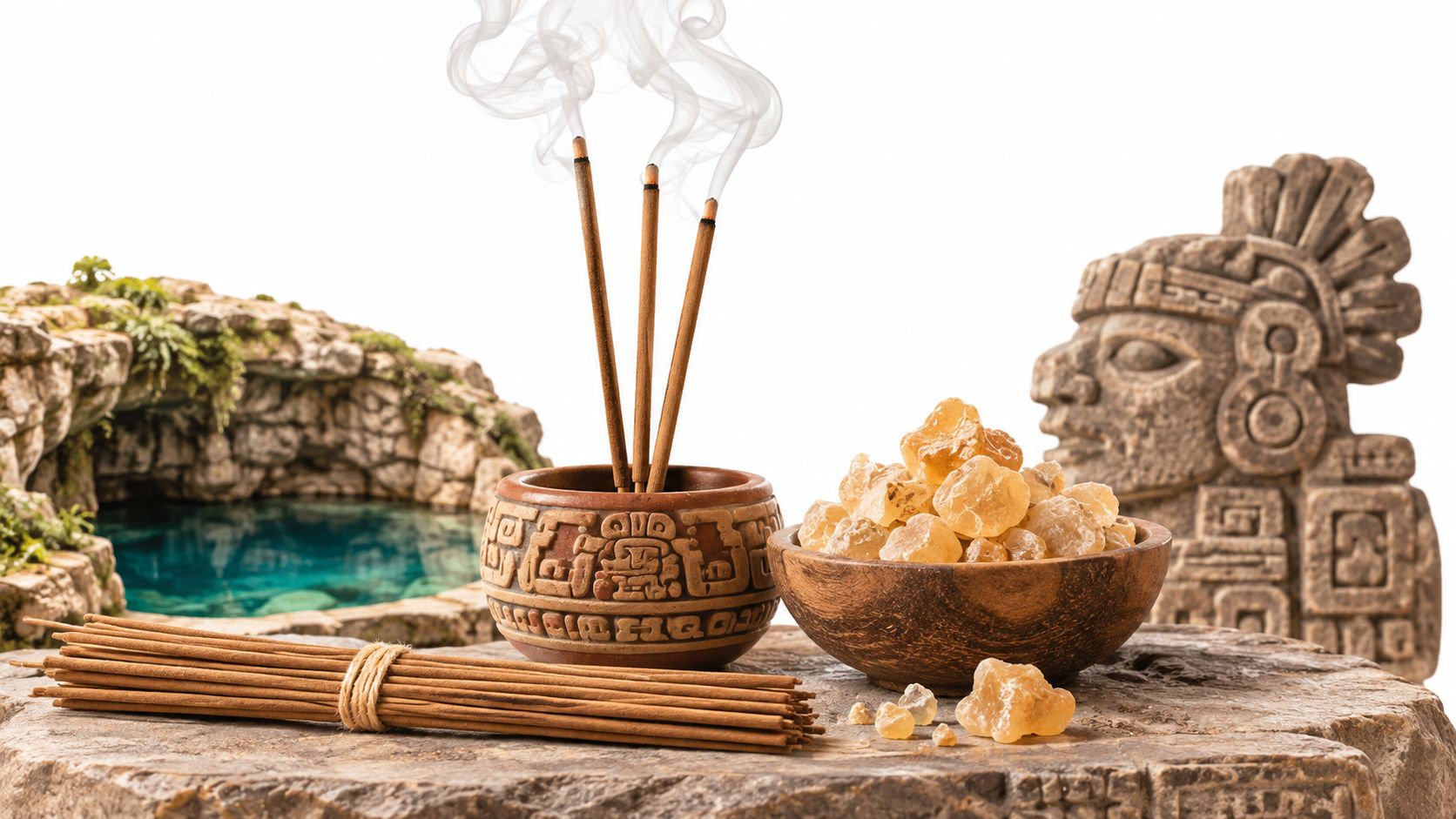
The resin-and-stick pairing below illustrates the distinction between the aromatic raw material and its convenient modern format.
Match the use to its context
Say you're choosing incense for an evening pause at home. You might enjoy copal's fragrance without claiming that your routine reproduces a Maya or Mexica ceremony. Acknowledging the difference lets you use the material thoughtfully without borrowing religious authority.
Present-day uses include:
Home ritual and offerings. A stick may accompany prayer, remembrance, or attention to a household altar, according to the person's own tradition.
Meditation and quiet time. Lighting incense can mark the beginning of a deliberate pause, rather than promise a particular mental effect.
Community ceremony. Copal retains religious meaning in Indigenous and Chicanx practices, including offerings and temazcal settings. Participation calls for guidance from the people responsible for that ceremony.
Home fragrance. Some buyers prefer a resinous scent, without attaching a ritual purpose to it.

For anyone considering a temazcal, Ayahuasca.com's resource on temazcal safety and medical screening offers relevant preparation questions. A ceremonial setting involves considerations beyond selecting incense.
Our overview of incense stick uses can also help distinguish fragrance, personal routine, and ritual purposes. Copal's documented sacred and economic roots deserve recognition, while its living ceremonial uses deserve more than a generic wellness label.
How to Choose and Test a Copal Stick
Buy a clearly described, undamaged sample before committing to a bulk order. A pleasant scent in an unopened packet doesn't tell you whether the stick will smolder consistently or suit your room.
Start with physical checks:
Label clarity. Look for the resin variety or blend, plus an ingredient description that distinguishes resin from added fragrance.
Consistent shape. Compare the sticks for reasonably even diameter and a firm, uniform feel.
Intact surface. Avoid obvious cracking, excessive loose dust, or sticks fused together.
Dry packaging. Check for moisture, damaged seals, or staining.
Storage conditions. Prefer stock kept away from direct sunlight, heaters, and damp areas.
At Aroma Warehouse, we offer hand-dipped incense sticks and cones in various scents and sizes; our Sonavi incense is intended for indoor use in well-ventilated spaces. Those format and use descriptions shouldn't be mistaken for confirmation that every incense product contains the same resin formulation.
What heat testing actually tells you

copal beginning to sinter around 131 °C, decomposition beginning above approximately 225 °C, and complete combustion occurring at about 550 °C. These are laboratory observations of copal, not storage limits for finished sticks.
Don't infer that an ordinary warm delivery automatically reaches those conditions or damages the product. Finished sticks contain other materials, and their response depends on the formulation. The practical lesson is to inspect heat-exposed shipments and test their performance, especially when resin loading or binder distribution may be uneven.
Run a useful sample test
Choose a small, labelled pack. Keep its packaging so you can identify the variety and batch when reordering.
Set up a supervised burn in a ventilated room using a heat-safe holder. Let the stick burn through only if the room remains comfortable and you can stay present.
Record what happens. Note smoke appearance, aroma at the beginning and toward the end, interruptions in smoldering, and ash fall. Smoke color alone isn't a purity or safety test.
Compare the burned sample with the physical checks. A good-looking packet doesn't override repeated extinguishing, and an unfamiliar scent doesn't necessarily indicate a manufacturing fault.
Make the buying decision. Keep a product that burns consistently and matches its description. Try another resin or blend if the aroma disappoints, and stop immediately if anyone reacts.
Keep a simple batch note with the product name, condition on arrival, aroma, and burn behavior. Retailers can use the same record when evaluating repeat orders.
Our guide to choosing good incense sticks offers additional selection criteria. Before a substantial purchase, ask the seller: How are the sticks stored, and how are shipments handled during hot weather?
How to Burn Copal Incense Sticks Step by Step
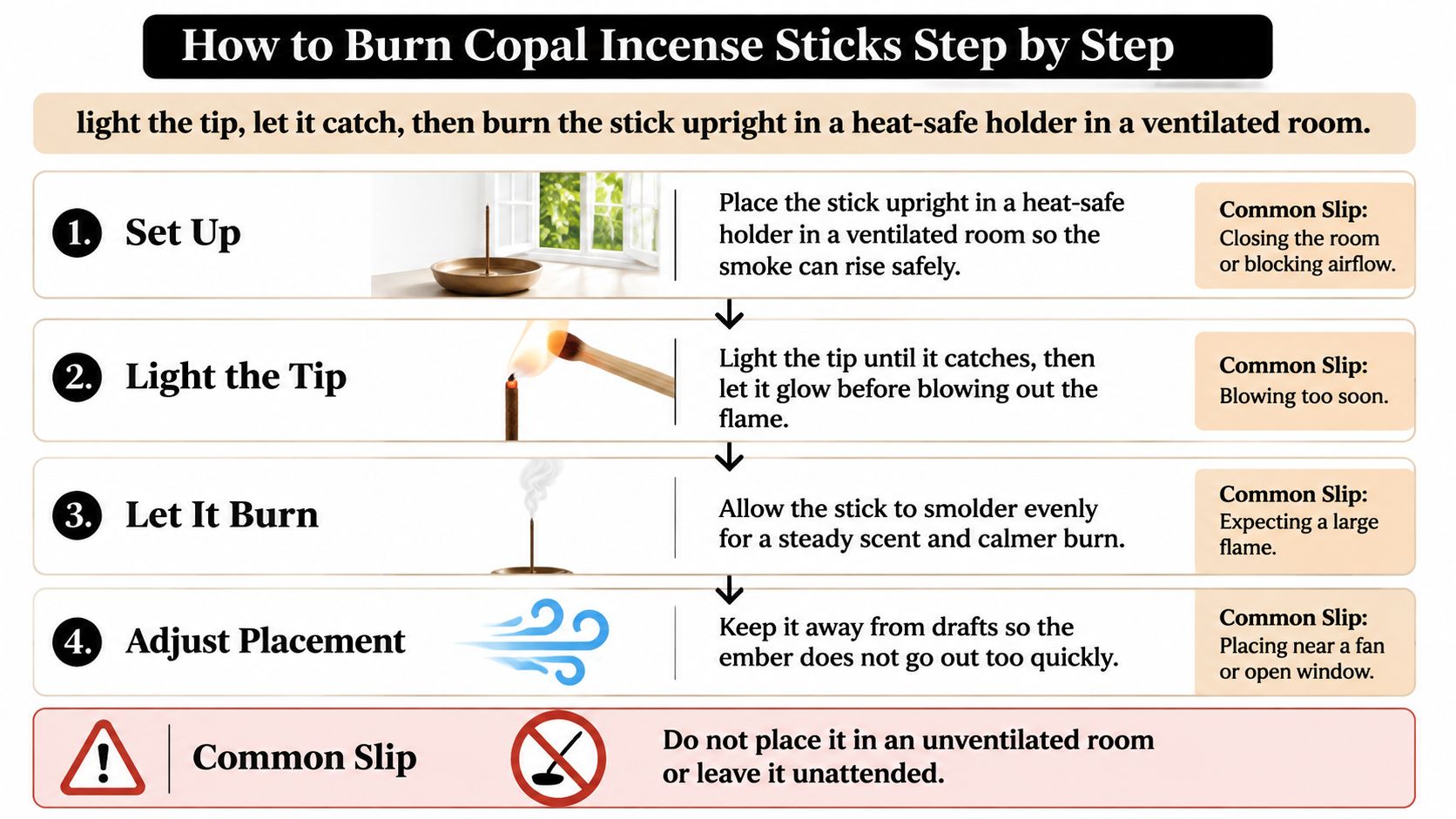
Light the tip, let it catch, then burn the stick upright in a heat-safe holder in a ventilated room. The goal is a glowing ember, not a continuing flame or a room filled with dense smoke.
Use this visual sequence as a setup reminder.
Prepare, light, and supervise
Set up the holder. Use a purpose-made heat-safe ceramic or stone holder, or a stable heat-safe vessel filled with sand, on a noncombustible tray. Check that the stick stands securely and that falling ash will land inside the tray rather than on furniture.
Light the incense-coated tip. Hold a match or lighter flame to the end until it catches and can sustain an ember. A quick brush with the flame may leave only part of the tip lit, while prolonged heating isn't a substitute for a sound stick.
Blow out the flame gently. Look for a glowing tip and rising smoke after the visible flame disappears. Avoid forceful blowing, which can scatter ash or damage a fragile end.
Place it securely and observe. Allow the stick to smolder without touching the burning portion. If an open window creates a direct gust, reposition the holder while preserving ventilation rather than closing the room completely.
Manage loose ash carefully. Let ash fall naturally into the tray, or gently dislodge an unstable hanging section without touching the ember. Don't repeatedly flick the stick or assume that a long ash column proves quality.
Finish deliberately. If you're ending the session early, press the glowing tip into sand until it's fully extinguished. Otherwise, supervise it until it burns out, and confirm that the holder and residue are cool before moving or cleaning them.
Judge the ember, not the spectacle
A satisfactory burn has a reasonably even glowing front and a steady, modest smoke trail. Ash may hold briefly before falling, but its shape isn't a reliable score for resin content or craftsmanship.
You don't need to finish an entire stick to use it correctly. Extinguish it when you've had enough fragrance, when you need to leave, or when the room becomes uncomfortable.
A video demonstration can help clarify the lighting motion and holder placement.
Keep a sand-filled extinguishing vessel within reach before starting. Preparing the stopping point is as important as preparing the flame.
Fixing Uneven Burns, Ash Drop and Weak Smoke
A stick that keeps going out needs a controlled check, not repeated aggressive lighting. First, make sure the tip established an ember and that the holder isn't enclosing the burning section.
Then separate a room problem from a product problem. Changing the placement is easy; repairing a damp, distorted, or inconsistently formed stick usually isn't practical.
Match the symptom to a sensible response
Copal stick symptoms, causes and fixes
Symptom | Likely cause | Fix |
|---|---|---|
Stick keeps going out | Thin or damp stick, or too little airflow | Relight with a longer tip hold, move to a more open spot, replace damp sticks |
Ash drops off in chunks | Unevenly bound resin or a dense, overloaded stick | Tap loose ash gently into the tray; switch batch if it repeats |
Smoke is weak or sputters | Soft spots, uneven burn or moisture | Carefully rotate or reposition the stick in the holder; replace it if it stays weak |
Stick feels soft or sticky | Possible heat exposure in storage or shipping | Discard deformed sticks; store cool and sealed |
Scent turns flat or sharp | Possible aged stock or heat-damaged resin | Compare with a fresh sample; buy smaller batches and store them sealed |
These are troubleshooting possibilities, not diagnoses. Stickiness alone doesn't prove heat damage, and a sharp aroma may be part of a blend rather than a storage fault. Compare the description, physical condition, and performance before assigning a cause.
Change the easy variable first
Relighting a partly lit tip or moving the holder away from a dead-air corner can resolve a setup issue quickly. Rotation may help you observe an uneven ember, but it won't repair poor binding or moisture inside the stick. Extinguish the stick before making any adjustment that could bring your hand near the hot end.
Softened, fused, or deformed sticks call for replacement rather than experiments with ovens, hair dryers, or stronger flames. Keep their packaging if you need to report the condition to the seller.
A burn problem isn't automatically user error. Compare the stick and the room before changing your technique.
Our incense-burning troubleshooting guide covers additional checks. If a sensible adjustment doesn't resolve the problem during a supervised sample burn, compare another batch under similar conditions before judging the whole product range.
Safe Use at Home, With Pets and Sensitive People
Copal smoke is an airborne exposure, not just an aroma. Decide whether to burn it based on who's present, where the smoke will travel, and whether you can supervise the ember.
Ventilation means exchanging indoor air, not just circulating smoke around a closed room. Open a window or use suitable exhaust ventilation, and keep the holder away from curtains, paper, bedding, and busy walkways.
Adapt the room to its occupants
Copal smoke safety by situation
Situation | What to change |
|---|---|
Poorly ventilated room | Open a window or use a fan to help exhaust air before lighting |
Asthma or breathing conditions | Talk with a doctor first; consider a smoke-free option |
Birds and other pets | Move pets out of the room and keep smoke away from their cages |
Children in the home | Keep sticks, holders and ash out of reach; supervise |
Scent-sensitive guests | Skip the stick while they're present rather than assuming distance is enough |
Unattended burning | Never leave a lit stick alone; check the holder is cool before moving it |
For pets, a separate room is only useful if smoke doesn't drift into it. Our guide to incense safety around pets helps frame that household decision. If a pet has respiratory symptoms or diagnosed asthma, Bandana Rx's overview of treatment options for allergic pet asthma provides background for a veterinary discussion, not permission to continue smoke exposure.
Smoke-free doesn't always mean sensitivity-free
A flameless diffuser avoids combustion but still releases fragrance, so it may not suit someone who reacts to scents. An unscented, smoke-free routine, such as quiet sitting with an electric candle, avoids both additions.
Check the room before every session, even if the previous burn seemed comfortable. Stop if anyone develops coughing, irritation, headache, or breathing discomfort, and seek appropriate medical or veterinary help for breathing difficulty.
What the Calming Claims Do and Do Not Prove
Copal is often described as calming and cleansing, but those words can refer to very different things. A religious understanding of cleansing, a person's enjoyable evening routine, and a clinical claim about anxiety aren't interchangeable.
The fairest approach separates cultural meaning, personal experience, and biomedical evidence. None needs to be dismissed to keep the others in perspective.
Cultural meaning and personal experience
Within Indigenous and Chicanx ceremonies, offerings, and temazcal practices, copal can have religious significance that isn't reducible to a pleasant smell. Treating that significance as a generic product benefit strips away the people, traditions, and responsibilities involved.
A personal report of calm also deserves a straightforward hearing. Someone may find that lighting incense, setting aside their phone, and sitting in silence helps them settle. That experience matters without proving which part of the routine produced it.
What the animal study found
A peer-reviewed study indexed by Aga Khan University found reduced anxiety-like behavior in rats exposed to Protium copal incense smoke in two behavioral tests, but not a third. The findings don't establish that copal treats anxiety or produces the same effects in humans.
They also don't justify extending the result to every copal-labelled stick. A finished fragrance blend isn't necessarily comparable to the material used in an experimental exposure.
Evidence boundary: Enjoying an aroma is a personal judgment. Calling it an anxiety treatment requires evidence that enjoyment alone can't supply.
For home use, describe what you notice: you enjoy the fragrance, it marks a pause, or it accompanies meditation. Retailers and studio operators can use equally clear language without promising therapeutic results or presenting spiritual cleansing as biomedical fact.
Notice calm as a personal experience, and treat health claims as unproven until suitable human studies support them. If smoke doesn't suit your household, you can keep the meaningful parts of the routine without burning incense.
Frequently Asked Questions
1. What type of incense holder works best for copal incense sticks?
A stable ceramic or stone incense holder is a good choice for copal incense sticks. Select one with a secure opening that holds the stick upright and a base wide enough to catch falling ash. You can also use a heat-resistant container filled with sand to support the stick and provide a safe place for extinguishing it.
2. How should copal incense sticks be stored after opening?
Store copal incense sticks in a sealed container or their original packaging in a cool, dry location away from direct sunlight and temperature fluctuations. Keeping them protected from moisture and excessive heat helps preserve their fragrance and physical condition. Avoid storing incense near windows, heaters, or humid areas.
3. How long does a copal incense stick typically burn?
The burning time depends on the stick's length, thickness, ingredients, and manufacturing method. Resin content and the combustible base can also influence how consistently a stick burns. Check the manufacturer's product information rather than assuming all copal incense sticks have the same burn time.
4. Can copal incense sticks be burned outdoors?
Yes, copal incense sticks can be used outdoors when conditions are suitable. However, wind can interrupt the glowing ember, scatter ash, and cause inconsistent burning. Use a stable, heat-resistant holder in a sheltered location away from dry vegetation and combustible materials. Never leave burning incense unattended, even outdoors.
5. Can you extinguish a copal incense stick and relight it later?
Yes. You can extinguish a copal incense stick before it finishes burning by pressing its glowing tip into a small container of sand until the ember is completely out. Allow the stick and holder to cool before handling or storing them. When you want to use it again, check that the remaining stick is dry and undamaged before relighting.
At Aroma Warehouse, we offer hand-dipped incense sticks and cones, fragrance oils, and incense holders for home use and retail assortments. Visit Aroma Fragrance Warehouse to compare incense formats and accessories, then start with a small selection you can evaluate for aroma, condition, and burn consistency before buying in bulk.


