

Miswak Natural Toothbrush Guide for Daily Care

You've set a short wooden stick beside your plastic toothbrush, and you're wondering whether that twig can really clean your teeth. Maybe you want something convenient for travel, or you're curious about a familiar oral-care tradition. A miswak natural toothbrush is worth understanding, but there's no need to throw away your toothpaste to try it.
The sensible approach is to learn what the fibers can clean, practice a gentle technique, and keep fluoride toothpaste in your daily routine. Natural doesn't mean complete, and a useful add-on doesn't have to replace everything else.
Table of Contents
What a Miswak Natural Toothbrush Is - A credible tool, not an automatic upgrade
Miswak Beside Brushing and Fluoride - What the routines actually offer - Why fluoride stays in the routine - How it can fit into an ordinary day
Choosing a Miswak Stick - Choose for control and easy upkeep
How to Shape and Use the Stick - Prepare soft fibers before you brush - Follow the surfaces, not just the easy spots
How to Trim Dry and Replace It - Judge the tip by its condition - Know when trimming isn't enough
Claims That Outrun the Evidence - Cleaning plaque isn't sterilizing the mouth - An extract toothpaste isn't an ordinary stick - Whitening and harder scrubbing aren't the goal
Start a Gentle Dual Routine This Week - Build control before adding reach
What a Miswak Natural Toothbrush Is

A miswak is a traditional chewing stick, most commonly made from the roots or
branches of Salvadora persica. People use it for oral hygiene across parts of Africa, the Middle East, and South Asia. Unlike a manufactured toothbrush, it starts with a solid end that you prepare yourself.
Think of it as a brush that grows its own bristles. The bark-covered wood provides the handle. When you expose and gently chew a fresh end, the inner wood separates into fibers that can sweep across tooth surfaces, while saliva carries soluble plant compounds through the mouth.
The comparison below shows the basic difference between the tools.
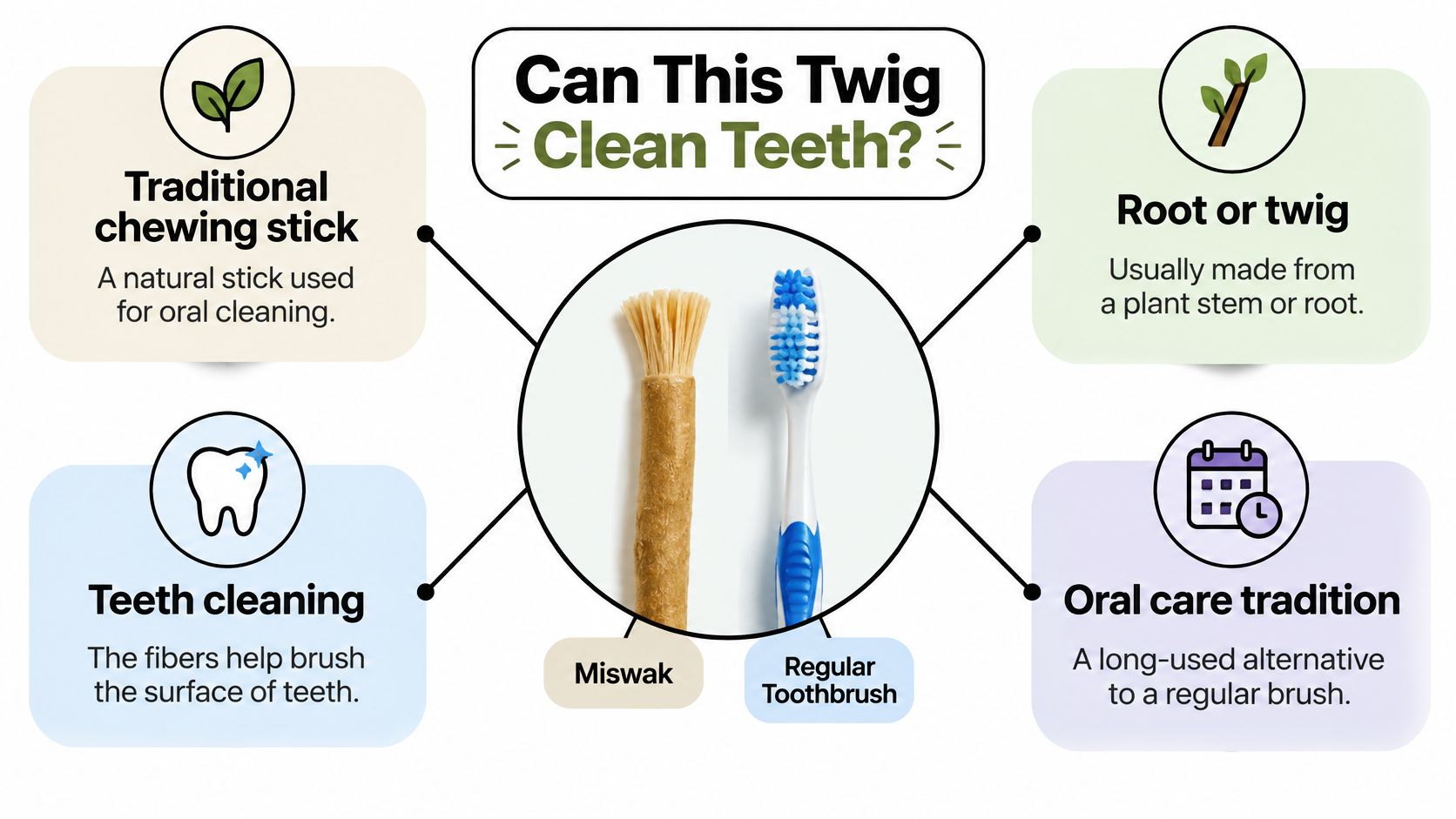
A credible tool, not an automatic upgrade
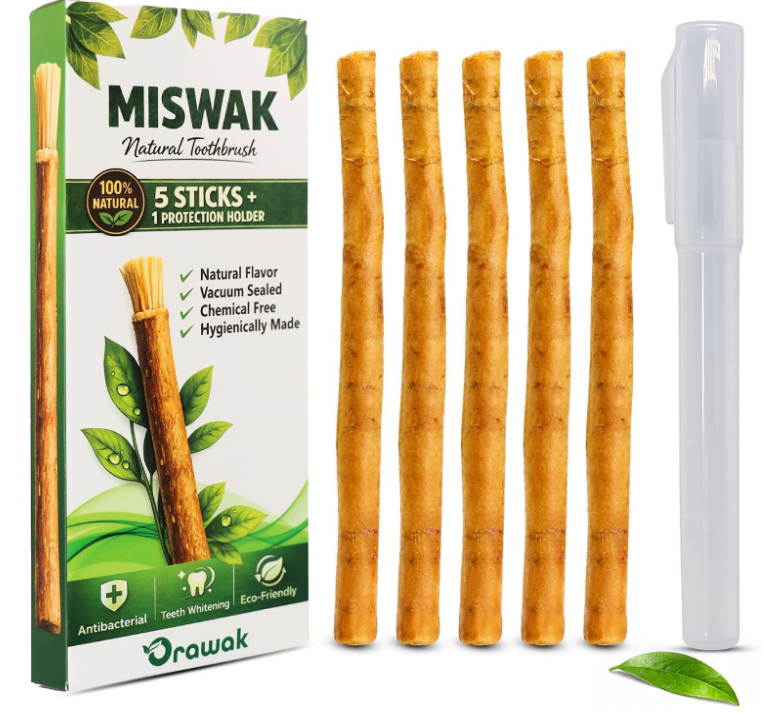
5 Miswak Sticks for Teeth
A 2022 systematic review published in Evidence-Based Dentistry screened 150 abstracts, included 10 randomized controlled trials, and used 9 in a descriptive meta-analysis, finding that miswak alone produced plaque and gingivitis outcomes statistically comparable to toothbrushing, not clearly superior.
That makes miswak more than an interesting historical object. It's an oral-cleaning tool that has been compared with conventional brushes in clinical trials. The review still called for stronger evidence, so comparable results shouldn't become a promise that every stick works equally well for every user.
Practical distinction: A tool can clean effectively in trained hands without being the easiest tool for every part of your mouth.
Say you can comfortably sweep the front teeth but struggle to reach behind your back teeth. The stick hasn't become useless, but your cleaning is incomplete. What matters is the contact you achieve, not which tool you bought.
Before learning the hand movements, it helps to separate the jobs involved: removing plaque, caring for the gum line, and protecting teeth against cavities.
Miswak Beside Brushing and Fluoride
Miswak makes the most sense beside brushing, with fluoride toothpaste still doing the cavity-prevention work. A useful analogy is a detailing brush next to a regular car wash: it can reach places the main wash misses, but it does not replace the soap, water, or protective wax. Used alone, miswak performed similarly to brushing for plaque and gum outcomes in the reviewed trials. Used alongside a toothbrush, it added meaningful improvements.
Those findings concern cleaning and gum inflammation. They do not show that an ordinary stick supplies the same cavity protection as fluoride toothpaste.
What the routines actually offer
The trial comparisons summarized in the clinical review available through Wiley support the plaque and gingivitis findings below, including significant improvements with combined use for plaque (p = 0.01) and gingivitis (p = 0.04).
Miswak alone, brushing alone, and both together
Routine | Plaque finding | Gingivitis finding | Best used when |
|---|---|---|---|
Miswak alone | Similar to brushing in the reviewed trials | Similar to brushing in the reviewed trials | A short clean or travel when a brush is unavailable |
Toothbrush alone | Reference group in the reviewed trials | Reference group in the reviewed trials | Everyday cleaning with fluoride toothpaste |
Miswak plus toothbrush | Significant improvement; p = 0.01, SMD 0.68, 95% CI 0.14 to 1.22 | Significant improvement; p = 0.04, SMD 0.66, 95% CI 0.03 to 1.29 | Extra gum-line cleaning and cleaning between teeth where the fibers can reach |
The table is not a ranking of products and not a promise of personal improvement. It shows that the stick can clean, that results depend on preparation and contact, and that combined use had the clearest added effect in these trials.
Read the first row as permission for a portable clean, not as a reason to retire your toothbrush. The second row is the conventional baseline many people already use well. The third row fits the main strength of miswak: an extra, technique-dependent pass along the gum line and around reachable edges.
Why fluoride stays in the routine
Plaque removal and cavity prevention are different jobs. Brushing and miswak disturb the film on teeth; fluoride toothpaste gives teeth a separate defense against decay that a plain stick should not be assumed to match.
A 2020 evidence review of miswak and oral health found comparable plaque reduction in some trials while noting wide differences in preparation, technique, and fluoride exposure. It also separates ordinary sticks from fluoridated miswak and miswak toothpaste, so findings for those products should not be transferred to plain wood.
If you are deciding what belongs in your toothpaste, Mouthology's explanation of fluoride considerations for your brushing routine gives useful context. Naturally occurring plant compounds are not the same as a known cavity-preventing dose.
How it can fit into an ordinary day
These are workable arrangements, not schedules proven better than one another:
At home in the morning: Add a gentle miswak session around your usual fluoride brushing. Do not scrub the same gum area repeatedly just because two tools are available.
During travel or after lunch: Use a prepared stick for a light clean when your toothbrush is out of reach. Keep the later fluoride brushing instead of counting the travel session as its replacement.
In the evening: Use fluoride toothpaste and floss or another suitable interdental cleaner. A miswak does not earn an exemption from tight contacts.
Should miswak come before or after toothpaste? The findings do not establish a best order. A practical choice is before the fluoride brush, so loose fibers are cleared without adding another rinse afterward.
If you have frequent cavities or periodontal problems, keep your dentist-directed routine intact. Add the stick only where it is comfortable and useful.
Choosing a Miswak Stick
Start with the label, not the most enthusiastic promise on the packet. Look for the plant name, Salvadora persica, and a clear statement of whether the product is plain or has added fluoride. A generic chewing-stick label doesn't tell you enough about what you're putting in your mouth.
Check the packaging for damage, visible contamination, and excess moisture. Don't choose a stick with mold or a sour smell, even if the seller describes it as fresh or natural. Freshness is a condition to inspect, not a marketing word to trust.
Choose for control and easy upkeep
A suitable stick should sit securely in a pencil-like grip without forcing you to clench your hand. You need enough usable wood to prepare fresh ends while keeping your fingers comfortably outside your mouth.
Check the grip: Avoid a piece so thin that it slips or so bulky that reaching the back teeth becomes awkward.
Inspect the wood: Reject sharp splits, loose fragments, or damaged areas that could catch your lip.
Start with a small purchase: Learn whether you like the feel and can maintain it before buying a large supply.
Read the promises critically: Whitening, sterilizing, and gum-disease claims need more than a natural label.
Don't assume all chew sticks are the same plant or serve the same purpose. If you're comparing varieties, our guide to licorice chew sticks, their uses, and precautions can help you distinguish another chewing-stick product from miswak.
Choose the form that suits the task. A plain stick may suit cultural use or a portable cleaning kit, while your usual toothpaste remains at home. The purchase should fill a useful gap, not create a reason to abandon a routine that already works.
How to Shape and Use the Stick
A miswak natural toothbrush requires more hand control than chewing a twig. Your aim is a soft working end, light contact, and deliberate coverage, especially where the stick feels awkward.
In a randomized trial involving 78 participants, miswak sticks, Salvadora persica toothbrushes, and standard toothbrushes all improved plaque and gingivitis after three weeks of correct use. That supports careful instruction rather than assuming the natural option is better.
Prepare soft fibers before you brush
Use this sequence as a handling guide, not a reason to rush through preparation.
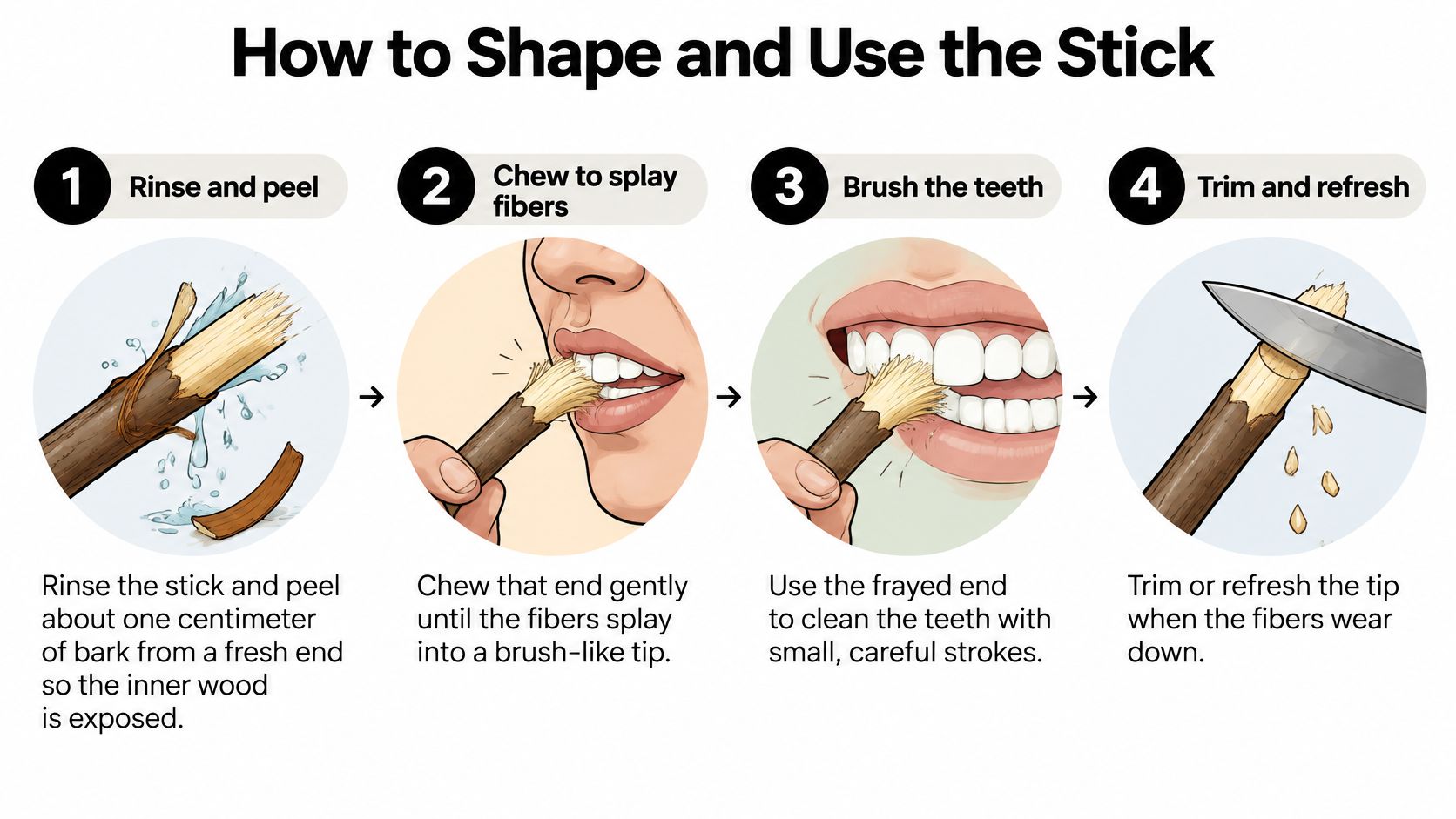
Rinse and expose a fresh end. Wash your hands, rinse the stick, and peel a short section of bark from the working end. If you use a small knife, cut away from your fingers on a stable surface. Peeling exposes the inner fibers; the common miss is leaving rough bark edges where they can rub your lip.
Chew gently until the fibers separate. Work the exposed wood gradually rather than biting down hard. Stop when the end feels flexible and brush-like, not splintery. The purpose is to soften the fibers, and the mistake to avoid is treating stiff wood as ready-made bristles.
The preparation and brushing sequence is illustrated below.
Follow the surfaces, not just the easy spots
Hold it lightly and work around the teeth. Use a pencil-like grip and short strokes across the outer surfaces, then the inner surfaces, then the chewing surfaces. Give the gum line careful attention without pushing the fibers beneath it. The grip helps you control pressure; skipping the tongue-side surfaces is the common miss.
Adjust the angle for spaces you can reach. Turn the frayed end slightly to bring soft fibers against the sides of teeth. Don't wedge solid wood into a tight contact or force fibers through resistance. Changing the angle improves contact, but assuming this replaces floss or another interdental cleaner leaves inaccessible areas untouched.
Finish and inspect the tip. Spit out loose fibers, rinse your mouth if needed, and rinse the working end. Check for broken pieces before putting it away. The purpose is to leave a clean, usable tool, and the common miss is packing a wet, debris-filled tip straight into a closed travel case.
You shouldn't need a tight fist or a forceful sawing motion. If the back teeth are difficult to reach, change your wrist angle rather than opening wider and pushing harder.
Let the fibers touch the tooth. Don't use the wooden core as a scraper.
Finish with a simple self-check: the fibers feel soft, you've contacted every intended surface, and the motion hasn't left your gums feeling scraped. Bleeding isn't proof that you've cleaned thoroughly. Stop if the action causes pain, and have persistent bleeding checked rather than brushing more aggressively.
How to Trim Dry and Replace It
Care begins immediately after use. Rinse loose debris from the fibers, shake off excess water, and stand the stick with the working end upward in a clean, ventilated place. Keep that end from resting against a dirty cup or countertop.
A protective case is useful for carrying a clean stick, but a closed case isn't a drying rack. Don't leave a wet working end sealed inside a bag. When you reach your destination, take it out and let it air-dry.
Judge the tip by its condition
Look at the working end before you decide to reuse it. Fibers that stay flattened, look dark, or spread so widely that they won't make controlled contact need refreshing. More pressure won't turn a worn tip into a useful brush.
Miswak care by the state of the tip
Tip or stick state | What to do | When |
|---|---|---|
Just used, still damp | Rinse, shake, and stand the working end up to air-dry | After every session |
Fibers flat, dark, or overly splayed | Cut off the used tip and chew a new end | When the brush no longer holds shape |
Too short, cracked, sour, or moldy | Discard the stick and start a new one | As soon as any of those signs appear |
Use clean scissors capable of cutting the wood, or a suitable small knife on a stable cutting surface, to remove the spent end. Don't tear away a stubborn section with your teeth. Inspect the newly exposed wood before preparing it.
There isn't a single established clinical trimming calendar for every user. Someone who uses the stick frequently will wear the fibers differently from someone who carries it for occasional travel. Condition is a better trigger than an invented expiry schedule.
Know when trimming isn't enough
A damaged stick doesn't always deserve another chance. Discard it if a crack affects your grip, if sharp fragments develop, or if it has become too short to control safely. Sour odor, slime, or visible mold means replacing the whole stick, not merely cutting off the obvious patch.
Store it away from a steamy shower caddy and direct heat. Don't share your stick, and keep the working end separate from other people's oral-care tools. A clean, ventilated storage spot is part of maintaining the tool, not an optional finishing touch.
Before the next session, check for dry fibers, no slime, and enough length for a secure grip. If you wouldn't be comfortable using the tip in its present condition, refresh or replace it instead of trying to overlook the problem.
Claims That Outrun the Evidence
A natural stick doesn't automatically whiten teeth, sterilize the mouth, or treat gum disease. Those are different claims, and evidence for removing plaque cannot prove all of them.
Keep the comparison between tools separate from promises about treatment.
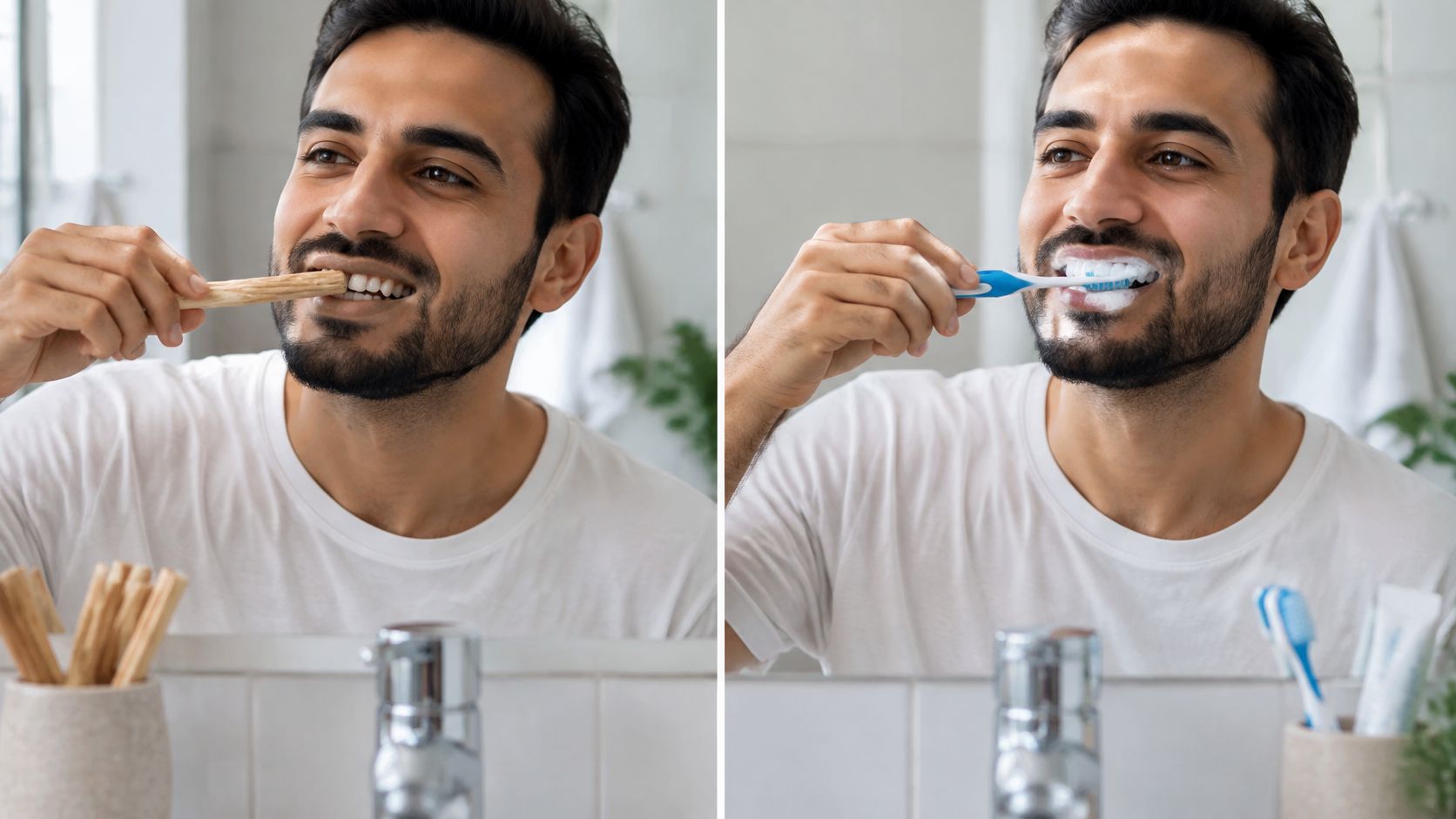
Cleaning plaque isn't sterilizing the mouth
In a double-blind randomized trial of 68 patients with gingivitis, active miswak reduced dental plaque from baseline (p = 0.007) but didn't outperform inactive miswak for plaque between teeth or change the microbial composition below the gum line.
That's a narrower result than a whole-mouth antibacterial treatment. It supports local cleaning through fiber contact, with soluble plant compounds potentially contributing, rather than a guarantee that chewing exposes every hidden area to an effective treatment.
An extract toothpaste isn't an ordinary stick
A clinical study of miswak-extract toothpaste found that after three weeks, bleeding around the gums decreased by 14.5% ± 8.1%, compared with 9.4% ± 7.8% for conventional toothpaste, while plaque reductions didn't differ significantly.
That result belongs to the tested toothpaste formulation. It doesn't establish that every chewing stick, powder, or extract delivers the same benefit, and it doesn't demonstrate a cure for periodontal disease.
If you watch a demonstration, focus on gentle handling rather than treating a confident presentation as proof of a health claim.
Whitening and harder scrubbing aren't the goal
Whitening isn't established by these findings. Removing debris or some surface discoloration isn't the same as bleaching the underlying tooth color. Don't increase pressure or concentrate repeated strokes on a stained area in pursuit of an unproven result.
Aggressive sawing can injure gum tissue. A sore gum margin isn't evidence that plant compounds are working, and more cleaning sessions won't necessarily correct poor technique.
The boundary: Miswak is an oral-care accessory for plaque disruption, not a disease treatment and not a fluoride substitute.
See a dentist for bleeding that continues, pain, or loose teeth. Those symptoms need assessment, not a stronger stick or a more ambitious home routine.
Start a Gentle Dual Routine This Week
Try learning the handling gradually instead of judging success by how much you can scrub. This is a suggested practice week, not a clinically tested treatment schedule.
Build control before adding reach
During the opening practice sessions: Prepare soft fibers and try light strokes on the outer tooth surfaces. Finish with your usual fluoride brushing, which still provides your complete routine while you learn.
As your grip becomes comfortable: Add the inner and chewing surfaces, plus a gentle gum-line pass. Keep floss or your usual interdental cleaner at night, and avoid repeatedly working over the same tender area.
Toward the end of the week: Try carrying the stick away from home. Plan where you'll rinse and dry it afterward, then check whether the working end needs trimming.
If your gums feel scraped, stop and reassess both the tip and your pressure. Don't push through discomfort to complete a practice plan.
Success means a controllable tool, a tip that dries between uses, and a fluoride routine that stays intact.
Keep the toothpaste already in your cabinet rather than replacing the tube. If bleeding, pain, or looseness persists, arrange a dental appointment instead of extending the experiment.
Frequently Asked Questions About Miswak Natural Toothbrushes
1. Can you use a miswak toothbrush if you have braces?
People with braces should exercise caution when using miswak. The natural fibers may catch on orthodontic brackets or wires, potentially causing discomfort or disturbing orthodontic appliances. A conventional orthodontic toothbrush and interdental cleaning tools are generally easier to control. Ask your orthodontist before incorporating miswak into your oral-care routine.
2. Is miswak suitable for children?
Miswak may be an option for older children who can handle it safely under adult supervision. However, parents should watch for loose wood fibers, splinters, and accidental swallowing. Children should continue using an age-appropriate toothbrush and fluoride toothpaste, with guidance from their dentist.
3. Can you use miswak if you wear dentures?
Miswak is designed primarily for cleaning natural teeth. It is not a substitute for products designed to clean removable dentures or partial plates. Dentures require appropriate cleaning brushes and denture-cleaning products to help remove food debris and buildup without damaging their surfaces.
4. Does miswak have a natural taste or smell?
Yes. Fresh miswak typically has a distinctive earthy, woody taste that some people describe as slightly bitter or peppery. Its aroma and flavor can vary depending on the plant material, freshness, and storage conditions. The taste may become less noticeable as you become accustomed to using it.
5. Can you use miswak after a tooth extraction or dental procedure?
It is best to avoid using miswak directly around a recent extraction site or healing dental work until your dentist or oral surgeon approves it. The fibers and brushing motion could disturb sensitive tissue or interfere with healing. Follow your dental professional's instructions before returning to your normal oral-care routine.
At Aroma Warehouse, we offer herbs including Licorice Chew Sticks and Sage & Smudges, alongside Scented Bath Salts, Essential Oils, and Unscented Salts. If this guide has you comparing plant-based products, visit Aroma Miswak Tooth Brush Warehouse to explore our selection, keeping the distinction between licorice chew sticks and Salvadora persica miswak in mind.


