

New Age Incense: A Complete Guide to Scents & Safety

You light a stick before meditation, expecting a gentle sandalwood trail to settle the room. Instead, the fragrance arrives sweet and heavy, the smoke lingers near the ceiling, and the label's promises about chakras, cleansing, or relaxation leave you wondering what you're burning. That moment captures the appeal and confusion surrounding new age incense.
The category sits at the meeting point of spiritual practice, aromatherapy, gift retail, and material science. A scent can support a familiar ritual, but the experience also depends on the combustible base, fragrance materials, product shape, and airflow in the room. Understanding those details helps you choose incense with respect for tradition, without accepting every mystical marketing claim as a scientific one.
Table of Contents
What New Age Incense Actually Means - Branding rather than a fixed formula - What the term can and can't promise
Where New Age Incense Comes From - A lineage built in stages - How the modern category formed
Common Ingredients and Scent Profiles - The three material layers - Reading the scent families
Safe Use, Ventilation, and Storage - A safer burning routine - Storage that protects the fragrance
Wholesale and Retail Sourcing Tips - Start with the sample, not the carton - Build a line customers can understand
Choosing the Right New Age Incense for You - Match intention with profile
What New Age Incense Actually Means
A meditation teacher lights a sandalwood and lavender stick before an evening class. The packaging nearby shows a soft watercolor moon, a chakra symbol, and words such as “balance,” “higher vibration,” or “energy clearing.” For the practitioner, the fragrance creates a transition from ordinary activity to intentional practice. For the retailer, the same product belongs beside crystals, yoga accessories, essential oils, candles, and journals.
That is the practical meaning of new age incense. It's primarily a retail category and marketing position, not a single spiritual doctrine, recipe, or country of origin. The label usually identifies incense designed for modern wellness settings, including meditation rooms, yoga studios, metaphysical shops, wellness boutiques, and gift stores.
Branding rather than a fixed formula
“New age” packaging often uses recognizable visual and verbal cues:
Wellness language: Labels may connect scents with meditation, relaxation, grounding, purification, or intention setting.
Symbolic naming: Product lines may use chakra colors, moon phases, crystals, astrology, or elemental themes.
Modern presentation: Minimalist boxes, decorative tubes, botanical illustrations, and coordinated scent collections make the products easy to merchandise.
Broad scent appeal: Traditional woods and resins may appear beside lavender, citrus, eucalyptus, vanilla, or fragrance-enhanced blends.
None of those features tells you exactly what's inside. A new age stick may use wood powder, a binder, bamboo, plant materials, essential oils, resinoids, or synthetic fragrance compounds. Two products with nearly identical spiritual language can burn very differently because their materials and manufacturing methods differ.
The category also shouldn't erase the traditions from which many products draw inspiration. Nag champa, Japanese incense, Indian masala sticks, Tibetan-style incense, and smudging materials have distinct cultural histories and uses. A helpful overview of the cultural significance of incense in global traditions can provide context that a small retail label rarely has room to include.
What the term can and can't promise
A product name can suggest a mood, but it can't prove that burning the product changes consciousness, removes negative energy, or produces a medical benefit. Those claims belong to belief, symbolism, or personal experience unless the seller provides credible evidence for a narrower statement.
Treat the category as a bridge. It brings traditional incense formats into contemporary wellness and lifestyle retail, while leaving you responsible for checking the ingredients, burn behavior, scent strength, and ventilation needs. That approach respects the spiritual role of incense and gives the physical product the careful attention it deserves.
Where New Age Incense Comes From
Incense didn't begin as a modern wellness accessory. People in several regions developed aromatic burning practices for worship, offerings, ceremony, atmosphere, and personal use. The materials and meanings varied, but the underlying action was familiar: fragrant plant matter was heated or burned so its aroma could fill a space.
A lineage built in stages
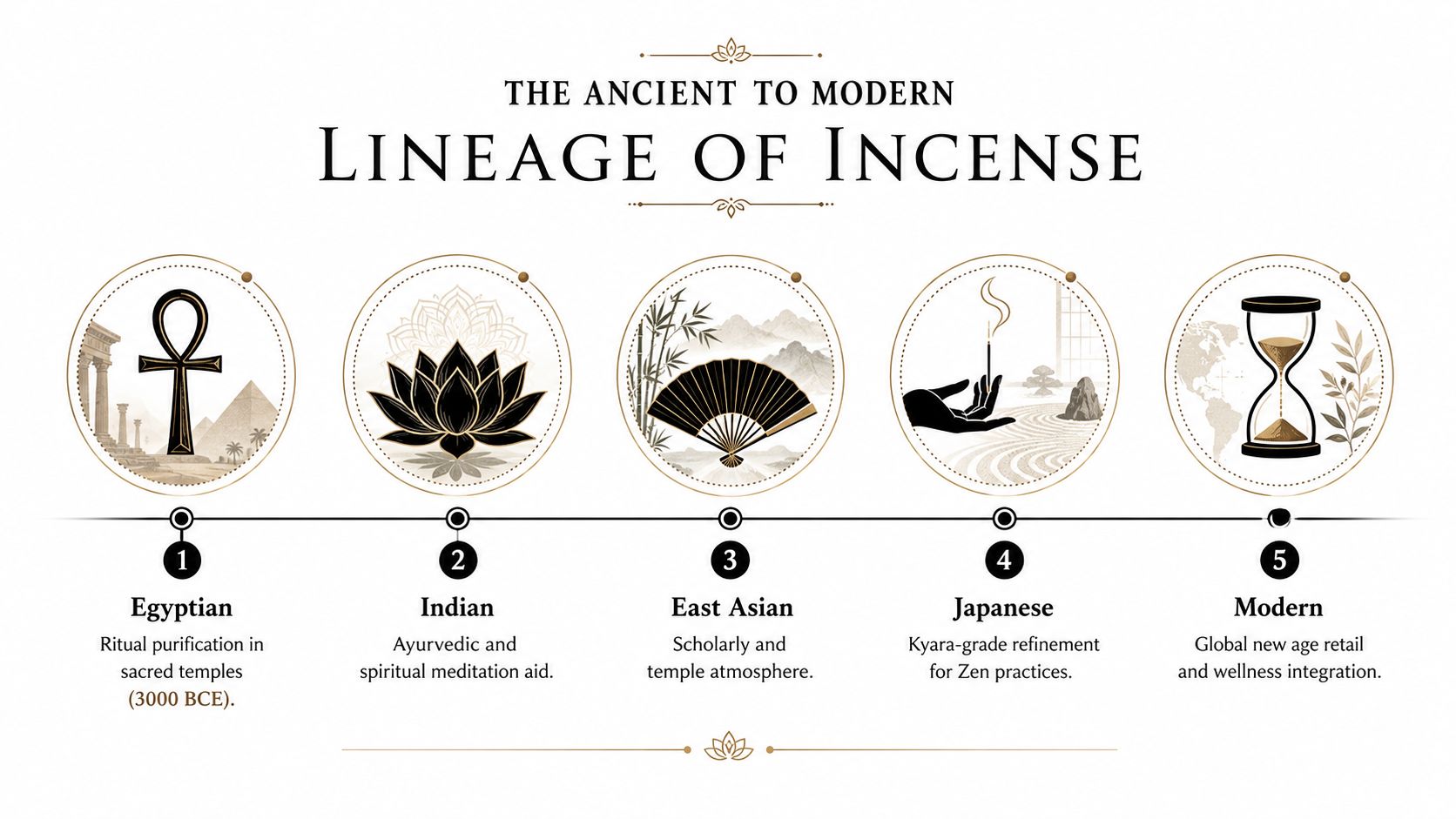
Ancient ritual practice came first. Egyptian temple traditions used aromatic substances in sacred settings, while South Asian practices developed around woods, herbs, resins, and offerings. East Asian cultures also incorporated incense into temples, homes, scholarly spaces, and contemplative routines. These traditions weren't interchangeable, and the same ingredient could carry different meanings across regions.
Craft traditions shaped the products. Indian incense makers developed sticks and paste-like blends using aromatic woods, flowers, herbs, resins, and binders. Japanese makers refined stick incense with an emphasis on subtle fragrance, material quality, and careful appreciation. Tibetan-style products often use dense herbal and resinous formulas, with a different appearance and scent profile from slim bamboo-core sticks.
Global trade widened access. Imported Indian sticks, including familiar nag champa styles, became recognizable to Western buyers. Japanese incense introduced another model, one that often emphasized restrained fragrance and craftsmanship rather than a large smoke plume. Products such as white sage bundles entered spiritual and metaphysical retail through a separate ritual pathway, and their use deserves cultural awareness rather than casual treatment as a universal “cleansing” tool.
How the modern category formed
During the counterculture era, Western interest in yoga, meditation, Transcendental Meditation, alternative spirituality, and Eastern philosophies created new demand for familiar ritual goods. Importers and wholesalers then adapted traditional-looking formats for Western shelves, often pairing temple-style recipes with aromatherapy language, herbal themes, flower references, and symbolic collections.
That adaptation produced the category shoppers now recognize. A box might preserve the visual language of Indian incense while presenting the scent as a tool for focus or relaxation. Another might borrow a Japanese-style stick shape but use a strong floral fragrance intended for ambient scenting.
The commercial history is substantial. In 1989–90, India's incense-stick industry was assessed at 147 billion sticks, with domestic sales estimated at ₹7.1 billion and exports around ₹1.5 billion, according to the documented incense industry history and statistics. The same source reports that India exported incense sticks worth $498.02 million across FY2012 to FY2016, while annual exports rose from $89.64 million to $100.02 million.
Those figures help explain why today's wellness shelf contains both sacred lineage and industrial consistency. For a fuller historical account, explore the journey of incense sticks through time.
Common Ingredients and Scent Profiles
A stick of incense looks simple, but it's a small combustion system. The manufacturer has to create a mixture that holds together, accepts fragrance, ignites predictably, and releases aroma at a controlled pace. The final scent comes from three functional layers, although many formulas combine them in complex ways.
The three material layers
The combustible base gives the product something to burn. Bamboo-core sticks wrap a scented paste around a thin central splint. Coreless sticks may rely on wood powder, charcoal, makko powder, or another combustible structure. The base affects ash, smoke, temperature, burn consistency, and how clearly the fragrance emerges.
The binder holds powders and aromatic materials together. Makko powder, plant gums, and other binders can help a coreless stick maintain its shape. Charcoal-based products often carry fragrance efficiently and can produce a more immediate scent release, but the overall emission profile depends on the full formula, not the base alone.
The aromatic portion may include essential oils, resinoids, absolutes, fragrance oils, dried herbs, flower material, and powdered woods. Natural materials can vary from batch to batch. Synthetic fragrance compounds may give manufacturers more consistent scent strength and cost control, but a responsible label should identify them accurately rather than relying on the vague word “natural.”
Reading the scent families
Use a scent wheel instead of choosing only by a spiritual name.
Scent family | Familiar materials | Typical impression |
|---|---|---|
Woody | Sandalwood, cedar | Warm, steady, grounding |
Floral | Lavender, chamomile, champa flower | Soft, sweet, comforting |
Earthy | Patchouli, vetiver | Deep, damp, meditative |
Bright | Citrus, eucalyptus | Fresh, sharp, clearing |
Resinous | Benzoin, frankincense, copal | Rich, balsamic, ceremonial |
Nag champa commonly combines a sweet floral character associated with champa flower and a warm woody foundation associated with sandalwood. The exact formula varies by maker, so one nag champa product may smell creamy and floral while another feels darker, smokier, or more resinous.
Terpenes also influence how people perceive plant aromas. A general resource to browse terpene flavors and scents can help you understand why related botanical materials may share bright, pine-like, citrus, or earthy impressions.
Benzoin deserves separate attention because it can add sweetness, warmth, and a rounded resin character. Retailers and home users can learn more from this guide to benzoin resin incense. Don't assume that a “calming” label means lavender will suit you, or that “purifying” means a product has a special chemical effect. Start with the actual scent family, then consider whether the aroma feels appropriate for the room and purpose.
New Age Incense Compared to Other Formats
A new age stick is only one way to scent a room. The format changes how you light the product, how much smoke it produces, how quickly the aroma spreads, and how much control you have over the session. Choosing by format first often prevents disappointment.
Format | Base material | Burn behavior | Scent character | Suitable use |
|---|---|---|---|---|
Bamboo-core or coreless aromatic paste | Predictable, gradual | Consistent and accessible | Meditation, ambient scenting, gifting | |
Copal, frankincense, benzoin, or other resin | Heated on charcoal or an electric burner | Dense, rich, sometimes intense | Ceremony, focused fragrance | |
Tied herbs or plant material | Smokier, less uniform | Herbal and ritual-forward | Ceremonial use, symbolic practice | |
Fine powders, woods, herbs, and binders | Often restrained and nuanced | Subtle or layered | Contemplation, appreciation, ritual | |
Compressed aromatic mixture | Compact, concentrated burn | Stronger burst in a smaller format | Shorter focused sessions |
The familiar new age stick works well for shoppers who want a simple ritual. You place it in a stable holder, light the tip, allow the flame to go out, and let the ember travel through the material. Bamboo-core sticks often feel familiar because the structure is easy to handle, while coreless sticks can offer a different ash pattern and scent delivery.
Resin asks more from the user. Copal and frankincense need a heat source and a heat-resistant vessel, and the fragrance can become much fuller than a lightly scented stick. That intensity can suit ceremony, but it can overwhelm a small room. A liquid product belongs to a different category altogether, and liquid incense should never be treated as though it can be burned like dry incense.
Format matters as much as fragrance. A scent you enjoy in a stick may feel too concentrated when heated as resin or compressed into a cone.
Smudge bundles emphasize smoke, plant identity, and ritual action more than polished fragrance throw. They also require careful sourcing and cultural sensitivity. Japanese-style sticks tend to appeal to people who prefer quiet, refined aromas rather than a strong perfume cloud.
For shoppers building an atmosphere rather than burning material, a candle can serve a similar decorative role without being incense. You can browse the Harmony Candle as an example of how fragrance and ritual ambience may be presented in another format. Match the product to the intended experience, not just the most attractive label.
Safe Use, Ventilation, and Storage
Incense is a combustion product, so ventilation isn't an optional detail. A California residence study measured PM2.5 emission rates from 7 to 202 mg/h and emission factors from 5 to 56 mg per gram of incense burned, according to research published by the American Chemical Society. The study also identified pollutants including benzene, toluene, xylenes, aldehydes, and PAHs.
PM2.5 means fine particulate matter small enough to travel into the respiratory system. Volatile organic compounds, often abbreviated as VOCs, are gases released from materials and fragrances. A short burn in a well-aired room is not equivalent to prolonged burning in a closed space, because room volume, airflow, product composition, and exposure time all change what remains in the air.
A safer burning routine
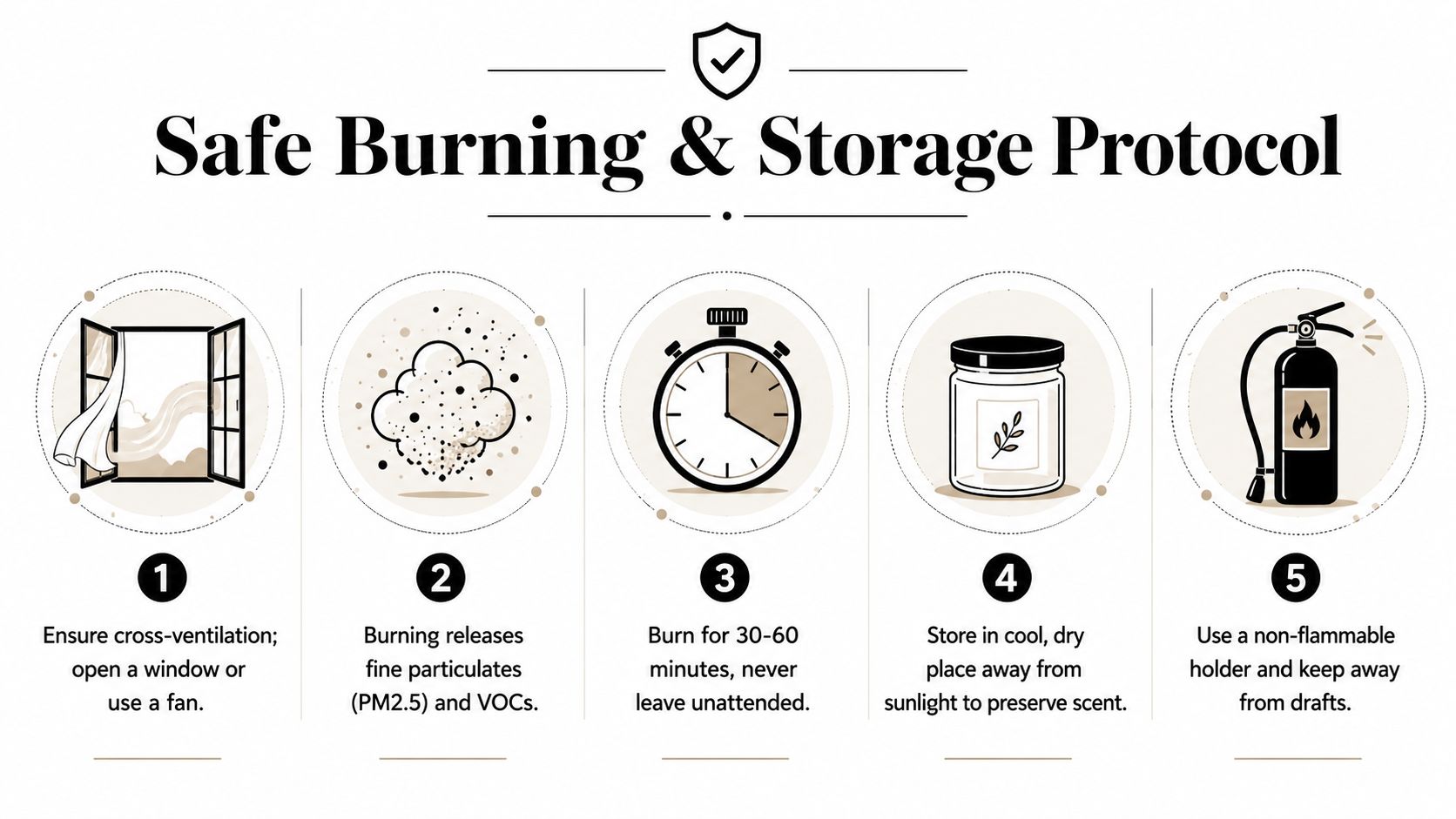
Use these practices every time:
Create air exchange: Open a window or door, use gentle cross-ventilation, and avoid burning in a closet, windowless bathroom, or sealed treatment room.
Choose a stable holder: Use a nonflammable burner that catches ash and keeps the ember away from wood, fabric, paper, pets, and children.
Keep the burn controlled: Don't leave incense unattended, and extinguish it if the smoke becomes irritating or the room starts to feel hazy.
Place it away from drafts: Strong airflow can scatter ash, disturb the ember, or carry smoke directly toward someone's breathing zone.
Dispose of ash safely: Wait until the material is fully cool before emptying the holder into a suitable container.
Emission research shows why “low smoke” needs careful interpretation. A shorter burn doesn't automatically mean low exposure if the product releases a high concentration of particles quickly. Buyers should look for disclosed ingredients and credible testing rather than relying on a scent name or spiritual promise. Reviews of temple and chamber measurements found wide variation in PM10, PM2.5, benzene, and formaldehyde levels between environments and products, as summarized in this review of incense emissions and health effects.
Storage that protects the fragrance
Keep sticks and cones in a cool, dry place away from direct sunlight. An airtight tin or sealed inner bag helps prevent humidity from softening the product and keeps nearby goods from absorbing the scent. Store strong resins separately from delicate floral products.
Upright storage can reduce crushing and preserve the shape of bundled sticks, while flat storage works if the package is rigid and the contents won't be compressed. Essential-oil blends can lose their top notes over time, especially when exposed to heat, air, or light. If you're sensitive to smoke or have a respiratory condition, avoid burning indoors and seek medical guidance about your individual risk. For practical reminders, review incense safety guidance, and use a broader indoor air quality resource when evaluating ventilation in your home or studio.
Wholesale and Retail Sourcing Tips
A good new age incense line starts with supplier questions, not attractive packaging. Retailers need to know what the product contains, how consistently it burns, how it's packed, and whether the supplier can repeat the same quality on the next order.
Start with the sample, not the carton
Request samples from every supplier you're considering. Burn them in the same holder and room, then record the scent before lighting, during the first part of the burn, and after the ember has traveled through the stick. Pay attention to whether the fragrance becomes harsh, whether the ash stays stable, and whether individual sticks burn at noticeably different speeds.
Ask for:
Ingredient information: Request the base materials, binders, fragrance type, and any declared allergens.
Batch consistency: Ask how the supplier checks scent, moisture, dimensions, and burn behavior between production runs.
Documentation: Request available safety data sheets, compliance documents, and testing relevant to your market.
Packaging specifications: Confirm stick count, cone count, inner wrapping, display-box dimensions, and case-pack details.
Order requirements: Clarify minimum order quantities, sample charges, lead times, replacement policies, and private-label options.
A supplier who can't identify whether a product uses essential oils, fragrance oils, resins, or a blend makes accurate merchandising difficult. “Natural” also isn't a complete specification. Plant materials can vary, and all combustible materials create smoke, so the product description should be precise rather than suggestive.
Frequently Asked Questions
1. Can new age incense be used in a meditation room?
Yes. New age incense can be incorporated into a meditation room as part of an intentional atmosphere. The best choice depends on how noticeable you want the fragrance to be and how much ventilation the room provides. A lighter scent can work well for a small personal space, while stronger fragrances may be better suited to larger, well-ventilated rooms.
2. How long does new age incense typically last after opening?
The usable life of opened incense depends on the ingredients, packaging, humidity, heat, and exposure to air. Properly sealed incense generally retains its fragrance better than sticks left exposed. If the aroma becomes noticeably weaker, the sticks absorb moisture, or the material develops an unusual odor, the product may no longer provide the intended experience.
3. Is new age incense suitable for yoga studios and wellness businesses?
It can be, particularly when the business chooses products that fit its atmosphere and customers. Wellness businesses should consider fragrance intensity, room size, ventilation, customer sensitivities, and clear product labeling before using incense during classes or sessions. Offering incense-free areas or alternatives can also make the environment more accommodating.
4. What should I look for when buying new age incense online?
Look beyond the product name and spiritual-themed packaging. Check the scent description, ingredients or material information, stick or package quantity, burn instructions, manufacturer or supplier information, and customer reviews. Product photos can help identify the format, but they cannot tell you how strongly a fragrance will perform, so detailed descriptions and sampling are especially valuable.
5. Can new age incense be part of a gift basket?
Yes. New age incense can work well in themed gift baskets centered around meditation, relaxation, wellness, yoga, or home fragrance. Consider pairing the incense with complementary items such as an incense holder, journal, candle, essential-oil product, or decorative wellness accessory. Choose broadly appealing scents when the recipient's fragrance preferences are unknown.
Build a line customers can understand
A small assortment often works better than a shelf crowded with similar names. Choose distinct scent families, such as a woody sandalwood, a floral lavender, a resinous frankincense, a sweet nag champa, and a bright citrus or eucalyptus option. Pair each with plain-language descriptions, while keeping spiritual associations clearly framed as intended use or personal ritual rather than a guaranteed outcome.
Packaging should help customers compare products quickly. Display boxes suit gift shoppers, tubes protect premium sticks, and clear ingredient panels support buyers who are concerned about fragrance materials. If you offer private label, keep the label honest about origin, composition, and use instructions.
Wholesale pricing should be evaluated against landed cost, damaged units, packaging, storage, and realistic retail demand. Don't accept a large minimum order to obtain a lower unit price if the scents haven't been tested with your customers. Strong suppliers make sampling, communication, and reorder planning straightforward. Inconsistent burn quality, undocumented ingredients, and unexplained changes in packaging are warning signs worth taking seriously.
Choosing the Right New Age Incense for You
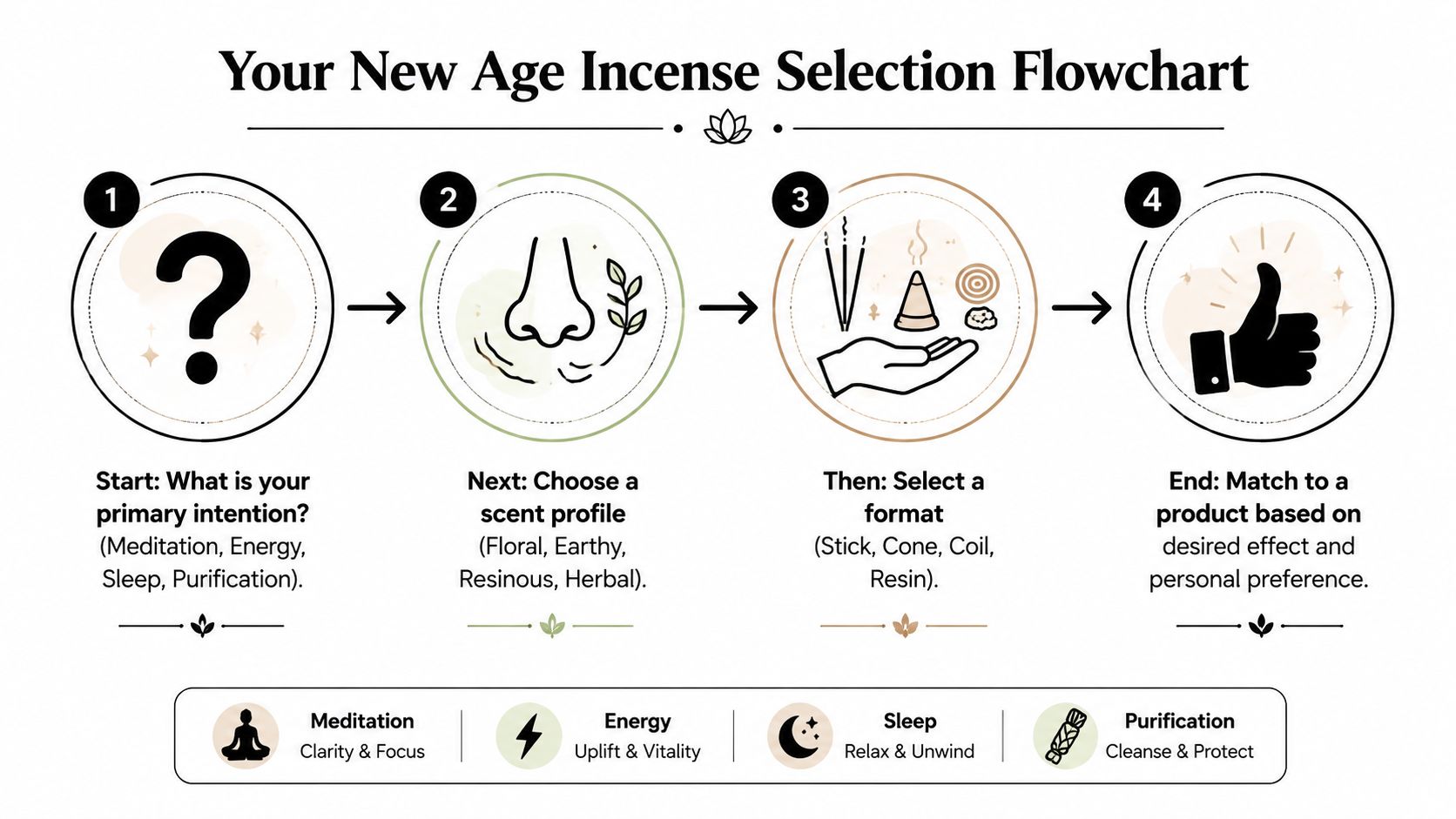
Start with the purpose, then choose the scent, and only after that select the format. A label that says “meditation” won't tell you whether the aroma is woody, floral, resinous, or sharp. Your own response to the fragrance matters more than the promise printed on the front of the box.
Match intention with profile
For meditation, many people prefer sandalwood, cedar, patchouli, or vetiver because these profiles feel warm, earthy, and steady. For a daytime practice, citrus, eucalyptus, or lighter florals may feel more open and energetic. Lavender and chamomile can suit a softer evening routine, although no incense should be treated as a guaranteed sleep aid.
Purification is often a symbolic or spiritual intention rather than a measurable property of the smoke. If that ritual matters to you, choose a product whose scent and cultural context you understand, and burn it with enough ventilation to keep the practice comfortable. Ingredient transparency is more useful than a dramatic claim about cleansing power.
Use these three buying criteria as your baseline:
Burn behavior: Look for a product that burns evenly and fits the time available for your practice.
Scent throw: Decide whether you want a discreet background aroma, a noticeable fragrance, or the dense character of heated resin.
Ingredient transparency: Prefer labels that explain the base, fragrance materials, and recommended use rather than relying only on words such as “pure” or “high vibration.”
Sticks are convenient for casual rituals and ambient scenting. Cones offer a compact format for a focused session, but their concentrated burn can feel stronger in a small room. Resins provide ceremonial depth and require more equipment, while crafted traditional sticks may appeal to buyers who want subtle fragrance and material appreciation.
The global category is commercially significant, though market estimates differ by methodology. One industry summary placed the worldwide incense market at USD 3.6 billion in 2023, with a projected 5.2% CAGR from 2024 to 2032, while other estimates placed the market above USD 3.69 billion in 2024 and projected it above USD 5.51 billion by 2030. A separate forecast estimated USD 12.4 billion in 2024 and USD 23.4 billion by 2032. These differences show why readers should treat market figures as estimates, but the broader direction remains clear in this global incense market overview. New age incense is both a meaningful personal tool and a serious retail category, provided sellers and users pair its symbolism with honest materials information and sensible airflow.
Aroma Warehouse offers incense sticks, cones, wooden burners, ash catchers, fragrance oils, and bulk supplies for home users, wellness studios, retailers, and resellers. Visit Save on Scents Incense to compare scent families and formats, choose suitable accessories, and source products for a thoughtful new age incense collection.


