

Best Coconut Fragrance Oil: A Buyer's Guide

You've found a coconut fragrance oil that sounds perfect for your next candle collection: creamy coconut milk, soft sweetness, beach-house warmth. The bottle smells convincing, but you still don't know whether that character will survive hot wax, stay balanced in a diffuser, or work in the soap you sell. Buy for the finished product, not the bottle. That's the difference between a pleasant sample and a dependable wholesale ingredient.
Table of Contents
Why Picking a Coconut Fragrance Oil Is Harder Than It Looks - Start With the Product You're Selling - Strength Isn't the Whole Purchase
What Coconut Actually Smells Like at the Chemical Level - Look for Creaminess With Definition - Ask Better Chemistry Questions
Comparing the Four Coconut Profiles Worth Buying - Choose a Workhorse and a Contrast - Keep Fresh and Dessert Profiles Separate
Matching the Oil to Your Candle, Soap, or Diffuser Base - Candles Need Their Own Approval - Soap, Diffusers, and Incense Require Different Tests
Dilution Rates and Blending Recipes That Actually Work - Build the Batch Sheet Before the Blend - Practical Blend Briefs for Your Bench
Reading Labels, IFRA Conformity, and Safety Documentation - Read Each Document for Its Actual Job - Keep Merchandising Separate From Compliance
Storage, Testing, and Working with a Wholesale Supplier - Protect a Reference and Compare New Lots - Buy Bulk Only After Approval
Frequently Asked Questions About Coconut Fragrance Oils - Is Coconut Fragrance Oil the Same as Coconut Essential Oil? - Is It Skin-Safe by Default? - Why Does My Coconut Candle Smell Weak? - Does Cloudiness Mean the Oil Has Gone Bad? - Which Profile Should I Try First?
Why Picking a Coconut Fragrance Oil Is Harder Than It Looks
A shop owner choosing a coconut scent has two decisions to make: what customers should smell and how the product should perform. Those decisions overlap, but they aren't interchangeable. A lotion-style coconut might suit a beach-themed gift display while feeling too rich for a yoga studio's room scent.
The common mistake is approving an oil immediately after smelling it neat. That test tells you whether you like its opening, not whether it belongs in your production base. Treat the bottle as an audition, not a purchase order.
Start With the Product You're Selling
Before comparing suppliers, write down the application and the result you want. For a candle, that might be a recognizable creamy coconut during burning. For incense, it might be a coconut character that remains pleasant after heating rather than smelling sweet on an unlit stick.
Use a buying specification instead of a loose scent description:
Application: Name the exact wax, soap base, diffuser system, or incense blank.
Scent direction: Decide whether customers should perceive fresh coconut, sunscreen-style creaminess, toasted coconut, or dessert.
Acceptance criteria: Define what would make you reject the sample, such as separation, an unpleasant residual odor, or poor performance during use.
Supplier evidence: Ask for application guidance and safety documentation before ordering production quantities.
This approach also prevents an expensive assortment mistake. A retailer doesn't need several nearly identical coconut oils just because their catalog descriptions differ. Buy distinct profiles with distinct jobs.
Strength Isn't the Whole Purchase
My recommendation is straightforward: choose the best coconut fragrance oil for your base, then judge its strength. Don't reverse that order.
A concentrated first impression can distract you from an uneven scent development or an unsuitable formula. Conversely, a restrained sample deserves a proper application test before you dismiss it.
Buying rule: An oil earns a place in your range when you can reproduce a finished product you're comfortable selling.
Price matters after that decision. Compare the cost of a usable, documented formulation, not merely the price of a bottle that smells impressive.
What Coconut Actually Smells Like at the Chemical Level
Coconut isn't a single generic aroma. A 2020 study identified 44 aroma compounds from 5 grams of extra-virgin coconut oil, with 50 volatile compounds detected across its analytical methods, according to the coconut aroma research published in npj Science of Food. The practical lesson is that a convincing coconut fragrance needs balance, not just intensity.
Look for Creaminess With Definition
Delta-lactones, particularly delta-octalactone and delta-decalactone, are important contributors to coconut's familiar creamy character. Supporting compounds can introduce sweetness, freshness, fruitiness, and other nuances. You don't need to identify individual molecules by smell, but you do need vocabulary more useful than strong or weak.
Use the following visual as a scent map rather than a formula specification.
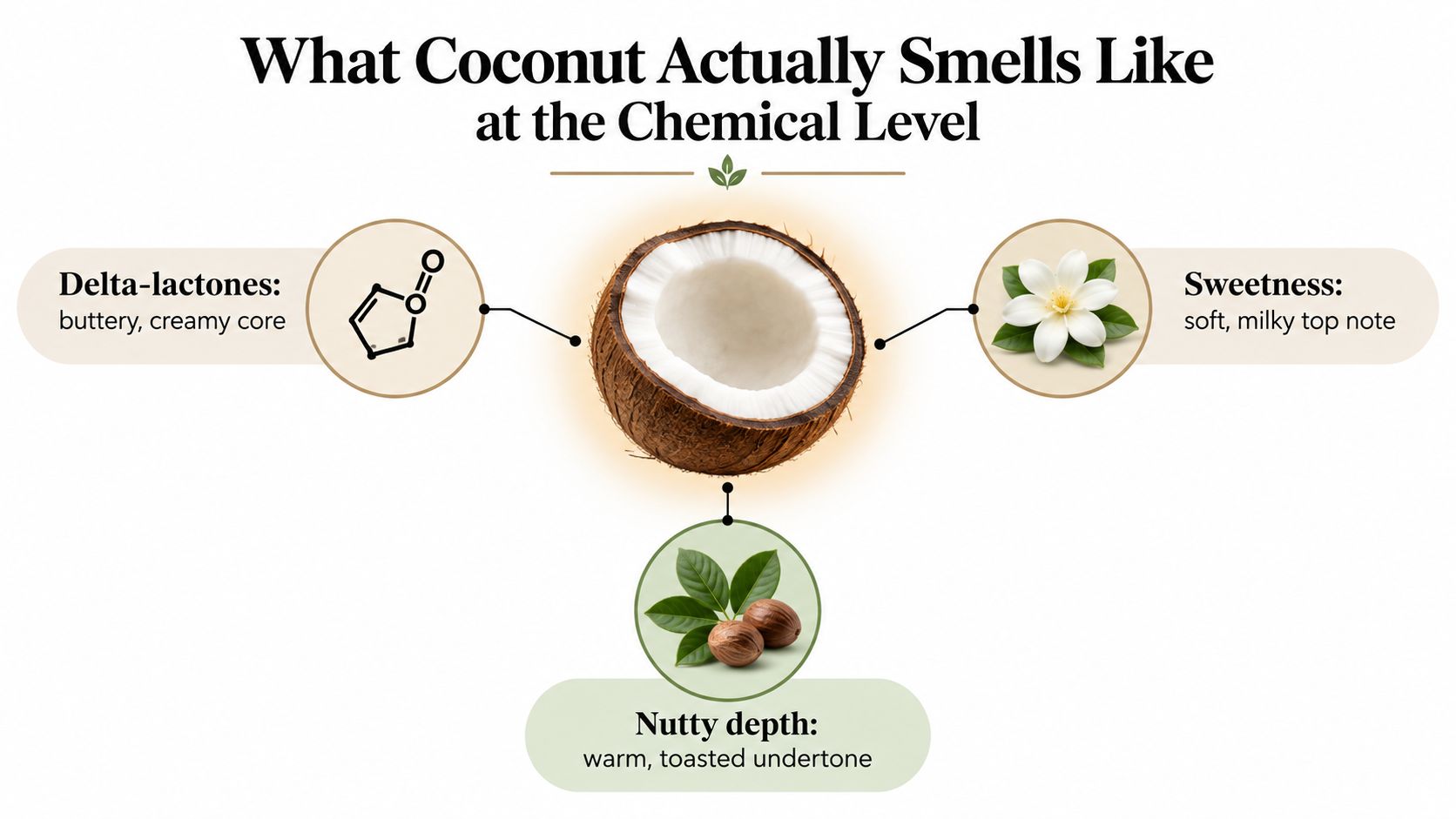
When evaluating a sample, separate its facets:
Creamy core: Look for a rounded, milky coconut identity rather than sweetness alone.
Freshness: Decide whether fruity or green accents support your intended product.
Residual character: Reject a dominant sour, rancid, solvent-like, or plasticky impression.
Overall balance: Ask whether you still recognize coconut after the brightest opening notes fade.
The research describes coconut-derived materials, not the composition of every commercially sold fragrance oil. A product label doesn't prove that a supplier's formula contains a particular lactone or follows a particular analytical profile.
Ask Better Chemistry Questions
Request an SDS, and ask whether a certificate of analysis or GC-MS profile is available. Use those documents to understand the material and its consistency, not as substitutes for evaluating the finished product.
Also separate fragrance terminology from botanical terminology. The guide to fragrance oils and essential oils provides useful background for that purchasing conversation.
My benchmark is a smooth creamy drydown with enough definition to remain recognizably coconut. A louder but rougher formula isn't an upgrade.
Comparing the Four Coconut Profiles Worth Buying
For a practical retail assortment, I'd compare creamy beach coconut, toasted coconut, coconut water, and vanilla-coconut gourmand. These are buying categories, not standardized chemical specifications. The recommendations below describe where I'd start testing, not guaranteed compatibility.
Coconut fragrance oil profiles at a glance
Profile | Best For | Watch Out For |
|---|---|---|
Core candle lines, beach-themed soap, comforting room scent | A sunscreen association that may not suit a clean or minimalist range | |
Warm candles, seasonal gifts, richer bath concepts | Roasted sweetness overwhelming the coconut character | |
Fresh diffuser and room-spray concepts, lighter soap scents | A bright opening without enough recognizable residual coconut | |
Dessert candles, indulgent soap and gift collections | Excessive sweetness and formula-specific color changes |
Choose a Workhorse and a Contrast
Creamy beach coconut would be my first sample for a general-purpose coconut line. It gives you a clear reference point for judging other profiles. Test it in candles and melt-and-pour soap first, but require separate cold-process evidence before treating it as a soapmaking workhorse.
For a warmer collection, compare that creamy sample with toasted coconut. I would position toasted coconut around comfort and roasted depth rather than beach imagery. In incense, judge whether the heated result preserves that distinction or becomes a heavy sweet scent.
The visual below offers another way to organize coconut scents by character and merchandising direction.
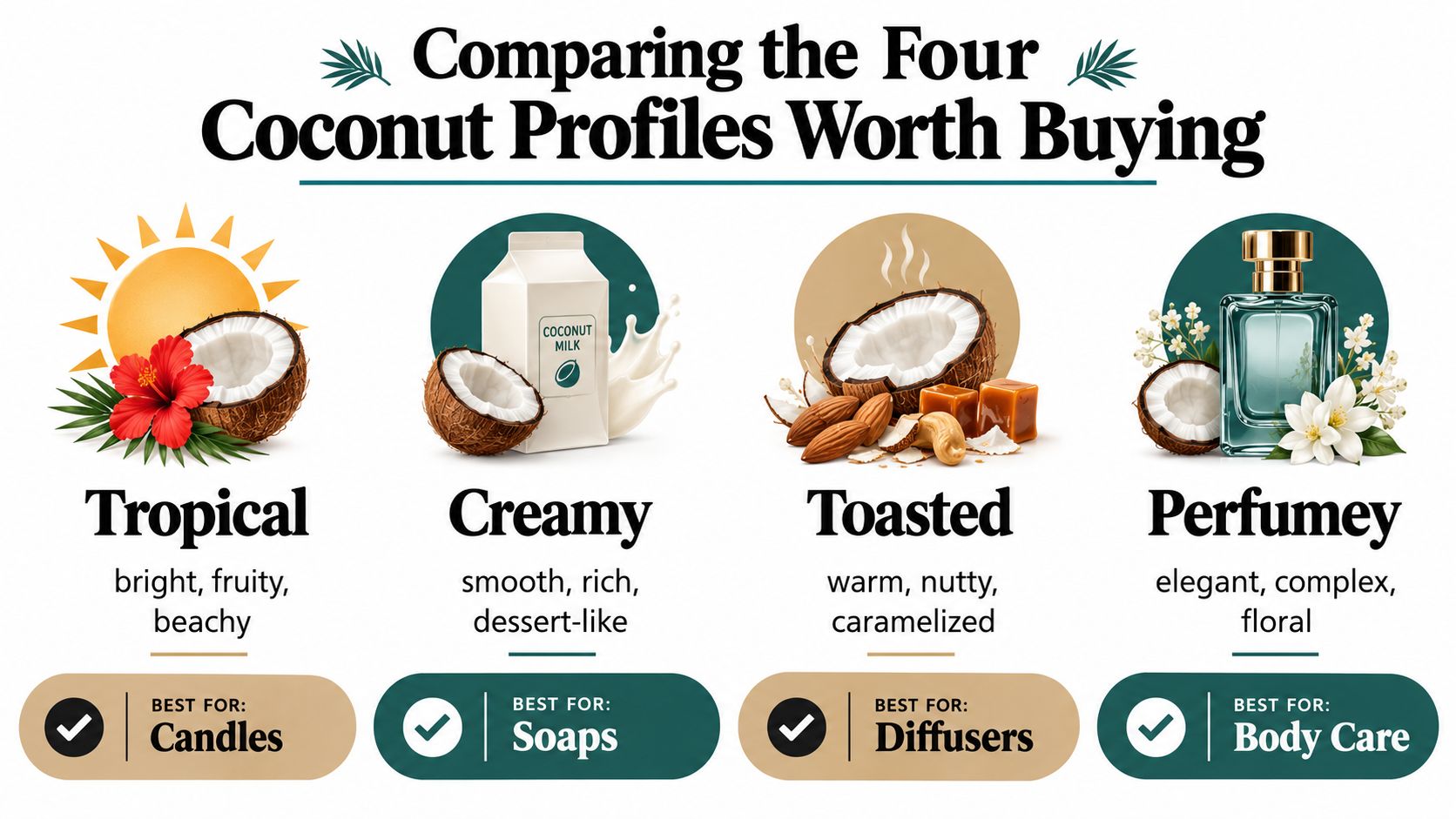
Keep Fresh and Dessert Profiles Separate
For diffusers and room sprays, coconut water is my starting recommendation when the brief is airy rather than indulgent. Evaluate whether the fresh accents still leave a coconut identity. Don't approve it solely because the first spray smells lively.
Vanilla-coconut gourmand belongs in a deliberately sweet range. I'd test it for dessert candles and bath gifts, then check whether customers perceive coconut or mostly vanilla. Cold-process soap still needs its own trial, and diffuser use needs its own compatibility check.
There's a commercial reason to consider coconut beyond beach season: NielsenIQ reported coconut up 152.1% in its tracked U.S. fragrance data for the 52 weeks ending February 22, 2025, in its U.S. fragrance-category overview. That isn't a forecast for your store or proof of demand for every coconut variant.
Start with contrasting samples, then let finished-product tests and actual customer purchases determine the assortment.
Matching the Oil to Your Candle, Soap, or Diffuser Base
Application approval comes before formulation. A supplier's recommendation for an oil warmer doesn't establish suitability for cold-process soap, a reed diffuser, or a burning incense stick. Use the fragrance-oil uses guide to frame your questions, then obtain guidance for the specific oil.
Keep the finished product in view while making that decision.
Candles Need Their Own Approval
For soy, paraffin, coconut, and blended waxes, request the wax manufacturer's fragrance guidance and the oil supplier's candle-use documentation. Don't apply the loading or processing instructions from one wax to another. For gel wax, obtain explicit compatibility guidance rather than treating it like conventional wax.
Don't use flash point as a shortcut for mixing temperature. Ask what the SDS entry means for handling, and follow the wax supplier's processing instructions for the formulation. Record wax, wick, vessel, fragrance addition, and curing conditions so you can interpret the result.
Compare unlit scent with scent during burning. For retail presentation ideas, Cedar & Lily Clothier's scented candles set resource can help frame a coordinated collection, but styling inspiration isn't evidence of fragrance compatibility.
Soap, Diffusers, and Incense Require Different Tests
For soap, ask specifically about cold-process behavior and melt-and-pour suitability. Record changes in working time, texture, color, and scent through the relevant production cycle. Don't infer soap performance from a successful candle.
For diffusion and incense, use an application checklist:
Reed diffusers: Obtain guidance for the complete fragrance-and-carrier system, including DPG or IPM where specified.
Electric diffusers: Follow the device manufacturer's material requirements instead of assuming all fragrance oils are interchangeable.
Room sprays: Require a stable formulation appropriate for spraying, not merely a pleasant diluted scent.
Incense: Check absorption, surface wetness, discoloration, and burn interference in the actual blank.
For a visual supplement to your bench work, use the video below alongside written supplier instructions.
My recommendation is to approve each application independently. If the supplier can't support your intended use, choose another candidate rather than trying to make an undocumented oil fit.
Dilution Rates and Blending Recipes That Actually Work
There isn't a responsible universal coconut fragrance percentage for candles, soap, diffusers, room sprays, and incense. The usable rate must come from the specific formula's documentation and the base manufacturer's instructions. A generic recipe can't establish that those limits agree.
Weigh your materials instead of counting drops. Keep the calculation basis explicit: a rate expressed against base weight isn't interchangeable with a rate expressed against total finished-product weight.
Build the Batch Sheet Before the Blend
Use the supplier's documented rate to calculate fragrance mass for your chosen batch. Then record the carrier or base mass, total finished mass, fragrance identity, lot, and intended application. If the instructions don't state the calculation basis, resolve that before pouring.
For candles, the guide to blending fragrance oils for candles is a useful starting point for organizing blend trials. Don't assume that combining separately documented oils automatically produces a documented finished blend.
Essentia Perfume's concentration guide offers context for fragrance-strength terminology. Use it for that purpose, not to set soap, candle, or diffuser loading rates.
Practical Blend Briefs for Your Bench
These are development directions, not validated formulas. Obtain approved usage guidance before turning them into production recipes.
Creamy beach candle: Start with a documented creamy coconut oil in your selected wax. Evaluate it alone before adding any supporting fragrance, so you can tell whether a later change improves the candle or obscures coconut.
For the other applications, use a deliberately different brief:
Toasted coconut-vanilla soap: Ask for a preblended, soap-documented option first. Compare its coconut identity and finished color against your packaging concept before developing a custom blend.
Coconut water room spray: Start with a spray-approved fragrance and compatible base. Evaluate clarity, separation, spray behavior, and residual scent rather than treating fresh-smelling fragrance as a complete spray formula.
Coconut incense: Follow the blank and fragrance supplier's preparation guidance. Approve the dried and burned result, not just the freshly scented stick.
Body products: Require documentation for the intended skin-contact use before selecting a scent level.
Stay within the applicable IFRA maximum and the base manufacturer's limits. Record every recipe change, and don't mistake a maximum permitted concentration for a recommended working concentration.
The useful recipe is the one you can reproduce and support with documentation. Without that foundation, precise gram measurements would create confidence you haven't earned.
Reading Labels, IFRA Conformity, and Safety Documentation
Coconut fragrance oil isn't coconut oil, a coconut essential oil, or an automatically skin-safe cosmetic ingredient. The name describes a scent direction, not a complete ingredient identity or permission to use it on skin.
Fragrance contact allergy affects roughly 1–3% of the general population and about 16% of patients patch-tested for suspected allergic contact dermatitis, according to the European Commission's explanation of fragrance-related skin problems. Mild-smelling products still require disciplined documentation.
Read Each Document for Its Actual Job
An SDS supports handling, storage, and hazard communication. An IFRA conformity document identifies restrictions for the fragrance and relevant use categories. Neither should be treated as a blanket approval of every product you might make.
Use this checklist to organize the supplier conversation.
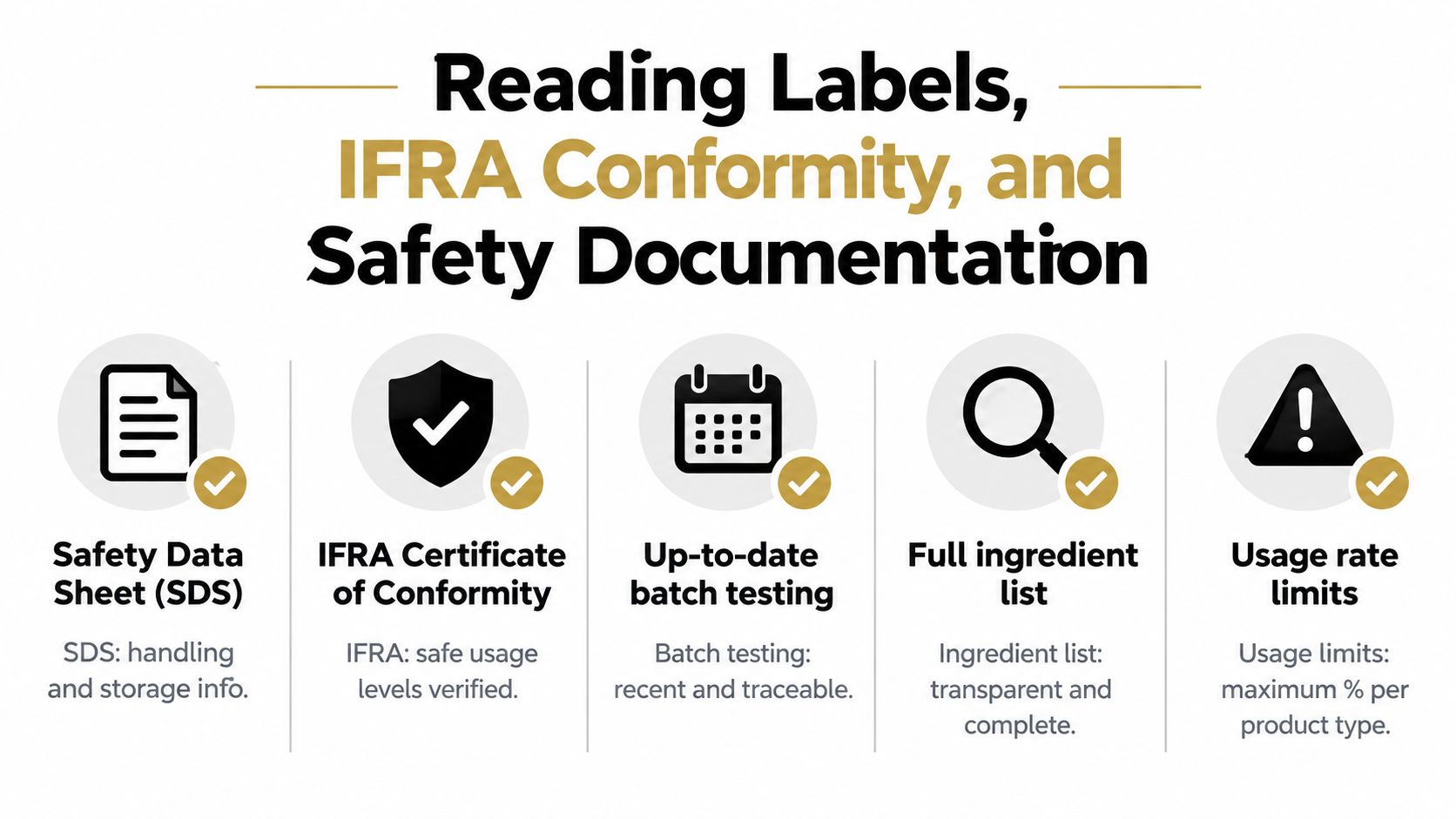
Ask for documents that match the exact product you're purchasing:
Product identity: Confirm that the name or code matches across the bottle, invoice, and documentation.
Application category: Locate your intended finished-product use rather than choosing a convenient concentration from another category.
Allergen information: Request relevant disclosures and check the requirements for your sales market.
Traceability: Keep the lot identifier and document revision with the production record.
A full proprietary fragrance formula may not be available. That doesn't excuse missing use restrictions or inadequate hazard information.
Keep Merchandising Separate From Compliance
The fragrance-labeling requirements guide can help organize your labeling questions. Your finished product still needs its own review for its composition, use, and sales destination.
Avoid blanket claims such as natural, hypoallergenic, or skin-safe unless you have appropriate substantiation. Coconut association alone doesn't establish either coconut allergy or freedom from fragrance sensitivity.
Order gate: If you can't identify the fragrance, its intended-use restrictions, and its lot, it isn't ready for wholesale production.
Storage, Testing, and Working with a Wholesale Supplier
A good wholesale relationship gives you more than replenishment. You need a supplier who can connect the sample you approved with the lot you receive, explain storage requirements, and answer application questions before you scale production.
Fresh-pour service is useful, but ask what freshness refers to. A recent bottling date doesn't, by itself, tell you the age or storage history of the bulk fragrance.
Protect a Reference and Compare New Lots
Follow the supplier's storage instructions. Ask whether amber glass or another light-protective container is recommended, keep closures secure, and avoid choosing storage temperatures by guesswork.
Retain a sealed reference sample and compare incoming lots for blotter scent, dilution stability, color, and application performance after 24–72 hours, a practical evaluation approach supported by the coconut aroma and quality-control reference. Log viscosity changes as observations rather than declaring them proof of deterioration.
For persistence testing, use equal concentrations and equal amounts, recording intensity at 0, 15, 60, and 240 minutes, then assessing the residual scent the next day, as outlined in the coconut aroma persistence reference. Keep the test conditions consistent enough to make the comparison meaningful.
Buy Bulk Only After Approval
Use the guide to buying fragrance oils for candles to organize supplier comparisons. Include domestic retailers, specialist candle suppliers, and fragrance houses according to the support your product needs.
Before committing, confirm:
Documentation access: Obtain the relevant SDS and IFRA information.
Sample continuity: Ask how the trial sample relates to the production lot.
Commercial terms: Clarify bulk sizes, shipping, returns, and business-license requirements.
Private-label scope: Establish whether the service covers packaging supplies, repackaging, or finished products.
Approve the oil first, then purchase inventory around a demonstrated need. A large bottle doesn't solve an uncertain formulation.
Frequently Asked Questions About Coconut Fragrance Oils
1. How can retailers choose coconut fragrance oils for different customer preferences?
Retailers can build a more versatile fragrance selection by offering contrasting scent profiles, such as fresh tropical coconut, creamy coconut milk, toasted coconut, and sweet coconut vanilla. Reviewing customer feedback and sales by scent category can help determine which profiles deserve repeat orders and which are better suited to seasonal collections.
What should businesses compare when choosing a wholesale coconut fragrance oil supplier?
Compare product consistency, available bottle sizes, minimum order requirements, shipping costs, documentation access, and the supplier's ability to identify product lots. Request samples before placing a bulk order, and confirm that the documentation matches the exact fragrance and intended application.
How can small businesses manage coconut fragrance oil inventory without overstocking?
Start with small sample quantities and test a limited selection of distinct coconut profiles. Track sales, production usage, reorder frequency, and remaining inventory before committing to larger quantities. This approach helps businesses identify dependable sellers while reducing the risk of tying up cash in slow-moving fragrances.
Can coconut fragrance oil be combined with other fragrance families to create new scent profiles?
Yes, compatible fragrance oils can be evaluated in small test blends to develop combinations such as coconut and citrus, coconut and sandalwood, or coconut and floral notes. Test each blend in the intended product base, follow applicable usage restrictions, and document the proportions so successful results can be reproduced.
What information should businesses keep when reordering a coconut fragrance oil they have already approved?
Maintain the supplier's product name or code, lot number, purchase date, sample approval notes, applicable safety documents, formulation records, and finished-product test results. Comparing new deliveries with a retained reference sample can help identify differences before the fragrance enters production.
Is Coconut Fragrance Oil the Same as Coconut Essential Oil?
No. Don't treat those names as interchangeable. Ask what the supplier is selling and use the ingredient identity and documentation, not the coconut wording, to make your decision.
Is It Skin-Safe by Default?
No. Check the specific skin-contact application and permitted use level. Candle or room-fragrance suitability doesn't establish permission to use an oil in lotion, bath products, or soap.
Why Does My Coconut Candle Smell Weak?
Separate the fragrance question from the candle-system question. Review wax, wick, vessel, processing, and cure records before changing the fragrance load. Compare the finished candle against your approved trial rather than judging from the bottle.
Does Cloudiness Mean the Oil Has Gone Bad?
Not necessarily. Compare it with the retained reference and supplier specification. Record changes in appearance and odor, quarantine unexplained deviations, and ask the supplier to investigate before using the material.
Which Profile Should I Try First?
Start with creamy coconut for a core range or coconut water for a fresh room-scent concept. Make the final choice from application tests, not those profile names alone.
Aroma Warehouse offers coconut-scented fragrance oils poured fresh to order, along with DPG, unscented incense sticks, and packaging supplies for retail and wholesale buyers. Visit Fragrance Warehouse to compare options, then request the specific oil's documentation and application guidance before placing your production order.


