

Patchouli Fragrance Oil: The Best Buying Guide for 2026

You're standing at a shelf or a supplier portal with two patchouli options and no clean way to compare them. One says earthy and authentic, the other says candle-safe and blended for consistency, and both sound plausible until you've had to explain the difference to a customer, a buyer, or your own workshop class.
Patchouli fragrance oil is one of those ingredients that looks simple until you stock it. The scent has a long commercial history, real sourcing differences, and enough batch variation to make a bad buy obvious after the fact. Retailers, resellers, and home users all run into the same problem: they need patchouli to smell right, perform well, and fit the product they're making, not just the romantic idea of patchouli. For a clear primer on how fragrance oils differ from essential oils, this overview of fragrance oils and essential oils is a useful starting point.
Table of Contents
What Patchouli Fragrance Oil Actually Is - The real-world scent profile - Essential oil versus fragrance oil
Where Patchouli Oil Comes From and How It Is Made - Why curing changes the scent - Why production style matters commercially
The Chemistry Behind the Scent - What the major constituents do - How perfumers position patchouli
Practical Uses Across Diffusers, Candles, Soap, and Incense - How I'd approach each format
Blending Patchouli With Other Oils - Building accords that actually sell - What to expect in retail
Safe Dilution Rates for Skin, Candles, and Home Fragrance - Choosing the right dose
Quality Indicators, Storage, and Wholesale Sourcing - What separates a good lot from a dud - Storage and buying signals
What Patchouli Fragrance Oil Actually Is
The first mistake people make is treating patchouli like one thing. In trade, patchouli fragrance oil can mean a true distilled oil from the plant, a fragrance composition built to mimic patchouli's profile, or a patchouli-forward blend designed for candles, soap, and diffusers. If you're buying for resale, that distinction affects label language, price expectations, and how much scent carry you can promise without overclaiming.
The real-world scent profile
Patchouli earns its reputation because the note is unmistakable. It usually reads as deep, earthy, woody, and slightly sweet, with a dry, lingering finish that can anchor a blend long after the top notes fade. That drydown is why it shows up so often in perfumes, incense, and base-heavy home fragrance products.
The tricky part is customer expectation. Some shoppers want the old-school, heavy, almost dusty character they remember. Others want a cleaner, smoother version that feels wearable in a modern fragrance. If you don't know which version you're buying, you'll end up with customer returns or a stock line that sits.
Essential oil versus fragrance oil
A distilled patchouli essential oil comes from the plant itself, while a fragrance oil is engineered to perform in a chosen product type. That matters because wax, soap, and diffuser bases all punish weak formulas fast. A good fragrance house may rebuild the patchouli effect with isolates and aroma materials so the scent stays stable and repeatable batch after batch.
Practical rule: if the customer needs a botanical story, ask for the exact material type. If the customer needs consistent performance in a candle or diffuser, judge the oil on that outcome, not on the romance of the label.
For sellers, that means the right question is never just “Does it smell like patchouli?” It's “Does it smell like the patchouli my customer expects in the actual product I'm making?”
Where Patchouli Oil Comes From and How It Is Made
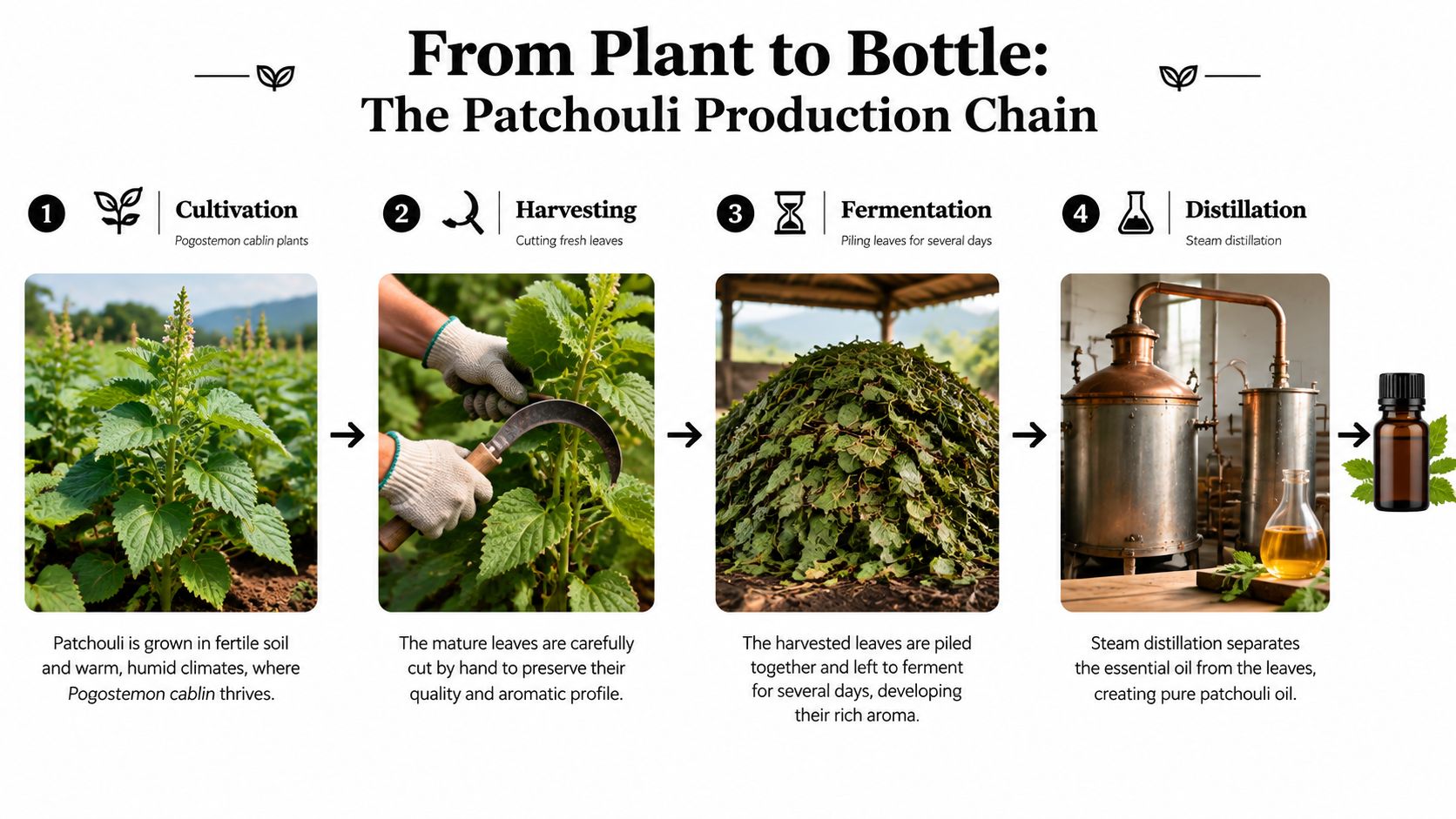
Patchouli starts in the field, not the bottle. Pogostemon cablin is grown commercially in places such as Indonesia, India, and China, and the leaf handling matters more than new buyers usually realize. Fresh green leaves don't give you the same character as leaves that have been handled the traditional way before distillation.
Why curing changes the scent
Growers typically harvest the leaves, let them wilt or partially dry, and then distill them. That extra handling shifts the aroma away from sharp green herbaceousness and toward the dark, earthy character people buy patchouli for. In other words, the “dirtier” tone isn't a flaw, it's part of the signature.
Steam distillation is the standard extraction method. The plant material goes into stills, steam carries the volatile compounds out, and the condensed oil separates from the water phase. When the leaves are properly prepared, the resulting oil usually has a deeper, rounder scent than something made from rushed or poorly handled material.
Why production style matters commercially
That same logic is why fragrance houses sometimes rebuild patchouli accords rather than relying on one source lot. They may use patchoulol-rich fractions, isomers, and other aroma materials to make a formula that behaves the same in thousands of units, which is valuable when a retailer can't afford scent drift across batches.
If you stock patchouli products, the production story should influence how you sell them. A customer buying an incense blend may enjoy a heavier, older-style profile, while a candle maker usually needs a cleaner, more reliable version that won't surprise them after pouring.
The Chemistry Behind the Scent
Patchouli doesn't smell the way it does by accident. The oil is dominated by sesquiterpenes, and patchoulol, also called patchouli alcohol, is the core marker most suppliers talk about. One industry reference notes patchoulol commonly sits around 25 to 40 percent of the oil, and sometimes around 27 to 35 percent depending on origin, harvest timing, and distillation method, while another commercial benchmark points to an ISO-based quality expectation of about 30 percent patchoulol for commercial grade oil. Patchouli perfumery base note details and commercial patchouli quality guidance both underline why buyers focus on this marker.
What the major constituents do
Patchoulol gives the oil structure and tenacity, but it doesn't work alone. Supporting molecules such as alpha-bulnesene, beta-patchoulene, alpha-guaiene, norpatchoulenol, and pogostol shape whether the oil reads woody, sweet, cellar-like, or more polished on the blotter. Two oils with similar analytical reports can still smell different because trace constituents and oxidation shift how the whole accord lands.
That's where buyers get tripped up. A GC profile can look acceptable, but the drydown may still feel flat, overly camphoraceous, or oddly muddy. In retail terms, that usually means the oil will either disappear too quickly in a blend or dominate in a way customers describe as harsh.
How perfumers position patchouli
Patchouli sits comfortably in woody, oriental, chypre, and modern amber structures. Classic versions lean vintage, earthy, and dense. More recent blends often smooth the rough edges so the note feels cleaner, more wearable, and less tied to the old stereotype of a single “hippie scent.”
Constituent | Typical Range (%) | Sensory Contribution |
|---|---|---|
Patchoulol | 25 to 40, sometimes around 27 to 35 | Woody backbone, fixative strength, long drydown |
Alpha-bulnesene | Variable, minor constituent | Dry woody lift |
Beta-patchoulene | Variable, minor constituent | Earthy depth |
Alpha-guaiene | Variable, minor constituent | Dark herbal-woody nuance |
Norpatchoulenol | Variable, trace constituent | Disproportionate effect on earthy profile |
Pogostol | Variable, minor constituent | Helps round the base and support texture |
Perfumers often pair patchouli with oud, sandalwood, vetiver, and labdanum for depth, then brighten modern versions with citrus, floral, or fruit top notes. For a retailer, that's a merchandising decision as much as a scent decision. A customer browsing vintage-style patchouli isn't usually looking for the same thing as someone drawn to a polished contemporary amber.
A lot of “bad patchouli” complaints are really blend-context complaints. The oil wasn't always wrong, it was just placed in the wrong architecture.
Practical Uses Across Diffusers, Candles, Soap, and Incense
Patchouli behaves differently depending on the base, and that's where many DIY formulas go wrong. In diffusers, it can take over if you pour with a heavy hand. In candles, it often throws beautifully, but in white wax it may discolor more than lighter notes do. In soap, it tends to hang on through saponification better than fragile top notes, which is why makers rely on it for earthy masculine and unisex bars.
How I'd approach each format
For a diffuser, start modestly. Patchouli has enough presence that a small amount can ground an entire blend without making the room feel crowded. That makes it useful for home fragrance buyers who want a calm, weighted aroma rather than something bright and fleeting.
In candles, patchouli tends to work best as a base note rather than the whole show. It supports woods, resins, vanilla, and amber-style accords well, and it gives a finished candle more body. For soap, the oil earns its keep by staying noticeable after cure, especially when the formula needs a scent that doesn't vanish under lye.
Incense makers know the note from a different angle. Patchouli has long been used to deepen resin blends and add a grounded finish to charcoal-disc or stick formats. If you're selling to smoke-shop, botanica, or meditation customers, that association still matters.
Practical rule: patchouli is strongest when it's asked to support a blend, not carry every product on its own.
If you're building a product line, practical sourcing starts to matter. Aroma Warehouse carries patchouli fragrance oil alongside other home fragrance materials, which makes it easier to compare it against your candle, diffuser, or incense base choices in one place. For a related usage overview, their candle and diffuser guidance is aligned with how this material gets used in retail products.
Blending Patchouli With Other Oils
Patchouli works best when you treat it like a base note with attitude. It can support a blend, soften a sharp edge, or make a thin formula feel finished, but it usually needs partners. The wrong partner makes it muddy. The right one makes it feel deliberate.
Building accords that actually sell
Top notes such as bergamot, sweet orange, and grapefruit lift patchouli's earthiness and make the opening more accessible. Middle notes like rose absolute, geranium, and lavender give the blend shape without erasing its character. Base companions, including sandalwood, vetiver, cedarwood, oud, and vanilla, reinforce the depth that patchouli already wants to give you.
Here are three ready-to-use directions that are practical for testing and small-batch sales:
Accord Name | Base Oils | Supporting Oils | Ratio |
|---|---|---|---|
Classic earthy blend | Patchouli, sandalwood | Bergamot | 50/30/20 |
Modern unisex mix | Patchouli, vetiver | Lavender, citrus | 40/30/20/10 |
Warm oriental | Patchouli, oud | Vanilla, labdanum | 40/20/25/15 |
Those ratios are starting points, not laws. Patchouli's impact changes a lot with concentration, and the same blend can swing from elegant to swampy if you rush the development stage. Let it sit for 48 to 72 hours before you judge it, because the top notes settle and the base stops feeling fragmented.
What to expect in retail
A vintage-style patchouli blend attracts a different buyer than a clean, modern one. The first group often wants depth, incense character, and familiarity. The second group wants a darker scent that still feels wearable in daily use.
For a useful companion angle on sweet base blends, this patchouli and vanilla blending guide fits especially well with modern gourmand and amber products.
If the first sniff feels too sharp, don't rewrite the formula immediately. Give the blend time, then cut or reinforce the note that's actually out of balance.
Safe Dilution Rates for Skin, Candles, and Home Fragrance
Patchouli is versatile, but it still needs the right dilution. Skin-contact products, candles, and room fragrance each ask for a different loading strategy, and the safest route is to use the supplier's SDS and IFRA documentation for the exact material in hand. A formula that works in a diffuser can be too strong for leave-on skin use.
Choosing the right dose
For leave-on skin products, keep dilution conservative and follow supplier guidance closely. For rinse-off products, the same basic rule applies, but the tolerance is usually higher because the contact time is shorter. For candles, patchouli's tenacity means you can often work with a lower dose than you might use for lighter notes and still get a solid throw.
For reed diffusers and room sprays, patchouli can help anchor brighter notes without needing to dominate the formula. That makes it a good support note for home fragrance ranges aimed at people who like grounded, moody profiles. If you're mixing carrier-based skin products, the right base oil matters too, and this carrier oil guide for skin use is worth checking before you bottle anything for body application.
Product Type | Recommended Dilution | Notes |
|---|---|---|
Leave-on skin product | Follow supplier and IFRA guidance closely | Patchouli can be persistent, so test low first |
Rinse-off product | Follow supplier and IFRA guidance closely | Shorter contact time gives more room, but don't guess |
Candle | Use lower loadings if throw is strong | Patchouli often performs well as a base note |
Reed diffuser | Keep balanced with lighter notes | Can become heavy if overused |
Room spray | Use sparingly and test on surfaces | Strong scent can linger longer than expected |
Sensitivity is still possible, even with a familiar note. If you're selling to makers, include the SDS with the product and tell them to patch test skin formulas before launch.
Quality Indicators, Storage, and Wholesale Sourcing
Patchouli quality is easier to judge once you know what to look for. I don't start with marketing copy, because words like dark, aged, natural, or premium can mean almost anything. I start with documentation, smell, and how the oil behaves on a blotter after the initial top edge fades.
What separates a good lot from a dud
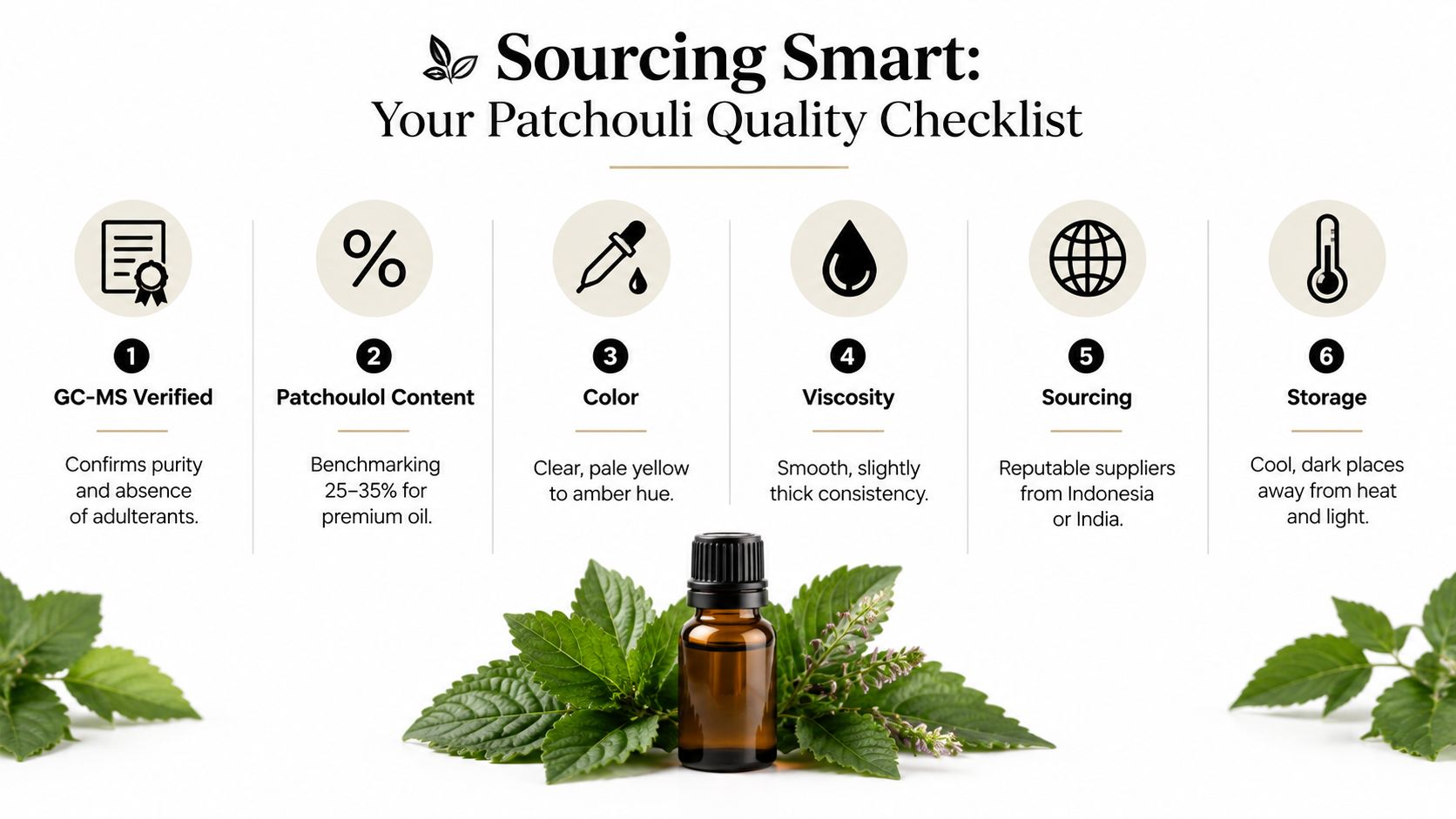
A serious supplier should be able to give you GC-MS verification, clear origin information, and a useful explanation of how the lot was handled. Patchoulol content is the headline number buyers usually check, and for commercial buying, the sweet spot is often in the 25 to 35 percent neighborhood when the rest of the profile supports the scent. Beyond that, color, viscosity, and balance matter too. A healthy oil usually looks clear and ranges from pale yellow to amber, but appearance alone won't save a weak aroma.
Different origins can smell distinct, and India, Indonesia, and China each bring their own variability to the table. That's normal. What isn't normal is a supplier who can't explain the batch differences or who treats every lot like it's identical.
Storage and buying signals
Store patchouli in amber glass, away from heat and light, and treat it like a material that rewards patience. The source brief notes a typical shelf life of 18 to 24 months when stored properly. If you're ordering wholesale, look at minimum order quantities, documentation quality, and whether the seller can explain why one lot is priced higher than another.
For more on how to screen a supplier, the product sourcing guide offers a good checklist mindset.
Watch for these signals:
Clean paperwork: The seller should provide the right safety and identity documents without hesitation.
Consistent smell on blotter: Recheck the oil after a day, not just at first sniff.
Reasonable transparency: Origin, lot handling, and material type should be clear.
Pricing that makes sense: If the price seems too low for the claimed quality, there's usually a reason.
If you're reselling, your margin depends on avoiding cheap stock that smells thin, stale, or oddly synthetic. A good patchouli lot gives you fewer complaints and a much easier story to tell at the shelf.
Bringing It All Together as a Buyer or Seller
Patchouli rewards buyers who think like operators, not romantics. The right lot has the right chemistry, the right performance in the intended format, and the right story for the customer in front of you. If you're stocking it for a shop or a resale channel, your job is to decide whether you want a vintage, earthy material, a cleaner modern patchouli profile, or a blend that uses the note as a base rather than a headline.
A practical buying checklist looks like this.
Confirm the material type: Essential oil, fragrance oil, or a patchouli accord each serves a different use.
Check the paperwork: GC-MS, SDS, and origin details should be available before you commit.
Smell it in context: Test it in wax, diffuser base, soap, or alcohol, not just on a strip.
Match the profile to the customer: Earthy and dark sells differently from smooth and refined.
Store it properly: Heat and light shorten usable life.
Buy for consistency: A repeatable scent is usually worth more than a dramatic first impression.
That approach keeps you from overbuying the wrong style of patchouli and helps you explain the product without leaning on tired stereotypes. The note isn't disappearing. It's being sold more intelligently now, and buyers who understand that will do better with it.
If you want patchouli fragrance oil, incense, and supporting blending materials from one supplier, Aroma Warehouse carries fragrance oils and aromatherapy accessories for retail and wholesale orders. Visit Aroma Warehouse to compare patchouli options, check related fragrance materials, and source the components you need for candles, diffusers, soap, or resale inventory.


