

Jumbo Incense Sticks: A Complete Wholesale Buying Guide
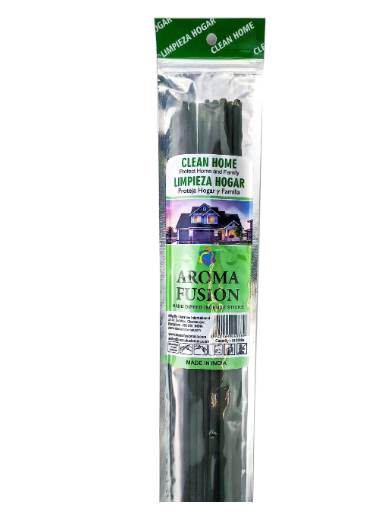
You're at your desk comparing two wholesale catalogs. The standard incense case looks easier to store and cheaper to buy, while the jumbo option commands a higher case price but promises longer sessions and stronger room coverage. Your calculator is open because “longer burn” sounds attractive, but it doesn't tell you whether the product will earn its shelf space, survive shipping, or create avoidable customer complaints.
That's the jumbo incense sticks decision. This isn't a novelty format. It's a wholesale category with clear advantages for studios, larger rooms, gift buyers, and ritual-focused customers, along with trade-offs involving combustion, storage, freight, minimum orders, and private-label risk. The global incense sticks market was valued at about USD 2.0 billion in 2025 and is projected to reach roughly USD 3.45 billion by 2034, at a projected 6.2% CAGR, according to DataIntelo's incense sticks market report.
Table of Contents
Why Jumbo Incense Sticks Deserve a Spot in Your Catalog - Start with the customer, not the case price
What Jumbo Incense Sticks Actually Are - Compare the specifications that affect your costs - Request a sample before approving the case
Materials, Construction, and Fragrance Profiles - Fragrance load needs a realistic test
Indoor Air Quality and Burn Time Trade-Offs - Match the product to the room
Wholesale Buying and Private Label Essentials - Choose the least complicated model that fits - Vet the factory before sending the deposit
Merchandising and Marketing Tips for Retailers - Make the shelf answer three questions - Sell the ritual around the stick
Common Questions About Jumbo Incense Sticks - How should customers store jumbo incense sticks? - Will one jumbo stick scent a whole room? - Why does a jumbo stick tunnel, crack, or go out? - Does natural mean safer?
Why Jumbo Incense Sticks Deserve a Spot in Your Catalog

Jumbo incense sticks earn their place when a customer needs a longer, more consistent
burn than a standard stick provides. Yoga studios, meditation centers, treatment rooms, event planners, and customers with large living spaces often don't want staff or guests relighting incense during a session. They want one clearly positioned product that burns steadily while the room remains in use.
That use case changes the wholesale calculation. A larger stick can support longer rituals, broader scent distribution, and fewer interruptions. In a commercial setting, fewer interruptions matter. Staff can light the product, check the holder, and return to other work instead of managing repeated relighting.
Start with the customer, not the case price
Before you order, identify the space and session type the product must serve:
Wellness studios: Customers may want incense during meditation, restorative yoga, breathwork, or sound sessions.
Large rooms: A stronger format can make more sense in an open living area than several small sticks scattered around the room.
Event use: Planners and spiritual practitioners may value predictable, extended scenting during ceremonies or gatherings.
Gift retail: The unusual format gives shoppers a reason to trade up from familiar standard packs.
The margin argument is straightforward. A jumbo stick costs more to produce and ship, but that added cost also creates room for a higher retail price. Buyers aren't only paying for more material. They're paying for a different use experience, stronger shelf presence, and a format that feels substantial in a gift or wellness setting. Your price architecture still needs to reflect landed cost, packaging, freight, and retailer markup. Never assume the larger format automatically produces a better margin.
A focused wholesale assortment also fits naturally alongside broader wholesale supplies for gift shops, especially where candles, burners, oils, spiritual goods, and wellness accessories already sell together.
Wholesale rule: Don't buy jumbo sticks because they look impressive in a catalog. Buy them because a defined customer group will use the longer format often enough to justify the space and cash commitment.
The trade-offs are real. Jumbo products occupy more storage space, create more dimensional shipping exposure, and may produce a longer indoor-emission window. A good first order accounts for all three before committing to deep inventory.
What Jumbo Incense Sticks Actually Are
A retailer orders “jumbo” incense expecting a longer-burning premium item, then receives a standard stick in an oversized box. That mistake starts with the label. Jumbo, giant, and extra-long are supplier terms, not universal technical standards. One factory may use them interchangeably, while another uses them to separate length, diameter, packaging, or price tiers.
For purchasing, define the product by its construction and measurable specifications. Jumbo incense generally uses the same bamboo-core format as standard incense, with a hand-rolled or machine-rolled combustible coating around the core. The scale changes. A stick may be longer, thicker, heavier, or larger in all three dimensions.
Use the broader guide to types of incense and their formats when comparing sticks with coils, resin, powder, and joss products. That comparison helps prevent a simple format difference from being mistaken for a quality claim.
Compare the specifications that affect your costs
The word “jumbo” belongs in your product notes only after the supplier provides the finished length, coated diameter, net mass per stick, core material, and verified burn-time range. These specifications determine case packing, holder requirements, freight exposure, and the customer's actual session length.
Spec | Standard Stick | Jumbo Stick |
|---|---|---|
Core | Usually bamboo | Usually bamboo, with construction quality varying by supplier |
Coating | Smaller combustible mass | Larger combustible mass and often a wider profile |
Burn behavior | Shorter session window | Longer session window, but product-specific |
Storage | Easier to pack densely | Requires more careful case and shelf planning |
Freight | Usually lower dimensional exposure | May create higher dimensional exposure |
Holder requirement | Standard ash catcher may work | Needs a stable holder matched to the stick's length and weight |
Naming | Often more standardized within a supplier's range | Supplier terminology varies widely |
Sticks remain a major part of the broader incense category, according to the industry summary on incense-stick market structure. Treat that market context as background, not as proof that a particular jumbo format will sell in your store. Your sample performance, landed cost, and buyer use case matter more than a broad category label.
Request a sample before approving the case
A sample should answer practical questions. Does the core stay straight in a tall burner? Does the coating crack during handling? Does ash fall cleanly, or break into hot fragments? Does the fragrance remain recognizable after the stick has smoldered for a while?
Record the sample's mass, dimensions, packaging size, and actual burn behavior. Put those specifications on the purchase order. This protects you from receiving an oversized package containing an ordinary stick, and it gives you a clear basis for checking repeat production.
For wholesale buyers, the burn-time claim is a cost input, not just a selling point. Compare verified performance with the space, holder, freight, and indoor-use requirements the format creates before approving a full case.
Materials, Construction, and Fragrance Profiles
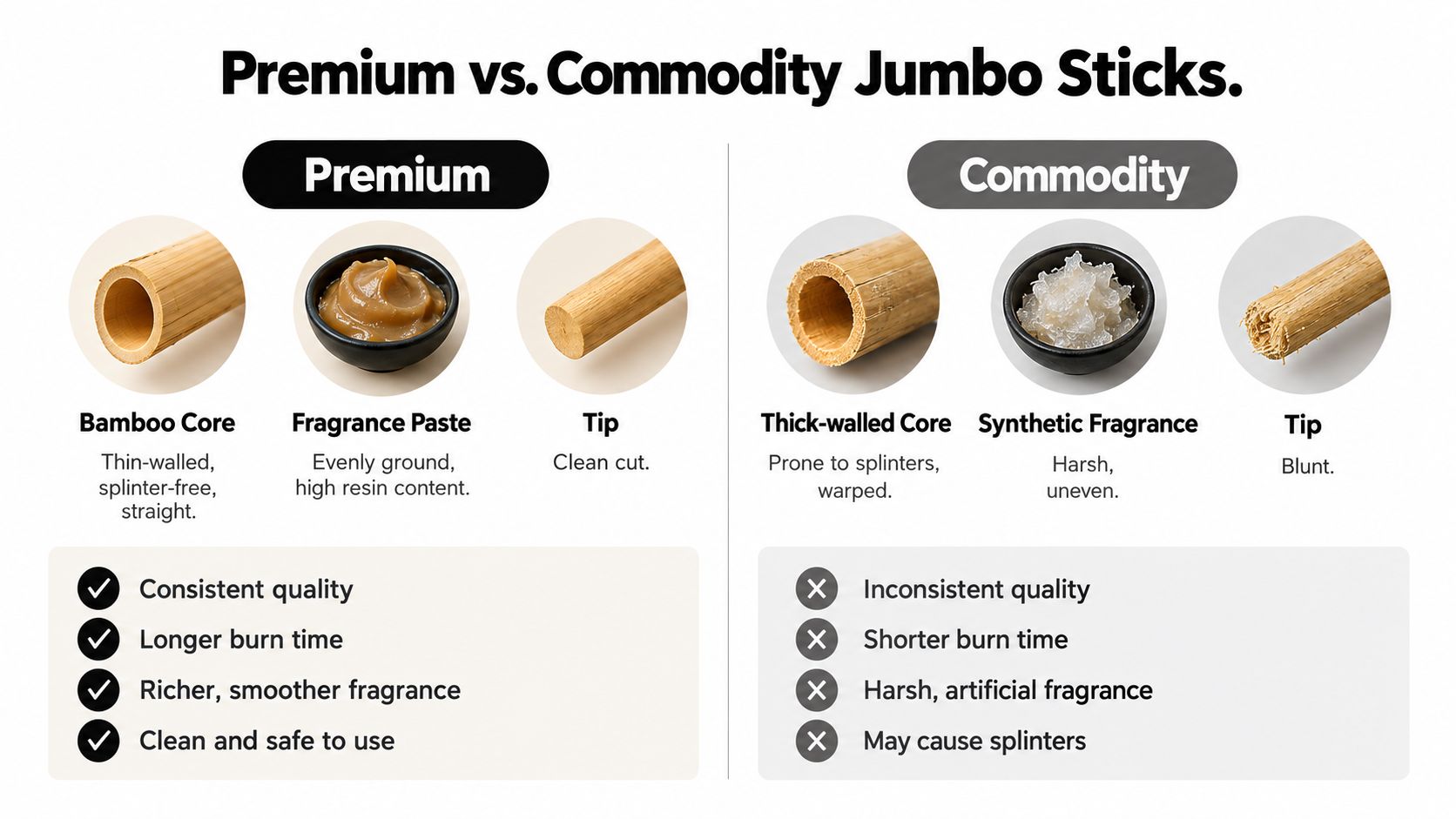
A premium jumbo stick starts with a dependable core. The bamboo should be straight, cleanly cut, and free of splinters that can catch or wobble inside a tall holder. A crooked core can create uneven airflow through the coating, while a rough end makes insertion into a burner frustrating for both retailers and customers.
The outer coating controls most of the burn experience. Manufacturers commonly combine combustible wood material with binders such as makko or charcoal-based ingredients, then add fragrance materials. The blend affects ignition, ember stability, ash texture, smoke volume, and how evenly the scent develops. A cheap coating may smell strong in the package but burn harshly or extinguish before the customer gets a complete session.
Fragrance load needs a realistic test
A larger stick contains more combustible material, but that doesn't guarantee a proportionally stronger fragrance. The coating mass can grow faster than the fragrance budget, leaving a product that burns longer without delivering the scent throw customers expect. Ask for fragrance details, but judge performance through a controlled sample burn in the type of room your customers use.
The families that usually make the most sense for wholesale testing include:
Sandalwood: Familiar, warm, and compatible with meditation and spiritual retail.
Nag champa: A recognizable incense profile with strong cultural and ritual associations.
Lavender: Easy to position in relaxation and self-care displays.
Palo santo-style blends: Useful for shoppers seeking woody, resinous profiles, though labeling must be accurate.
Frankincense and copal: Resin-led options that give a collection a more ceremonial identity.
Large rooms generally need fragrance profiles with enough body to remain noticeable after the initial ignition phase. That doesn't mean “strongest possible.” Harsh smoke and an aggressive synthetic note create returns faster than they create repeat sales.
Charcoal-based coatings can produce immediate scent impact, but smoke behavior varies by formulation. Charcoal-free options may appeal to buyers seeking a different combustion profile, yet charcoal-free does not mean emission-free. Combustion still creates particulate matter and gases, so make indoor-use guidance part of the product presentation. For a broader explanation of construction and incense categories, point staff toward this guide to good incense sticks.
How to Burn Jumbo Incense Sticks Safely
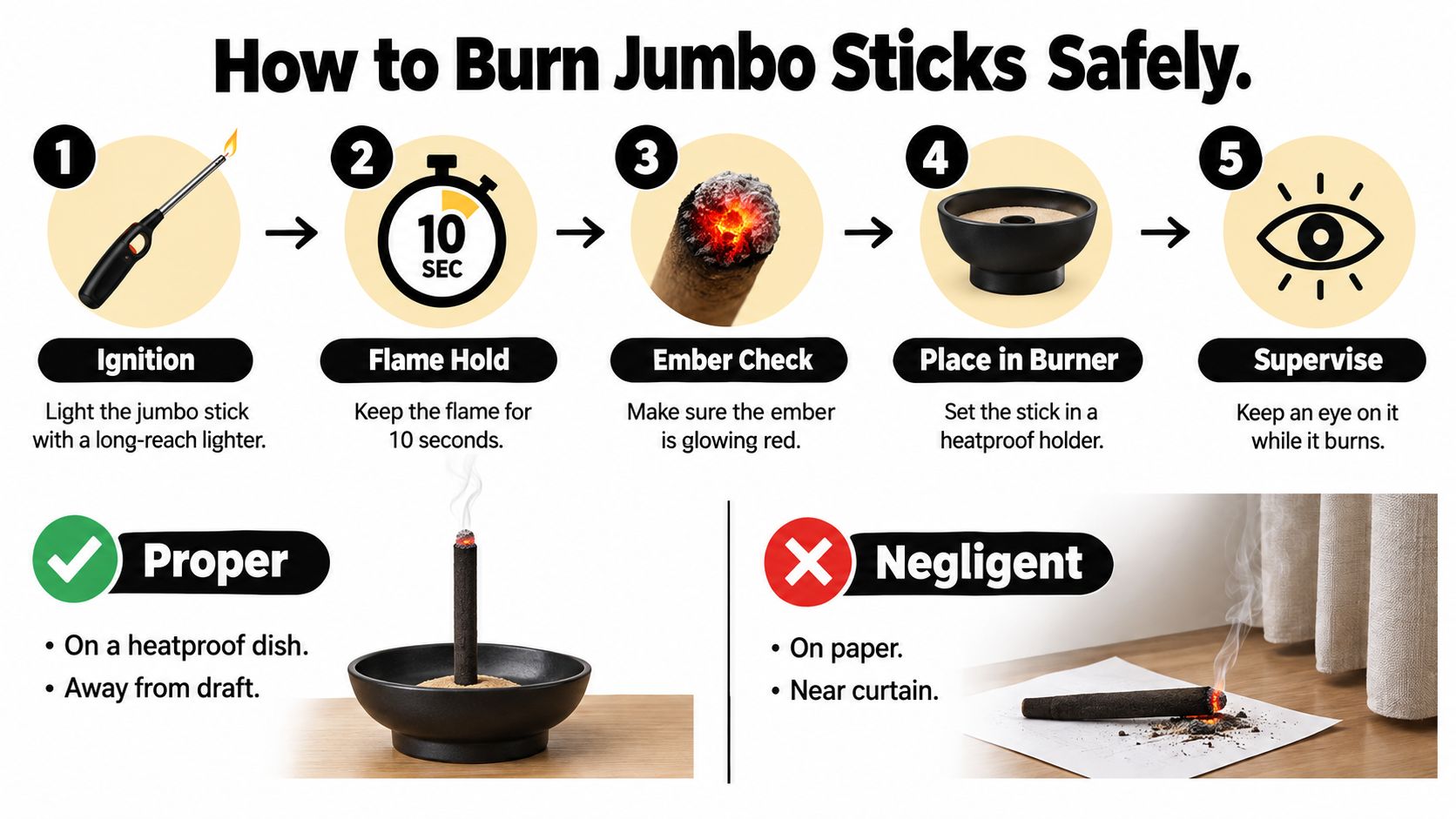
The difference between a proper burn and a negligent one is usually simple. In the proper scenario, the stick sits in a heatproof holder with the ash landing inside a tray, away from curtains, paper, pets, and drafts. In the negligent scenario, someone balances an oversized stick on a flimsy wooden block beside a textile and leaves the room.
Jumbo incense needs more deliberate handling because the stick may be longer, heavier, and active for a longer session. Retailers should explain the procedure at the point of sale rather than assume customers already understand it.
Use a long-reach lighter or a lit candle. Hold the flame to the tip until the end catches.
Keep the flame on the tip briefly. A roughly 10-second flame hold is part of the supplied safety guidance, but the ember matters more than the clock.
Check for an even red ember. Blow out the visible flame only after the tip glows consistently.
Place the stick in a heavy holder. Choose a ceramic dhoop stand, ash-catcher tray, or another heatproof design that won't tip under the stick's length.
Stay present while it burns. Never leave active incense unattended.
Ventilation matters. A cracked window or circulating HVAC system can reduce stagnant smoke, while a sealed room allows combustion products to accumulate. Don't recommend bedrooms, nurseries, or enclosed treatment rooms as default locations. Customers with respiratory conditions should be especially cautious and may choose outdoor use instead.
Ash must fall into a suitable receptacle. The supplied plan's ash estimate isn't supported by the verified data, so avoid promising a particular weight. Use a metal dish with water for disposal, and don't vacuum hot ash. At the end of a session, customers can let the stick finish under supervision or pinch it out safely with a nonflammable tool. Any remaining ember belongs in a water-filled metal container.
Show customers the incense safety guidance and train staff to sell the holder with the stick, not as an afterthought.
Indoor Air Quality and Burn Time Trade-Offs
The most important buying question isn't “How long does it burn?” It's “Where can customers burn it responsibly?” Incense combustion produces measurable PM2.5, and a peer-reviewed study of 23 incense types measured emission rates from 7 to 202 mg/h, with PM2.5 emission factors from 5 to 56 mg per gram burned. The wide range matters because formulation and combustion conditions can change the result substantially, as shown in the peer-reviewed incense-emissions study.
Larger formats increase the fuel load and can extend the period during which a room receives combustion byproducts. That makes jumbo incense more suitable for larger, ventilated living rooms, open studios, and outdoor settings than compact bedrooms or poorly ventilated spaces. Don't market “natural,” “clean,” or “non-toxic” as a safety guarantee. A plant-based ingredient list doesn't remove the emissions created by burning.
Match the product to the room
Burn time depends on length, diameter, density, fragrance loading, humidity, and airflow. Technical measurements on 10 incense sticks found packaging burn times of 25 to 35 minutes and showed a positive correlation between combustible length and emitted benzene, with a reported correlation of 0.76. Combustible diameter had a weaker reported relationship of 0.69, and the samples didn't show a clear monotonic pattern across every product, according to the technical study on incense-stick geometry and emissions.
Format | Length | Diameter | Average Mass | Burn Time |
|---|---|---|---|---|
Standard | Supplier-specific | Supplier-specific | Supplier-specific | Product-specific |
Long | Supplier-specific | Supplier-specific | Supplier-specific | Product-specific |
Jumbo | Supplier-specific | Supplier-specific | Supplier-specific | Product-specific |
The table is intentionally specification-led. The verified data doesn't support universal jumbo dimensions, average mass, or burn-time figures, so suppliers should fill these fields with tested values rather than marketing estimates. Ask for test conditions, because a burn-time claim without room airflow, humidity, and stick specifications is incomplete.
The health guidance is direct: incense releases particulate matter and gases including carbon monoxide, benzene, acrolein, and PAHs. A source review on incense smoke and indoor exposure makes the practical point clear. Longer sessions require better ventilation and more careful customer education.
For apartment-focused shoppers, recommend reviewing this guide to incense for small apartments before choosing the largest format.
Wholesale Buying and Private Label Essentials
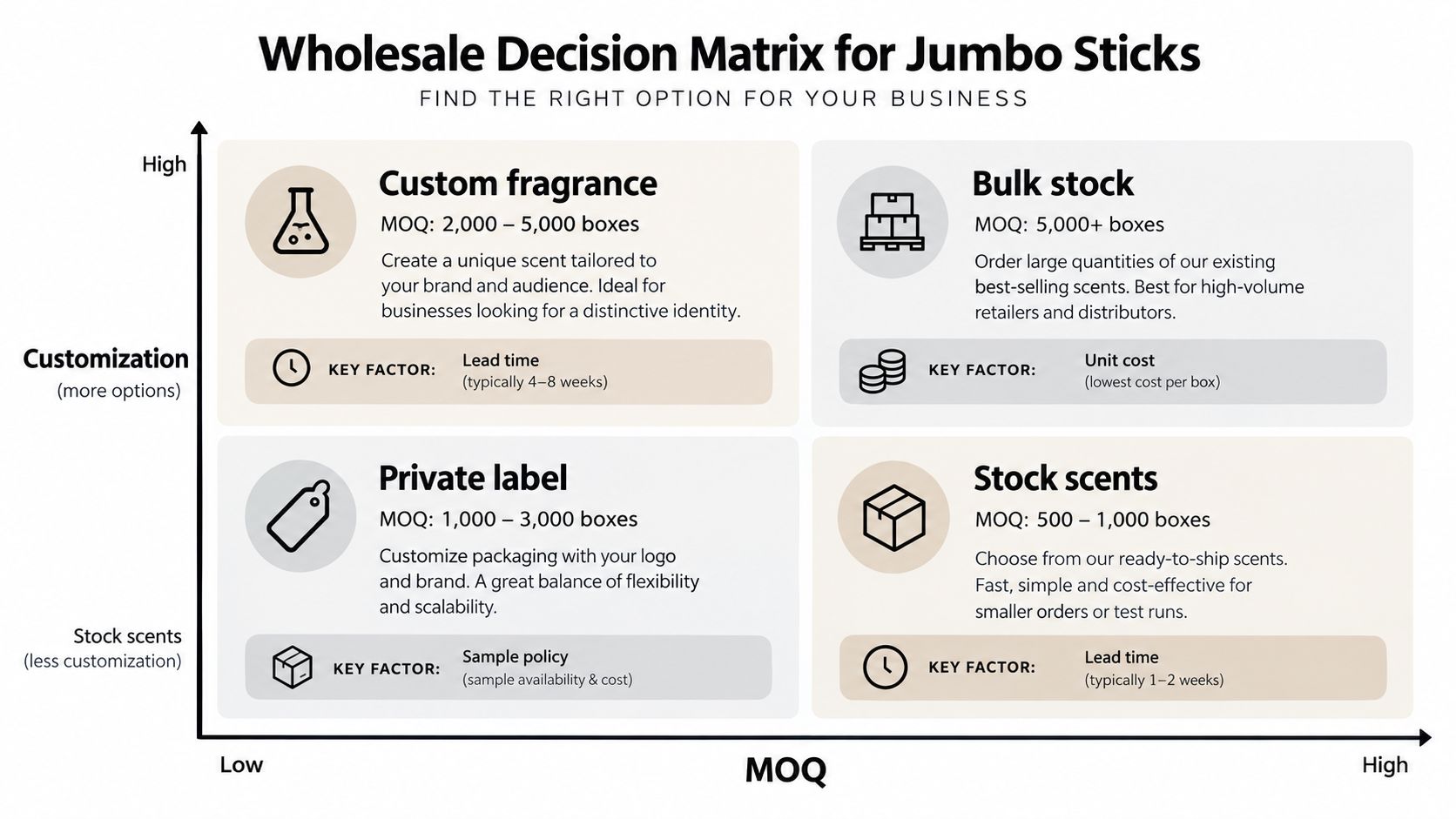
Wholesale buying works best as a decision matrix, not a hunt for the lowest quoted unit price. You're balancing MOQ, product consistency, packaging, compliance, freight, payment terms, and the cost of unsold stock.
The precise MOQ and pricing figures listed in the planning brief aren't supported by the verified data, so don't present them as industry standards. Suppliers set their own thresholds by country, fragrance, packaging method, and production schedule. Request a written quote that separates product cost, packaging, artwork, sampling, tooling, inland freight, export charges, and shipping.
Choose the least complicated model that fits
Stock scents are the safest starting point. You can test demand with established fragrance families, simpler packaging, and fewer development decisions. The weakness is limited differentiation, especially if nearby retailers sell the same product.
Private label creates stronger shelf identity, but it adds artwork approval, packaging coordination, quality-control responsibility, and inventory risk. If you're building a branded range, a practical resource on private label product creation can help organize the early product-development process.
Custom fragrance is appropriate only when you have a clear customer brief and enough sales confidence to support a dedicated production run. Ask the factory whether fragrance samples are retained as a reference standard, who owns the formula, and what happens if the raw materials change.
Packaging choices carry different trade-offs:
Kraft boxes: Practical, lightweight, and easy to print, but less protective against crushing.
Cardboard tubes: More giftable and protective, with more dimensional volume.
PVC wrap: Often economical, but weaker for premium positioning and sustainability messaging.
Gift tins: Strong shelf presence and reusable packaging, but higher packaging and freight exposure.
Your supplier should provide documentation for the destination market. For U.S. sales, request complete ingredient information, warning language, batch identification, and fragrance documentation appropriate to the product. For European Union and United Kingdom distribution, ask about allergen disclosure and applicable classification, labeling, and packaging requirements. Don't copy another brand's label and assume it transfers legally to your formula.
Vet the factory before sending the deposit
Order samples from the actual production line, not just a showroom sample. Compare core straightness, coating uniformity, scent before ignition, scent during combustion, ash behavior, breakage, and pack count. Put acceptance criteria in writing.
Clarify whether the quote is FOB or CIF, which party handles export documentation, and when title and risk transfer. Use milestone payments tied to sample approval, production completion, and pre-shipment inspection where possible. A cheap case that arrives damaged, mislabeled, or inconsistent is not cheap inventory.
Merchandising and Marketing Tips for Retailers
Jumbo incense sells through explanation. A customer sees a long stick and immediately asks how it differs from the product already on the shelf. If your packaging only says “extra-long,” you've left the most important selling work unfinished.
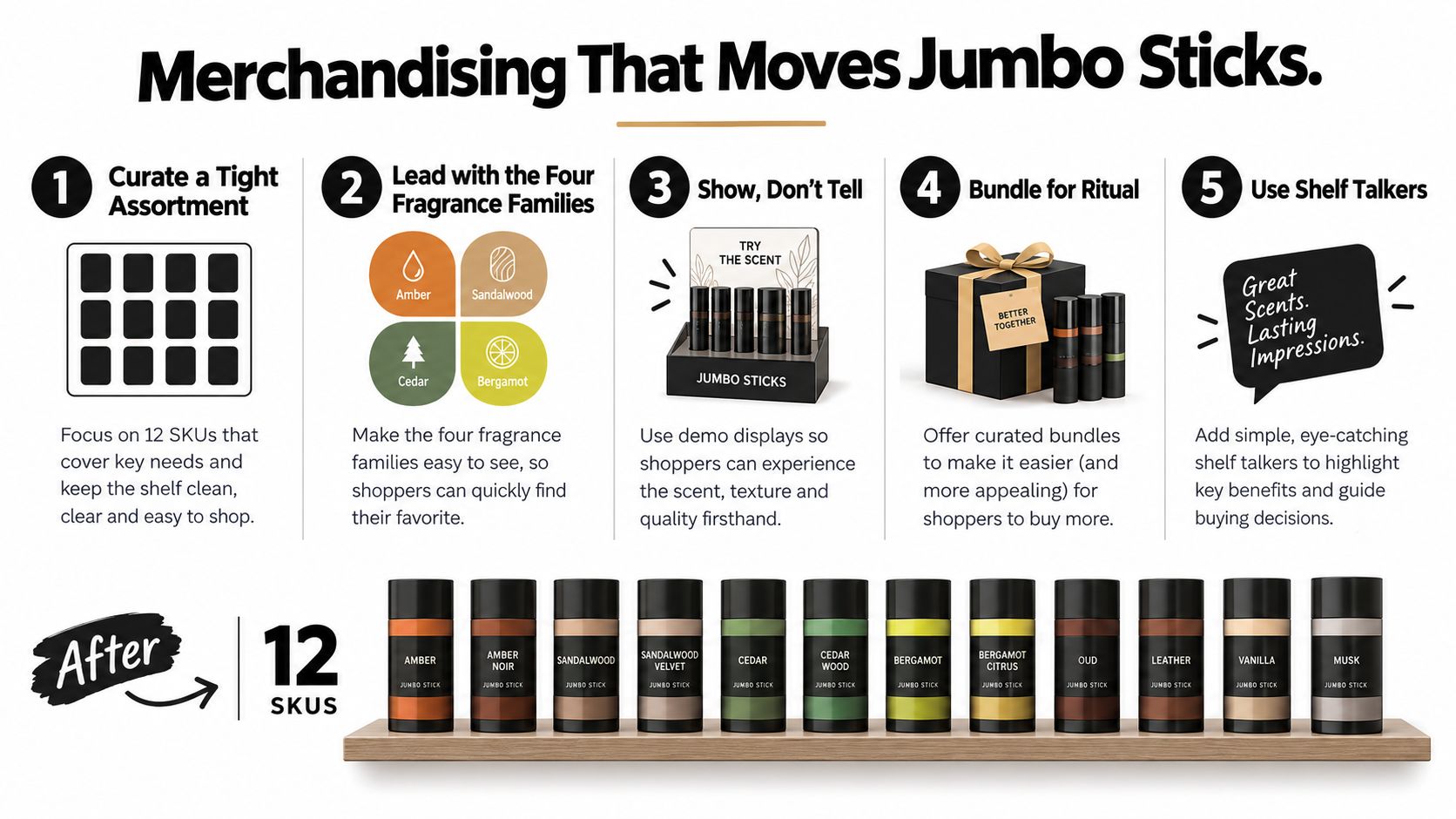
Start with a tight assortment rather than a wall of slow-moving fragrances. The supplied merchandising plan calls for a 12-SKU starter assortment, but the broader lesson matters more than treating that count as universal. Build a balanced range across florals, woods, resins, and fresh profiles, then use sampler bundles to let shoppers discover the format without committing to a single large pack.
Make the shelf answer three questions
Customers need to know:
What does it smell like? Use plain scent descriptions, not only poetic names.
How is it different? State the longer-session benefit without making an unsupported burn-time promise.
Where should I burn it? Mention a stable holder and ventilation directly on the shelf talker.
A three-tier price ladder can help shoppers self-select. Use an accessible trial option, a central everyday gift price, and a more substantial premium presentation. The planning brief's exact $3, $6, and $12 price points aren't verified, so treat them as a merchandising concept rather than a universal recommendation. Your middle tier should offer the clearest value, not merely sit between two arbitrary numbers.
A tester stick clipped to a display block can communicate scale better than a photograph. Pair it with a small scent-throw guide and a statement explaining that the format is designed for longer sessions. Train staff to say, “This is the larger format for customers who want one extended burn in a bigger, ventilated room.” That script sells the use case without promising safety or a fixed duration.
Sell the ritual around the stick
Cross-merchandise with yoga mats, meditation cushions, crystal kits, candles, diffusers, burners, and ash catchers according to the store's identity. A wellness shop can frame jumbo incense around studio sessions and meditation. A gift shop can present it as part of a home ritual set. Use a practical merchandising e commerce guide to keep product descriptions and category presentation consistent across online and physical channels.
Two promotions are especially useful. A first-time bundle lets a shopper test several fragrance families, while a “burn longer” set pairs jumbo sticks with a stable holder and clear safety instructions. Seasonal displays can work well during colder months when customers spend more time indoors, but keep ventilation advice visible rather than hiding the combustion trade-off.
Common Questions About Jumbo Incense Sticks
Retailers usually hear the same questions after the sale. Give staff short, accurate answers, and don't fill gaps with invented guarantees.
How should customers store jumbo incense sticks?
Store them sealed, dry, and away from heat, sunlight, and strong competing fragrances. The supplied shelf-life figures of 18 to 24 months and the humidity threshold in the plan aren't supported by the verified data, so ask the manufacturer for a documented shelf-life recommendation tied to the actual formula and packaging.
Will one jumbo stick scent a whole room?
It can provide broader coverage than a standard stick, but the result depends on room size, airflow, fragrance composition, and placement. Don't promise a precise number of minutes or square feet unless the supplier has tested the product under stated conditions. Tell customers to start with one stick, ventilate the space, and adjust their routine based on comfort.
Why does a jumbo stick tunnel, crack, or go out?
Uneven coating, moisture, a crooked core, insufficient ignition, or strong airflow can interrupt the ember. A practical troubleshooting routine is to store sticks horizontally, inspect the tip before relighting, and contact the supplier if the same defect appears across a batch. Don't tell customers to rotate a burning stick unless the holder and manufacturer's instructions support that practice.
Does natural mean safer?
No. “Natural” describes ingredients or sourcing language, not the absence of combustion emissions. “Charcoal-free” describes one formulation choice, while “hand-rolled” describes production method. Ask suppliers for ingredient information, fragrance compliance documentation, core sourcing details, and any relevant certification claims before printing them on packaging.
Question | Concise Answer | Retailer Talking Point |
|---|---|---|
How should it be stored? | Keep it sealed, dry, and protected from heat and competing odors. | “Keep the bundle in its sleeve and a closed container.” |
Will it cover a large room? | It may provide broader scent distribution, but room conditions control performance. | “Start with one stick in a ventilated space.” |
Why did it go out? | Coating, moisture, airflow, or ignition may be responsible. | “Check the ember and report repeated defects from the same batch.” |
Is natural smoke-free? | No. Burning plant-based materials still creates smoke and combustion byproducts. | “Natural isn't the same as emission-free.” |
A 30-second staff response can sound like this: “Jumbo incense is designed for a longer session and is best used in a stable, heatproof holder with ventilation. Burn one at a time, keep it away from fabrics and drafts, and stop using it if the smoke irritates you. If you're choosing between scents, start with a sampler rather than buying a full case of one profile.”
FAQ What should retailers check when a jumbo incense shipment arrives?
Retailers should verify the case count, individual stick dimensions, packaging condition, fragrance consistency, core straightness, and visible damage. Comparing the shipment against the approved sample and purchase-order specifications can help identify production or packing problems early.
How can retailers calculate the landed cost of jumbo incense sticks?
Add the product cost, packaging charges, freight, import or handling costs, and other applicable fees, then divide the total by the number of sellable sticks received. Using landed cost rather than the supplier's unit price gives retailers a more useful basis for setting retail prices and margins.
Can jumbo incense sticks be sold as individual sticks?
Yes, depending on the retailer's packaging and merchandising model. Individual-stick sales can give customers a lower-cost way to try an unfamiliar jumbo format, while bundled or boxed products can provide a more giftable presentation. Packaging should protect the sticks and provide the information required for the product.
What information should retailers request before creating product listings for jumbo incense?
Ask the supplier for the exact stick dimensions, net weight, ingredients or applicable ingredient information, fragrance description, burn-time testing details, packaging specifications, and available safety or compliance documentation. Having these details helps retailers create accurate product listings instead of relying on generic “jumbo” or “long-burning” claims.
How can retailers test jumbo incense demand before placing a large wholesale order?
Start with a limited assortment of fragrance profiles and track which scents receive the most customer interest and repeat purchases. Retailers can also use sampler or trial-sized merchandising where appropriate before committing more inventory to a particular fragrance, packaging format, or product configuration.
Aroma Warehouse supplies incense, burners, ash catchers, fragrance oils, and unscented sticks for repackaging and private-label projects, with wholesale options for U.S. retailers and resellers. Visit Aroma Warehouse to review the available incense and accessory assortment, then build your jumbo-stick test order around the room, fragrance family, packaging format, and customer education your business can support.


