

Glass Dropper Bottles Bulk: A Wholesale Buying Guide
The most popular advice on glass dropper bottles bulk is also the most expensive mistake. You're told to find the lowest unit price, lock in amber glass, and order as many as you can store. That advice ignores what actually decides your margin. A cheap bottle with a softening bulb, a loose collar, or a carton that arrives cracked costs more than a higher priced bottle that seals, ships intact, and holds your formula without changing it.
Buy on total landed cost, not unit price. That means bottle, dropper, cap, inserts, freight, breakage, replacements, and packing labor, tested as one assembly before you scale.
Table of Contents
Bottle Sizes and Who Buys Each One - Larger Sizes and Standard Shapes
Glass Type and Dropper Parts to Specify - Specify Each Component in Order
Amber Versus Clear Glass and When Light Matters - Where Each Color Fits
Labeling and Private Label Decoration Options - Keep Sustainability Claims Honest
Pricing Tiers, MOQs and How to Order Samples - Run Samples Like a Production Test
Packing, Shipping and the Real Cost of Breakage - Build a Landed Cost Worksheet - Choose an Ordering Model That Fits Demand
Gate-Check Your Bulk Order Before You Scale - Gate One Formula Compatibility - Gate Two Transit and Gate Three Economics
Bottle Sizes and Who Buys Each One
Start with capacity, because capacity decides your customer, your label size, and your freight bill. Don't build a line around every size a supplier stocks. Pick the size your buyer already expects for that product.
Capacity | Typical use | Common buyer |
|---|---|---|
5 mL | Fragrance sample or tester | Perfumers and sample-kit makers |
10 mL | Perfume oil or single-note sample | Gift sets and sampler packs |
15 mL | Single essential oil | Aromatherapy retailers and test orders |
30 mL (1 oz) | Standard retail essential or fragrance oil | Shops, Etsy and eBay sellers |
50 mL | Blended oils and serums | Wellness studios and small brands |
100 mL | Bath and body oils or larger blends | Spas and refill-focused sellers |
5 mL to 10 mL bottles work as testers and samples for fragrance and perfume oils. They let a customer try a scent without committing, and they keep sampler packs light to ship. 15 mL to 30 mL is the most common retail range for single essential oils, with 30 mL as the default shelf size most shoppers recognize.
Larger Sizes and Standard Shapes
Move to 50 mL to 120 mL for blends, serums, carrier oils, and bath products where the customer uses more per application. The trade-off is weight. A larger bottle raises freight per order and leaves more product exposed to air once opened, so it only makes sense when use rate justifies it.
These sizes exist as repeatable stock because container production was mechanized long ago. Glass manufacture is believed to have originated roughly 5,000 years ago in Mesopotamia or Egypt, and glassblowing emerged approximately 2,000 years ago, probably in Syria, according to the Western Australian Museum history of glassmaking. A lower-cost lime glass developed in 1864 helped mechanize production, although hand-blown pharmaceutical and cosmetic ware continued into the 1930s.
That standardization has a modern spec you can use. ISO 11418-1:2016 defines requirements for design, dimensions, materials, and performance of drop-dispensing glass bottles used as primary packaging for non-parenteral pharmaceutical preparations. Specify capacity and dimensions against a defined standard, not against a photo.
Keep the neck finish identical across sizes so one dropper family fits your whole line. That cuts spare parts, simplifies capping, and prevents a warehouse mix-up between similar collars. Aroma Warehouse supplies glass bottles and droppers for repackaging and private label, which suits resellers, wellness studios, and small brands building a first range.
Practical rule: Start with one or two sizes. Each extra SKU adds stock, labels, cartons, and breakage exposure before it adds sales.
Glass Type and Dropper Parts to Specify
A dropper bottle isn't a bottle. It's an assembly, and the weakest part decides whether the order works. Specify every part in writing, then test the complete assembly with your actual formula.
Start with the glass. For fragrance oils, essential oils, and other non-parenteral liquids, Type III soda-lime-silica glass is generally an appropriate baseline because it provides moderate hydrolytic resistance and is commonly suitable for oral, topical, and other non-injectable products, under USP <660> glass classification. USP <660> distinguishes Type III from higher-resistance Type II and Type I glass, and surface treatment can raise soda-lime glass from Type III to Type II performance.
Don't write "glass" on a purchase spec. Name the classification. Request hydrolytic-resistance documentation when your liquid is acidic, aqueous, or stored long term. Reserve Type I borosilicate or Type II treated glass for highly sensitive formulations, and don't assume Type III works for injectable products.
Specify Each Component in Order
Glass body: Name Type III in the spec and check filled samples for alkali release or formula change during storage. Decorative glass with no documented chemical resistance is a different product.
Dropper bulb: Match the elastomer to oil, alcohol, or water blends. Alcohol-based blends can soften some bulbs, and essential oils can affect some elastomers, so a bulb that works for a carrier oil may fail in a perfume blend.
Glass pipette: Require consistent length and a smooth tip. Check for uneven dosing, a pipette that doesn't reach near the base, and breakage at the neck during capping.
Collar and thread: Match the finish to the neck with a dimension drawing, not a verbal description. If you're comparing closures, review common bottle cap types and neck finishes before you approve tooling or stock.
Cap liner: Choose a liner or gasket compatible with your formula and check it for staining, swelling, and seal failure after storage and shipping.
FDA container-closure guidance treats these parts separately for a reason. Glass components may need chemical-resistance evaluation, and elastomeric closures need separate suitability assessment. That's why a sound glass body doesn't rescue a failing bulb or liner.
A sample that passes a fit and fill test is worth more than a catalog description. If a supplier can't name the glass type and bulb material, you're buying a look, not a package.
Recommendation: Approve the assembly, not the bottle alone. Reject any combination that leaks, stains, clouds, or changes odor in a filled test.
Amber Versus Clear Glass and When Light Matters
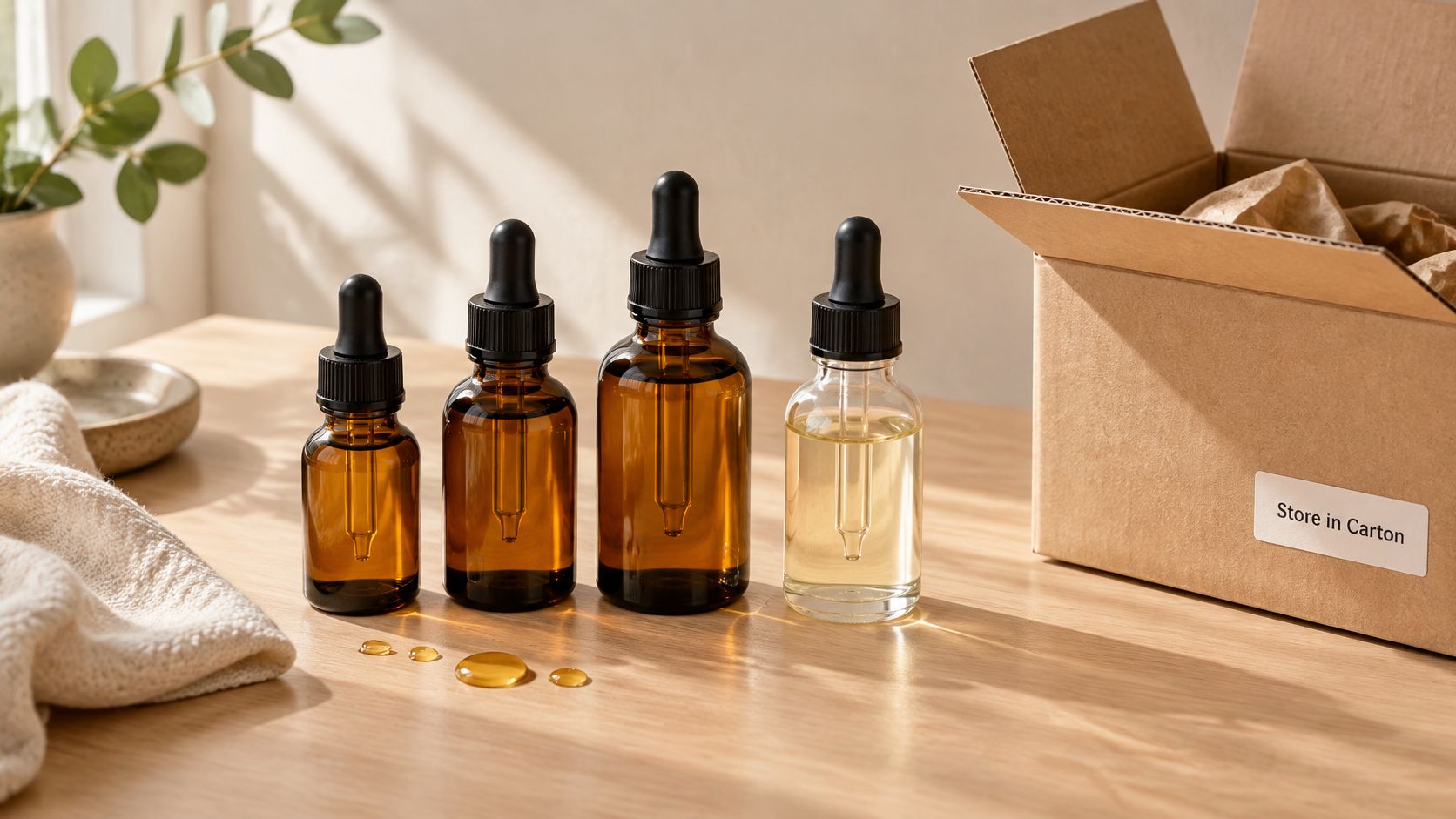
Use amber glass by default for light-sensitive oils. Use clear only when the formula is light-stable or the filled bottle ships and sits inside a protective carton. That's the decision, and most bulk buyers should not overthink it.
Light drives photochemical breakdown, especially ultraviolet and shortwave blue light. Over time that can change color, odor, potency, and oxidation-sensitive constituents. Amber works like sunscreen for the oil because colored glass absorbs ultraviolet and shortwave visible radiation.
The numbers are not close. Amber glass can absorb nearly all radiation below approximately 450 nm, and reported transmission at 550 nm is roughly 20 to 35% for amber glass compared with at least 85% for clear glass, in line with research comparing light protection by bottle color and material. That research found amber glass provided substantially greater protection than transparent glass, although some semi-opaque and opaque plastics can provide even stronger barriers in certain conditions.
Where Each Color Fits
Citrus and other oxidation-prone oils benefit most from amber because they degrade faster and their scent shift is easy for customers to notice. A clear bottle kept in a closed carton or on a dark shelf may be enough for a stable blend sold quickly, but you need a reason you can defend. Cobalt blue filters some light and looks distinctive on shelf, yet it's often chosen for decoration first. Don't treat decorative color as tested protection.
Watch the weak points. An amber body paired with a clear bulb, thin collar, or loosely fitting cap lets light and air reach the product through the top. The bottle, pipette, bulb, and neck closure should be evaluated as one package, with consistent wall thickness specified for the glass.
Recommendation: Specify amber for bulk essential and fragrance oils unless you document why a clear SKU is safe for that formula, channel, and shelf life. "Customers like to see the color" isn't a technical reason.
Labeling and Private Label Decoration Options
Your bottle is the label's canvas, and each decoration method changes cost structure as much as appearance. A method that looks premium can lock you into a minimum run you can't sell through. A cheap method can peel in a customer's bathroom and make a good oil look careless.
Decoration method | Best for | Trade-off |
|---|---|---|
Paper or waterproof sticker labels | Small runs and quick launches | Can peel and vary in placement |
Screen printing on glass | Durable premium look | Setup per color and a higher minimum run |
Hot-stamped foil | Metallic accent on simple artwork | Tooling cost and limited detail |
Full-wrap or shrink sleeve | Coverage and tamper evidence | Extra cost and possible dropper misalignment |
Blank bottle with customer label | Lowest cost and most flexibility | Buyer handles labeling work |
Sticker labels win on speed. You can launch, revise artwork, and split one bottle stock across several scents. Waterproof stock matters for oils, because a standard paper label that absorbs a leak looks damaged even when the product is fine. Placement consistency is the hidden labor cost, especially if you're hand-applying at volume.
Screen printing gives you durability and a clean, integrated look, but setup is charged per color and the minimum run rises. It pays off only when artwork is final and the scent sells steadily. Hot-stamped foil suits simple logos and premium accents, not fine text or complex gradients. Full-wrap sleeves give coverage and tamper evidence, but a sleeve can hide dropper alignment and complicate inspection.
If you're deciding how to brand stock product, understanding the difference between white label and private label helps you choose who controls artwork, formula, and compliance before you pay for decoration.
Keep Sustainability Claims Honest
Don't print a universal recyclability promise your customers' local systems can't support. The EPA estimated glass containers generated approximately 9.79 million tons of municipal solid waste in the United States in 2018, with about 3.06 million tons recycled for a recycling rate of 31.3 percent and approximately 55.4 percent landfilled, according to EPA containers and packaging data. Germany provides a contrast, recycling around 2.5 million tonnes of used packaging glass in 2022 for an 84.6 percent recovery rate.
Glass can re-enter material streams at scale, but performance depends on collection, sorting, transport, and user behavior. Tie label claims to realistic local access. Use clear disposal or reuse language you can support.
Finish with compliance basics. Your label needs accurate net contents and ingredient listing and warnings that match your product category and sales channel. Avoid therapeutic or medical claims on a standard dropper bottle.
Recommendation: Start with waterproof stickers or blank bottles until volume proves itself. Move to screen printing only when one SKU earns the setup cost.
Pricing Tiers, MOQs and How to Order Samples
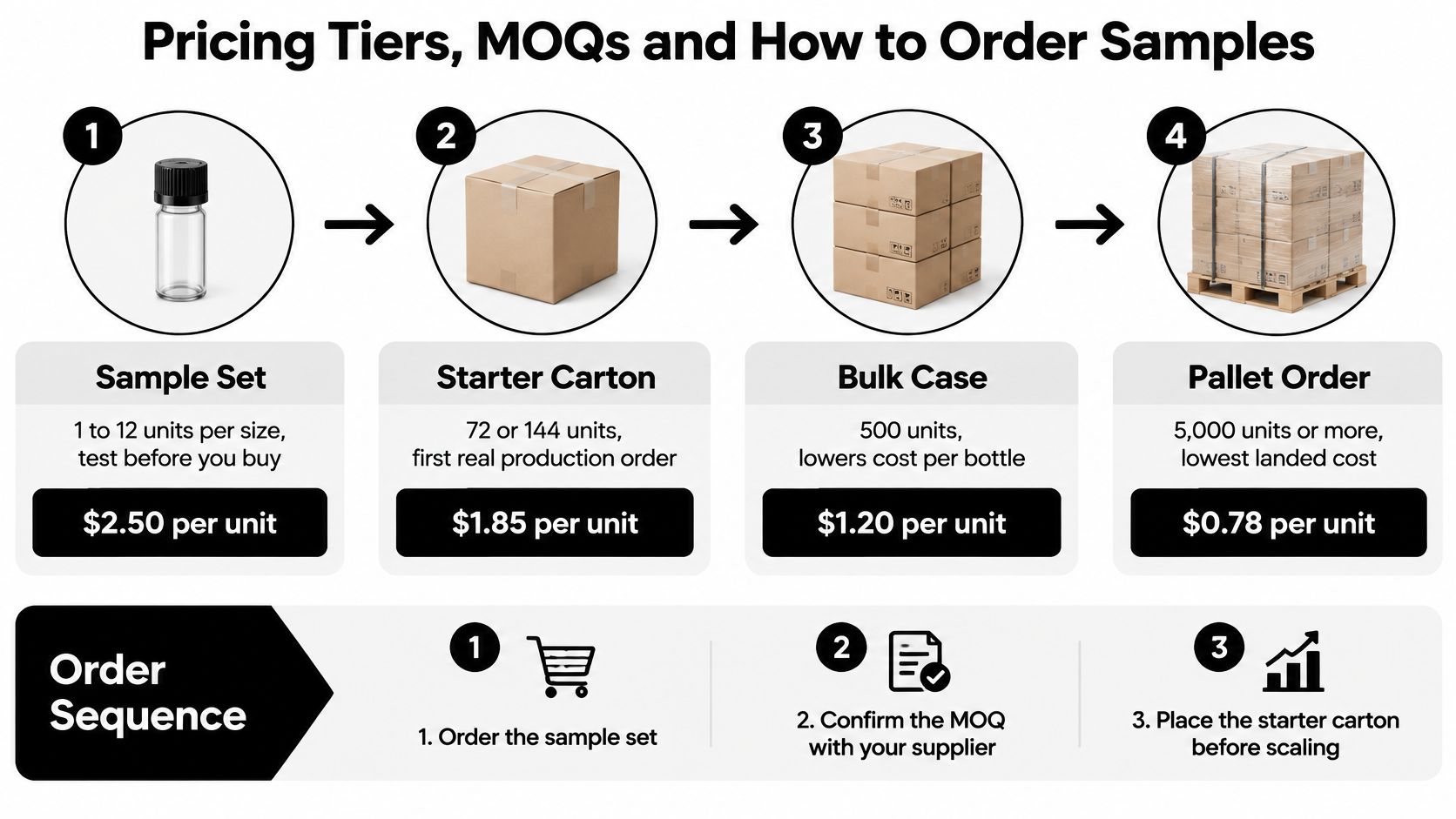
MOQ shapes your first order more than unit price does. A low price at a quantity you can't sell, store, or ship without breakage isn't a saving. Use tiers to stage risk.
The tier flow below shows how order size changes your commitment from testing to scaled stock.
Order tier | Typical quantity | What changes | Unit price |
|---|---|---|---|
Sample set | 1 to 12 units per size | Fit and formula test, no minimum pressure | Quote to request |
Starter carton | 72 or 144 units | Standard colors and sizes, lower risk | Quote to request |
Mid-volume run | 500 to 1,000 units | Price break and lower freight per unit | Quote to request |
Large run | 1,000+ units | Custom color or screen printing may need a higher minimum | Quote to request |
Unit prices move with glass type, color, decoration, dropper specification, and region, so request a written quote for the exact assembly. Don't compare a bare clear bottle quote against an amber bottle with a premium bulb and printed cap. They're not the same product.
Quantity usually lowers unit cost, but custom work adds setup that only pays off at volume. Custom color, screen printing, and foil can raise the minimum sharply. If you're stocking a shop assortment at the same time, wholesale supplies for gift shops is useful context for planning opening orders without overbuying slow lines.
The short video below is a useful visual check on how dropper assemblies and bottle formats vary before you finalize samples.
Run Samples Like a Production Test
Order each planned variant: Get one sample of every size and color you intend to buy, with the production dropper and cap.
Fill with actual formula: Don't test with water. Oil, alcohol, and water-based blends stress bulbs and liners differently.
Seal as you'll sell it: Cap at your normal torque and apply the label or sleeve you plan to use.
Store for four weeks: Keep samples at room temperature and in a warm spot, then check for leaks, staining, odor change, and clouding.
Ship a test carton to yourself: Use your real carton, dividers, carrier, and packing method to see transit damage.
Confirm lead times in writing: Separate stock lead time from custom lead time before you promise a launch date.
Start at the starter tier: Scale only after samples and transit both pass.
Sample rule: If you won't fill it, wait, and ship it, you haven't sampled it. You've only looked at glass.
Recommendation: Buy samples first, then a starter carton of one or two sizes. Let measured sell-through justify the mid-volume price break.
Packing, Shipping and the Real Cost of Breakage
Glass sells a premium image, but it's rigid, heavy, and fragile. That combination is expensive to move. Beauty-packaging coverage describes glass vessels as rigid, heavy, more expensive from a materials perspective, and capable of retaining residual product at the end of use, as noted in Vogue coverage of beauty packaging sustainability. For an online reseller, a lower unit price can disappear in one damaged shipment.
Most product pages emphasize recyclability and say little about breakage, secondary packaging, or dimensional weight. Those omitted lines decide whether bulk glass makes money. "Recyclable" does not automatically mean lower-impact or cheaper in ecommerce when weight and damage dominate.
Build a Landed Cost Worksheet
Cost line | What to enter | Why it matters |
|---|---|---|
Bottle and dropper | Quoted unit price times units | Largest line but not the only one |
Inserts and cartons | Cost per carton and dividers | Dividers cut breakage more cheaply than replacement |
Freight | Carton count and weight per shipment | Heavy glass raises cost per unit shipped |
Breakage allowance | Breakage rate from test carton times landed cost | Set from a test, not a guess |
Replacements and refunds | Replacement units plus refund cost | Often left out of wholesale comparisons |
Fulfillment labor | Minutes per order times labor rate | Hand-packing fragile bottles adds up |
Use your own test carton for the breakage allowance. A supplier's packing claim isn't data until your carrier has handled your filled, labeled, capped product. If you need a costing structure, how to calculate product costs gives a practical frame for adding these lines before you set retail price.
Choose an Ordering Model That Fits Demand
Case-packed wholesale inventory: Best when one SKU sells steadily and you can store full cases. It usually lowers freight per unit but ties up cash.
Smaller replenishment orders: Best when cash flow is tight, shelf space is limited, or you're still learning demand. Unit cost may be higher, but waste and storage fall.
Mixed-SKU cartons: Useful for a small line with several sizes if the packer separates each bottle carefully. Poorly packed mixed cartons increase contact damage and picking errors.
Ship droppers separately from bottles when your packer can assemble on receipt, because protruding pipettes and bulbs create pressure points. Use divider inserts rather than loose fill, since bottles that touch in transit chip each other. Drop-test a sealed test carton from several sides, then inspect necks, pipettes, and liners before scaling.
Recommendation: Rank suppliers by landed cost per intact, saleable bottle. A supplier with better dividers can beat a cheaper bottle quote after freight and breakage are counted.
Gate-Check Your Bulk Order Before You Scale
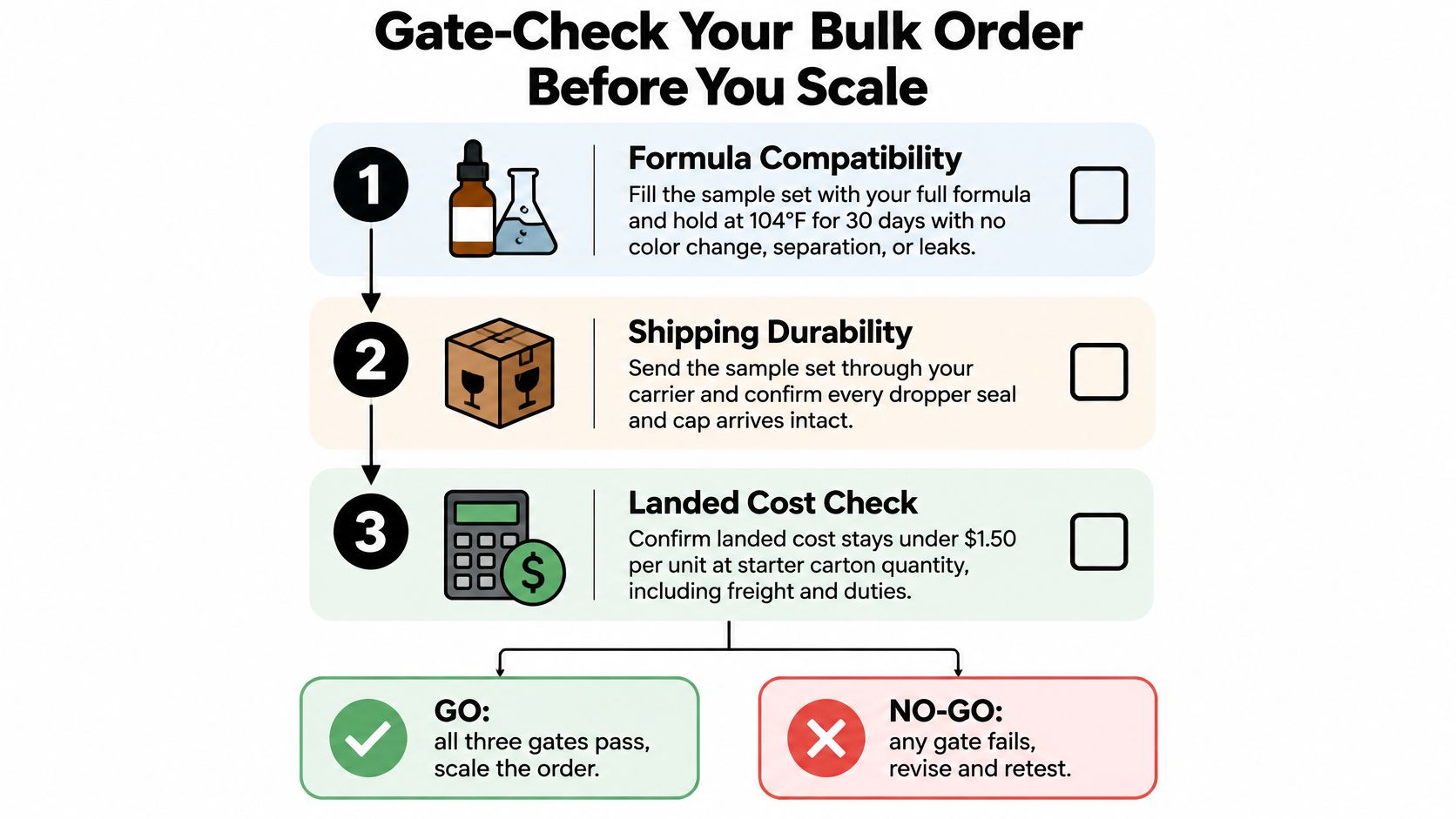
Don't scale because a sample looked good on a bench. Scale when three gates pass with your formula, your carton, and your numbers. Any failed gate means revise and retest, not order anyway and hope.
Before the gates, confirm in writing your glass type, amber specification for light-sensitive oils, neck finish, dropper materials, and stock or custom lead time. Those details drive every result that follows. If you're still comparing suppliers, a structured approach to product sourcing helps you document quotes and samples consistently.
Gate One Formula Compatibility
Fill the sample set with your actual formula, seal it with the production dropper and cap, and hold it for four weeks. Reject any SKU showing leaks, staining, odor change, clouding, swelling, or a softened bulb. A generic claim that glass is chemical-resistant doesn't settle suitability for essential oils, tinctures, serums, or ingestible products.
Packaging must protect against light, moisture, microbial contamination, leakage, and loss of container integrity, and elastomeric closures need separate suitability assessment, under FDA container closure systems guidance. The pipette bulb, gasket, adhesive, and cap liner can contribute extractables or fail to seal even when the glass body is sound.
Gate Two Transit and Gate Three Economics
Drop-test one sealed test carton from several sides, leak-check every bottle, and record breakage as a rate. Use that measured rate in your landed cost worksheet. Don't substitute a hopeful allowance because the carton felt sturdy.
Then rebuild total landed cost with freight, inserts, replacements, refunds, and labor included. Proceed only if your chosen tier still beats smaller replenishment orders on cost per intact bottle. For a small brand buying 100 to 1,000 units, that comparison often changes the right order size.
Avoid medical or ingestible claims unless the complete package has been appropriately evaluated for that use. A standard cosmetic or fragrance test doesn't qualify a package for therapeutic positioning.
Recommendation: Place one concrete first order, a sample set of each planned size plus one test carton, with one or two sizes and one decoration method. Scale to the starter carton only when compatibility, transit, and economics all pass.
Start your bulk order with samples you can fill, ship, and cost properly, then build your range around the size and dropper assembly that passes all three gates. Aroma Warehouse offers glass bottles, droppers, fragrance oils, and private label supplies for retailers, wellness studios, and resellers who need a practical starting point. Visit the store to select your sample sizes and plan your first starter carton with landed cost in mind.


