

China Rain Fragrance Oil: Scent Profile and Guide

You've got a bottle of China Rain fragrance oil on your bench, a stack of labels to print, and three different customers asking if it'll work in candles, soap, and body spray. That's the reason this scent keeps coming up. It isn't just nostalgic, it's adaptable, and the challenge is knowing where it performs well, where it falls flat, and what documentation you need before you sell it.
Table of Contents
What Makes China Rain Fragrance Oil So Popular - Why makers keep coming back to it
The Scent Profile and Fragrance Accord Structure - How the layers behave in finished products - Why the structure matters for makers
Best Applications for China Rain Across Product Categories - Candles and room diffusion - Soap and bath and body products - Where it tends to disappoint
Blending Pairings That Complement China Rain - Pair by effect, not by theme - Practical blend discipline
Dilution Rates and Safety Guidelines for Every Use Case - A simple usage guide by product type - What to ask before you pour
Storage Best Practices and Shelf Life Expectations - What storage gets right - Rotation beats guessing
Wholesale and Bulk Ordering Strategies for Retailers - What to evaluate before you place a bulk order - Order like a reseller, not a hobbyist
Frequently Asked Questions About China Rain Fragrance Oil - Is China Rain fragrance oil the same as an essential oil - Can China Rain be used in reed diffusers - How does it compare to other rain or ozone scents - Is it safe around pets in diffusers
What Makes China Rain Fragrance Oil So Popular
A customer picks up a candle, sniffs it, and says it smells “clean, soft, and familiar” without being sugary or sharp. That's the lane China Rain fragrance oil has occupied for years. It sits between floral and fresh, which makes it easy to sell in gift shops, metaphysical stores, salons, and online boutiques where shoppers want something pleasant but not overpowering.
The appeal is partly historical and partly practical. China has a long scent culture, with a perfume-like product documented in 958 CE, and by the 14th century Chinese perfume makers were blending flower oils into more complex fragrances, long before modern perfume oils emerged in the 1970s (South China Morning Post). That long context matters because this fragrance doesn't feel like a novelty scent, it feels like part of a much older preference for clean, wearable aroma.
Why makers keep coming back to it
China Rain is popular because it behaves like a bridge scent. It can read airy and floral in a soap, then feel smoother and more intimate in a body oil or room spray. That flexibility helps small makers avoid stocking too many niche scents that only move in one season.
It also fits the way buyers shop fragrance oils online. People often discover one scent, then look for related oils, layering ideas, or wholesale options. For anyone still sorting out the basics of fragrance materials versus naturals, this overview of fragrance oils and essential oils is a useful companion.
Practical rule: if a scent has to sell across candles, soap, and ambient products, it needs to stay readable in each format without becoming loud. China Rain does that better than many “fresh” blends.
The Scent Profile and Fragrance Accord Structure
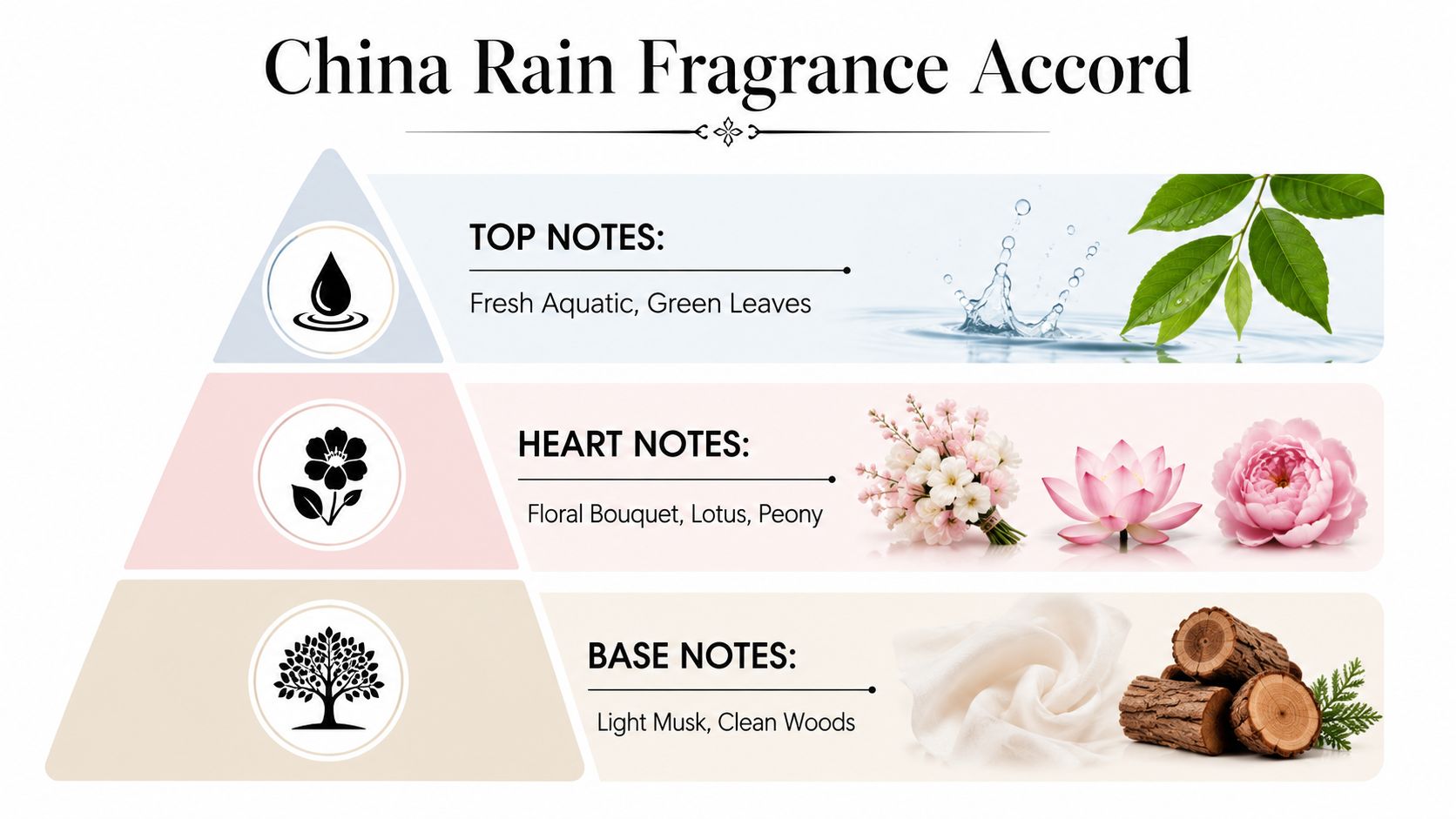
China Rain is typically built as a fresh floral-musk accord, and that structure is the reason it works in so many formats. The opening is usually described with bergamot and green top notes, the heart moves into lily, rose, and cyclamen, and the drydown settles into white moss and clean musk (Lone Star Candle Supply). That layered construction is what gives the fragrance its “rain” impression at first sniff, then lets it hold on in finished products.
How the layers behave in finished products
The top notes do the first job. In candles and sprays, bergamot and green notes create the light, dewy impression people expect from a rain scent. They're volatile, so they lift quickly, which is useful when you want the fragrance to announce itself without feeling heavy.
The heart notes are where the scent becomes recognizable. Lily, rose, and cyclamen keep it from reading as a simple aquatic or ozone profile. They give it a floral center that feels polished rather than detergent-like. The base is the technical anchor, because white moss and clean musk add persistence and help the scent carry in larger spaces.
China Rain usually wins in products that need soft diffusion, not aggressive sweetness. If a formula already smells crowded, this fragrance can disappear instead of enhancing it.
There's also a useful historical lens here. The modern oil may be associated with the 1970s, but the preference for layered floral materials isn't new in China. The older perfume tradition helps explain why a fragrance like this feels coherent even when it's marketed as a contemporary oil. For comparison with another floral profile, this black tea fragrance shows how a different accord can lean fresher or more grounding without losing wearability.
Why the structure matters for makers
In candles, the mossy-musky base improves room presence. In body products, that same base can make the scent feel more polished, but it also means you need to watch total fragrance load carefully. If you treat it like a single-note floral, you'll miss the way the base affects longevity and diffusion.
Best Applications for China Rain Across Product Categories
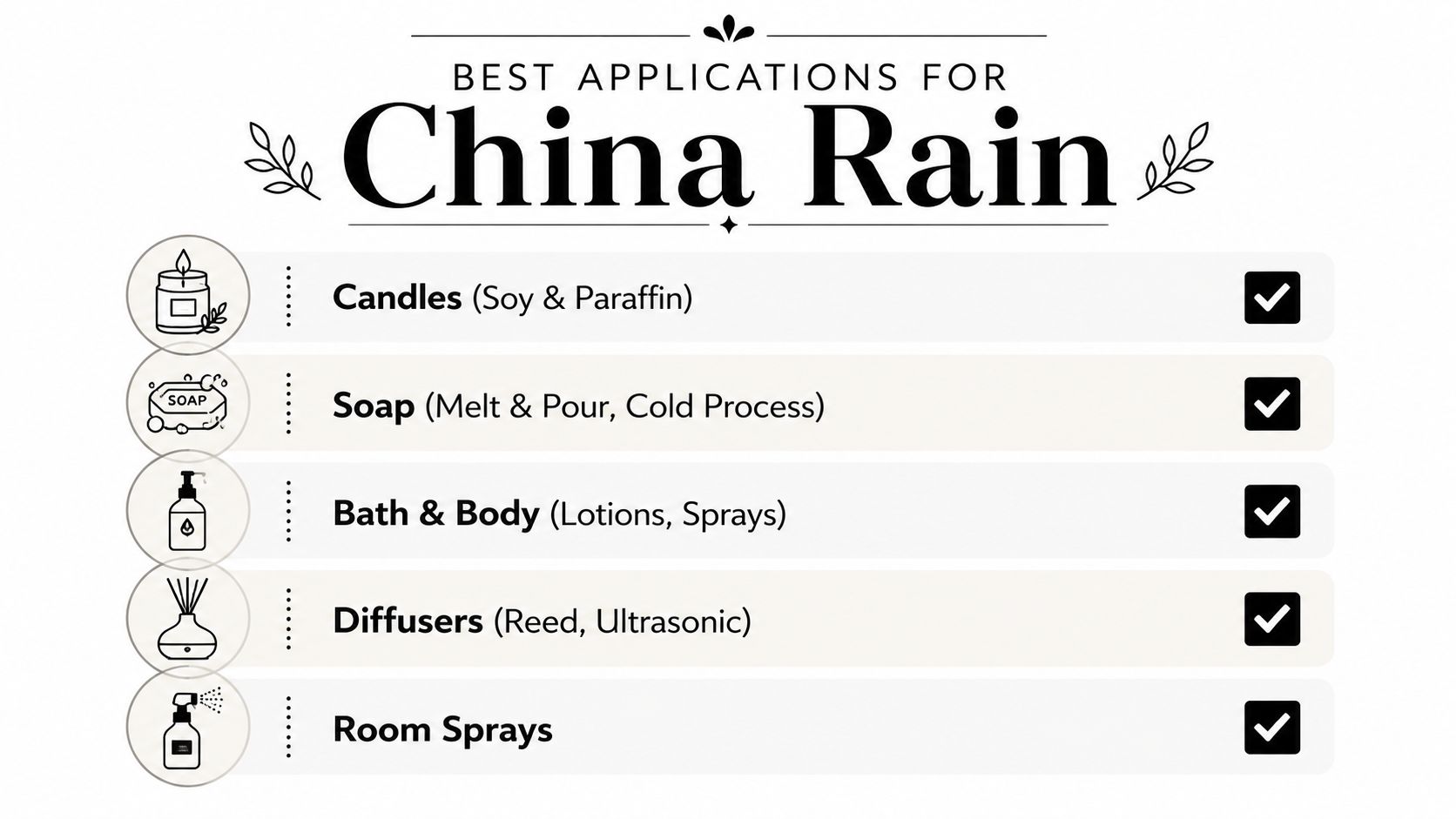
China Rain does not behave identically in every product, and that's where a lot of generic advice falls apart. In candles, it can feel crisp and lingering. In soap, it often comes through softer and more abstract. In leave-on products, the same formula that smells elegant in a wax melt can become too assertive if the dilution is careless.
Candles and room diffusion
China Rain is a strong candidate for candles because its muskier base helps it travel once the wax warms. That gives you better room-filling behavior than a fragrance that is built entirely on top notes. Soy wax may present a softer scent impression, while paraffin often pushes fragrance harder, so test both before choosing your production formula.
For reed diffusers and room sprays, the profile usually reads clean and airy. It can work well in a home fragrance lineup where you want one scent family that doesn't compete with citrus, lavender, or linen. If your product line includes ambient scenting, China Rain can sit comfortably alongside incense, oil warmers, and similar atmosphere-driven goods.
Soap and bath and body products
In melt and pour soap, China Rain often holds its identity better than in some other floral oils because the profile is already clean and balanced. Cold-process soap is trickier. The fragrance may still perform, but the maker needs to watch for acceleration, scent fading, and any discoloration in the finished bar.
For lotions, sprays, and body butters, the scent can be beautiful when kept restrained. Leave-on products magnify compliance concerns, so you need supplier documentation before you assume a fragrance that works in soap will also work on skin. A broad mix of market channels, including large marketplaces and dedicated suppliers, has created a lot of inconsistent claim language, which is why cross-category testing matters more than glossy product descriptions.
Maker's shortcut: the more the product stays in the air or wax, the more forgiving China Rain tends to be. The more it touches skin, the more documentation and restraint you need.
Where it tends to disappoint
It's usually a poor choice for anyone who wants a loud tropical, gourmand, or candy-like profile. It also may not be the best fit if the finished product is supposed to smell sharply aquatic. China Rain is cleaner and softer than that, and trying to force it into a different category usually leads to disappointment.
For a quick companion read on compounding fragrance materials, how to blend fragrance oils for candles is worth keeping nearby if you're building a line around this note family.
Blending Pairings That Complement China Rain
China Rain blends best when the partner oil respects its airy opening and clean base. If you overpower the floral heart, the scent gets muddy. If you only add more brightness, it can feel thin. The smartest blends either sharpen the freshness, round the florals, or deepen the base without burying the original character.

Pair by effect, not by theme
If you want more lift, citrus oils and herbal notes can help the bergamot-green opening stay bright. If you want more floral presence, jasmine or peony-style oils can make the heart feel fuller without turning it syrupy. If you want a warmer, longer finish, sandalwood, amber, or vanilla can extend the base and make the blend feel more rounded.
Small test batches matter here. A blend that smells balanced on a blotter can behave differently in wax, soap, or alcohol-based spray. For candles especially, keep notes on what the oil smells like cold, then check how it behaves after curing and burning, because the top note and base note can separate in practice.
Practical blend discipline
One useful approach is to start with China Rain as the dominant note and use the partner oil as an accent. That keeps the identity intact while still letting you customize for a seasonal or private-label line. If you build from the secondary oil outward, the result often loses the signature softness that makes this fragrance recognizable.
A boutique maker who wants a spring line might lean floral and green. A wellness shop might prefer a smoother, cleaner base with a little sandalwood depth. Neither path is wrong, but both should be tested in the actual finished format before you commit to labels, signage, or a wholesale order.
Dilution Rates and Safety Guidelines for Every Use Case
The most expensive mistake with China Rain isn't buying the wrong scent, it's putting it into the wrong product at the wrong concentration. A fragrance can smell excellent in a wax melt and still be too strong, too weak, or inappropriate for skin-contact use. IFRA categories exist to keep those uses separate, so don't treat one dilution as universal.
A simple usage guide by product type
Product Type | Recommended Usage Rate | Key Considerations |
|---|---|---|
Candles | 6% to 10% | Test hot throw, cold throw, and wick performance before scaling. |
Cold-process soap | 3% to 5% | Watch for acceleration and any discoloration in cured bars. |
Lotions and body butters | 1% to 3% | Confirm leave-on compliance and skin safety documentation first. |
Diffuser blends | Follow supplier guidance | Base choice and viscosity affect performance and reed movement. |
For skin products, the supplier paperwork matters more than the scent description. Request an IFRA certificate and a Safety Data Sheet before you buy in bulk, especially if you plan to resell. If you need a quick refresher on carrier compatibility for skin applications, this guide on carrier oils for skin is a practical companion.
What to ask before you pour
Confirm the intended category: A candle-safe oil isn't automatically appropriate for a lotion or perfume roll-on.
Check sensitizer awareness: Floral-musk accords can include materials that matter for customers with sensitivities.
Verify batch paperwork: Ask for documentation tied to the specific lot when possible, not just a general product description.
Test on your own base: Soap batter, wax, and lotion emulsions all change how the scent presents.
Don't skip patch testing: Especially for leave-on products, your own testing routine should be conservative.
If a supplier can't explain category use, allergen guidance, or batch consistency, that's a sourcing problem, not a formulation problem.
Storage Best Practices and Shelf Life Expectations
Fragrance oil doesn't stay stable by luck. Heat, light, and oxygen exposure all shorten usable life, and China Rain is no exception. A well-formulated oil often keeps for 1 to 2 years when stored properly, but the actual answer depends on how you handle the container from the day it arrives.
What storage gets right
Amber glass is a safer choice than a clear bottle if the oil will sit on a shelf, because it limits light exposure. Tight-sealing caps matter too, since every bit of air exchange gives oxidation another chance to start. If you buy in bulk, keep the working bottle separate from the reserve stock so you're not repeatedly opening your full inventory.
A stable, cool storage area is better than a hot back room or a window display. The goal is to keep the oil from swinging between conditions that encourage evaporation and oxidation. If the scent starts to shift, smells flatter than before, or performs weakly in finished products, that's a strong signal to inspect the stock rather than blame the formula immediately.
Rotation beats guessing
Wholesale buyers should label incoming stock by batch and use older bottles first. That sounds basic, but it prevents the common problem of discovering a weak bottle after the customer has already noticed the problem. Rotation is especially important when the scent is being used across multiple product lines, because a fading oil can look like a formulation issue when it's really an age issue.
If you're deciding between storage options, the winner is simple. Dark, sealed, cool, and rotated beats decorative, warm, and forgotten every time.
Wholesale and Bulk Ordering Strategies for Retailers
Retail buyers too often shop fragrance oil the way they shop a candle accessory, by price alone. That's a mistake with China Rain, because the buying risk isn't just cost, it's whether the next bottle smells the same as the last one. Batch consistency is what protects your brand when customers come back expecting the exact scent they bought before.

What to evaluate before you place a bulk order
Start with sample sizes, then test them in the actual products you sell. A sample that smells lovely on a strip can still underperform in wax, soap, or a diffuser base. Once the scent passes your test, compare suppliers on documentation, consistency, and whether they can support private-label needs with packaging or related materials.
A wholesale order also makes more sense when the product can support cross-sell opportunities. China Rain pairs naturally with incense, oil warmers, electric diffusers, and giftable ambient products, which helps independent retailers move more than one item from the same customer visit. If you're still comparing channels, this overview of where to buy fragrance oils for candles can help you structure the search.
Order like a reseller, not a hobbyist
The Ecommerce API resource from Zinc is a useful reminder that modern product sourcing increasingly depends on clean data flow and inventory discipline, not just one-off purchasing decisions. That mindset fits fragrance buying too, because bulk scent orders work best when the seller can track stock, restock predictably, and keep product claims aligned across channels (Zinc Ecommerce API).
A good supplier should make your job easier in a few concrete ways.
Freshness: fragrance oils poured fresh to order often give you better potency control.
Documentation: clear product paperwork reduces liability and confusion.
Packaging support: bottles, droppers, and repackaging supplies help private-label sellers move faster.
Stock discipline: predictable fulfillment protects your repeat customers.
China Rain sells well because it's broadly appealing, but broad appeal only helps if your supply chain is steady. A beautiful scent with inconsistent batches becomes a customer-service problem quickly.
Frequently Asked Questions About China Rain Fragrance Oil
What does China Rain fragrance oil smell like?
China Rain is generally a fresh floral-musk fragrance with airy green and bergamot notes, floral notes such as lily, rose, and cyclamen, and a clean moss-and-musk drydown.
Can China Rain fragrance oil be used in candles?
China Rain can be a versatile choice for candle making, but the fragrance should be tested in the specific wax and formulation to evaluate hot throw, cold throw, and overall balance.
What fragrances blend well with China Rain fragrance oil?
China Rain can be paired with complementary fresh, floral, clean, musky, woody, or earthy fragrance profiles. Blending should focus on the desired effect rather than simply matching similar scent themes.
How should China Rain fragrance oil be stored?
Store fragrance oil in a suitable, tightly closed container away from excessive heat and light. Proper storage helps protect the fragrance's consistency and performance.
What should retailers consider when buying China Rain fragrance oil in bulk?
Retailers should evaluate sample performance, batch consistency, documentation, packaging options, freshness, fulfillment reliability, and whether the supplier can support their wholesale or private-label needs. The article specifically emphasizes consistency when purchasing China Rain in bulk.
Is China Rain fragrance oil the same as an essential oil
No. It's generally treated as a fragrance oil, which means it's a formulated scent material rather than a single plant-derived essential oil. That difference matters because performance, consistency, and usage guidance are handled differently.
Can China Rain be used in reed diffusers
Yes, it can be used in reed diffusers if the base and viscosity are chosen correctly. A diffuser base that moves well through reeds will usually perform better than a thick or poorly matched carrier. Test it before you commit to a retail line.
How does it compare to other rain or ozone scents
China Rain is usually softer and more floral than a sharp ozone profile. It leans into clean musk, moss, and florals instead of just wet-air effects, which is why it feels more wearable and less metallic than many “rain” blends.
Is it safe around pets in diffusers
Use caution. Pet safety depends on the specific formulation, the room, the species, and the exposure level, so it's not something to guess at from a fragrance description alone. If you sell or use diffusers in homes with animals, keep usage conservative and advise customers to consult a veterinarian for species-specific concerns.
Aroma Warehouse carries fragrance oils, incense, burners, diffusers, bottles, and the practical supplies makers need to test, package, and resell with confidence. If you're building around China Rain fragrance oil, visit Aroma Incense Warehouse to source the tools and supplies that keep your formulas consistent and your inventory ready to move.


