

Ayurveda Incense Guide: Ingredients, Smoke and Safe Use

The most popular advice about Ayurveda incense is also the most misleading. You're often told to pick a stick that says natural, herbal, or Ayurvedic, light it whenever you want a calmer room, and assume the tradition makes the smoke healthier.
That shortcut skips two separate questions. What botanicals give Ayurveda incense its scent and meaning, and what does burning any stick release into your air? You can value the first answer without trusting the label to answer the second. Once you separate tradition from emissions, choosing and using incense becomes much clearer.
Table of Contents
Common Ayurvedic Incense Ingredients and Their Scents - Common Ayurvedic Incense Botanicals at a Glance - A Simple Way to Choose by Mood
What Ayurvedic Incense Is and Where It Comes From - Ritual and Therapeutic Uses Overlapped
Does the Ayurvedic Label Make Incense Safer - Similar Labels Can Mean Very Different Emissions - Three Questions Before You Believe a Claim - Buyer Checklist for Ayurvedic Incense
What Incense Smoke Releases and How Much - Measured Incense Emissions by Pollutant - Pollutant Classes That Recur
How to Burn Ayurvedic Incense Safely at Home - A Seven Step Burn Routine
Lower-Exposure Options and Shared Spaces - What Each Option Can and Cannot Do
Choose and Test Your First Ayurvedic Incense - Run a One Week Test
Common Ayurvedic Incense Ingredients and Their Scents
Most Ayurveda incense blends a few core botanicals, aromatic woods, plant resins, and powders, bound with a base and rolled or dipped onto a stick. The table below is your quick lookup. Treat the scents as reference descriptions, because the binder, fragrance oil, and charcoal change how an actual stick smells.
Common Ayurvedic Incense Botanicals at a Glance
Ingredient | Common name | Typical scent | Traditional role |
|---|---|---|---|
Sandalwood | Creamy, sweet, woody | Cooling and ritual aroma in Ayurvedic practice | |
Spikenard | Earthy, musky, deep | Named in Caraka and Suśruta texts, burned as dhoop in Himalayan temples | |
Indian bdellium resin | Balsamic, warm, slightly bitter | Burned as dhoop in temples, traditional medicinal resin | |
Frankincense | Clean, resinous, citrus edges | Ritual fumigation across South Asia | |
Holy basil | Herbal, fresh, clove-like | Sacred plant, leaves used in worship | |
Neem | Bitter, green, sharp | Traditional medicinal plant with a strong scent |

Sandalwood is the baseline most buyers recognize first. It's smooth and sweet, so it doesn't fight other notes. Jatamansi sits at the opposite end, dark and musky, while guggul adds warm, balsamic depth. If you want to understand why resins like guggul and loban behave differently from wood powders, our guide to gum and resin ingredients in incense explains how they melt, bind, and carry scent.
Two sticks can list the same botanical and smell quite different. A sandalwood stick with more charcoal often smells drier and smokier. One dipped heavily in fragrance oil can smell sweeter and stronger, even if it contains less actual wood. That's why a scent name tells you the intended direction, not the exact result.
A Simple Way to Choose by Mood
Evenings and winding down: Try sandalwood or jatamansi for a softer, deeper background.
Daytime focus: Choose frankincense or tulsi when you want a cleaner, more alert herbal note.
A sharp clearing note: Use neem sparingly, since its bitter edge can dominate a small room.
Label rule: Named botanicals such as sandalwood, jatamansi, or guggul tell you more than vague words like "herbal blend" or "natural."
Read the ingredient list before the marketing claims. A useful label names plants, the base material, and any fragrance oil or binder. If it only promises purity without naming what's in the stick, you don't have enough information to compare it with anything else.
What Ayurvedic Incense Is and Where It Comes From
Ayurvedic incense is fragrant material made from botanicals chosen within Ayurveda, the traditional Indian system of medicine, and burned for fumigation. The Sanskrit term is dhūpa, also written dhūpana. A traditional spice cabinet is a fair comparison: each item was kept for what it was believed to do, not only for flavor or smell.
The jars and sticks below show the older logic, plant materials kept for ritual, household, and therapeutic uses at the same time.
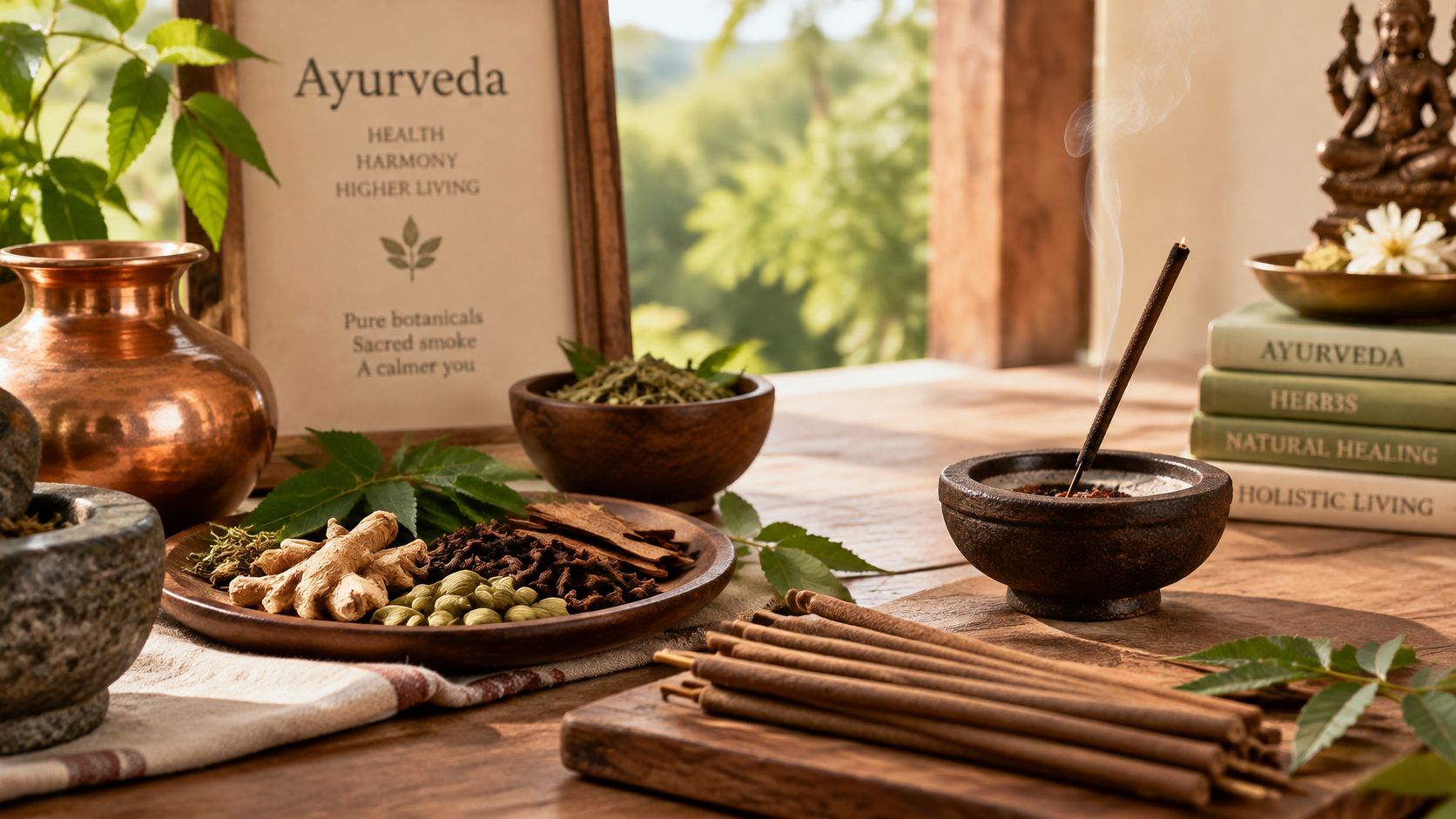
That history is documented, not just marketing. The historical study of Nardostachys jatamansi in the Indian Journal of History of Science reports that jatamansi is mentioned in the Caraka Saṃhitā and Suśruta Saṃhitā, foundational Ayurvedic medical texts that were compiled over many centuries. The same study documents that temples above 10,000 feet in Uttarakhand, including Kedarnath and Badrinath, burned dried jatamansi and guggul as dhoop, sometimes mixed with clarified butter or ghee. Centuries of continuous use in mountain temples tells you the practice is old and rooted, not a recent packaging trend.
Ritual and Therapeutic Uses Overlapped
In early use, fumigation served both ritual and therapeutic purposes. Priests burned aromatic materials in temples, and practitioners used smoke in settings tied to healing and cleansing a space. You can see similar overlaps between scent, worship, and daily life in our overview of the cultural significance of incense in global traditions.
Readers often mix up two forms. Dhoop usually means loose resin or powder, or a coreless paste, burned on charcoal or as a thick piece. A stick is different. A maker rolls or dips material onto a thin core, so you burn the core and base along with the botanicals.
This short video gives useful background on how traditional aromatic practices are presented today, which makes the distinction between cultural meaning and measured effect easier to keep in mind.
Historical use explains why jatamansi and guggul were chosen and why they still carry meaning. A long tradition is a reason to respect the practice. It is not, on its own, a guarantee about what a modern stick releases when it burns, so treat the word "Ayurvedic" as context for the ingredients rather than a verdict on the product.
Does the Ayurvedic Label Make Incense Safer
No. The Ayurvedic label describes a tradition, not how smoke behaves. Combustion is the exposure whatever the packaging says, including herbal, natural, and sandalwood sticks. A plant powder, binder, charcoal base, and fragrance oil all change when they burn, and your lungs meet the smoke, not the unburned ingredient list.
Similar Labels Can Mean Very Different Emissions
A 2024 California-residence study published in Environmental Science and Technology measured PM2.5 emission rates of 7–202 mg per hour and emission factors of 5–56 mg per gram burned. That wide range is the lesson. Two products can share soothing language and still release very different amounts of fine particles per hour and per gram.
Visible smoke isn't a reliable guide either. The same source notes that "smokeless" sandalwood sticks could still produce high contributions to ozone-forming and secondary organic aerosol chemistry. In plain language, you can see less smoke while gas-phase compounds remain. Low smoke doesn't automatically mean low exposure.
Particle size matters as much as particle amount. Chamber testing of sandalwood and aloeswood sticks measured particle emission rates of approximately 5.10 × 10^12 to 1.42 × 10^13 particles per hour, with peak particle diameters of 93.1–143.3 nm. Depending on formulation, 40–60% of counted particles were in the 100–560 nm accumulation range, while 16–55% were ultrafine particles between 50 and 100 nm. Particles that small can stay airborne and penetrate into the respiratory tract.
Three Questions Before You Believe a Claim
Traditional description or measured result: "Used in Ayurvedic practice" describes history, it doesn't measure your room air.
Burn rate and room size named: A result without stick mass, burn duration, and room volume can't be compared fairly.
Gases covered as well as particles: A claim based only on visible smoke misses volatile compounds and carbonyls.
A supportable claim sounds like "traditional sandalwood aroma." A claim such as "cleans the air" needs test data, not heritage.
Buyer Checklist for Ayurvedic Incense
Criterion | What to check | Red flag |
|---|---|---|
Ingredient list | Named botanicals such as sandalwood, jatamansi or guggul | Only "herbal blend" or "natural" wording |
Fragrance load | Stated fragrance oil or binder, with its share if given | Heavy synthetic scent on every stick |
Stick mass and burn time | Weight per stick and burn duration | Neither stated |
Wood or charcoal content | Stated proportion of wood, resin or charcoal | Not disclosed |
Emissions data | Chamber results for particle size, mass per gram, VOC and carbonyl measures | "Smokeless" with no test data |
Testing conditions | Burn rate, room volume and ventilation used in the tests | Results with no conditions named |
Return terms | Stated policy on returns for scented products | Not stated |
Use the checklist as a conversation with the seller. Ask for particle-size distribution, mass emission per gram burned, and VOC or carbonyl measurements from standardized chamber testing. If those data aren't available, treat the product as an aromatic choice, not a verified low-emission one.
Check returns before buying scent by description alone. We don't accept returns on fragrance, incense, or perfume oils because of the possibility of contamination, so a small first pack is safer for your budget than a bulk guess. Cultural and aromatic value can be real and worthwhile. Therapeutic claims need separate clinical evidence, and they shouldn't be inferred from a botanical name.
What Incense Smoke Releases and How Much
Start with the numbers, then learn how to read them. Units differ across rows, per gram burned, per hour, and per cubic metre, so only compare figures that share the same unit.
Measured Incense Emissions by Pollutant
Measure | Reported figure | What it tells you |
|---|---|---|
Fine particulate matter (PM3.2) | 12.5 ± 4.2 mg per gram burned | Mass emitted per gram, 60–70% of it is under 1 µm |
PM2.5 emission rate | 7–202 mg per hour | Varies widely by product and burn conditions |
PM2.5 emission factor | 5–56 mg per gram burned | Same study, compares products by mass burned |
Toluene | 70.8 ± 35.7 µg per gram burned | Most abundant measured compound across the volatility range |
Diethyl phthalate | Up to 16,365 µg/m³ in air, up to 13,582 µg per stick | Fragrance binder in some Indian stick products |
The visual summary below groups the main pollutant types and units, which helps when you're comparing a per gram figure with a room concentration figure.
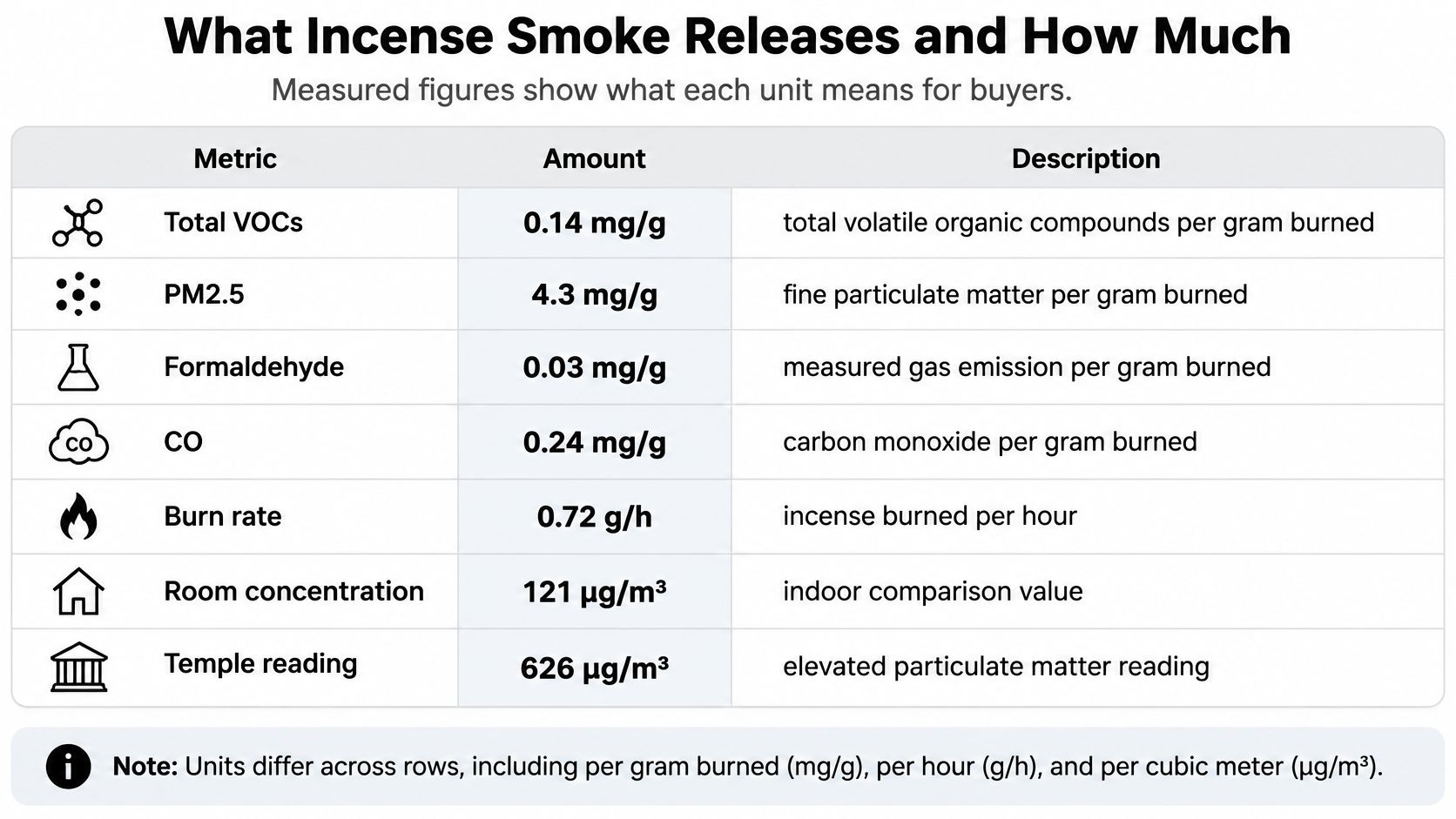
The particulate factor shows how much fine particle mass comes from each gram burned. A review of incense smoke particle emissions reports a PM3.2 emission factor of 12.5 ± 4.2 mg per gram of incense burned, and 60–70% of collected PM3.2 mass consisted of particles smaller than 1 µm. Small mass doesn't mean harmless mass when most particles are tiny enough to remain suspended.
Gases tell another part of the story. A 2008 medical review of incense emissions reported diethyl phthalate, a fragrance binder used extensively in India's incense-stick industry, at concentrations as high as 16,365 micrograms per cubic meter in emissions from some products, with up to 13,582 micrograms per incense unit. More recent laboratory work described there found toluene to be the most abundant measured compound, averaging 70.8 ± 35.7 micrograms per gram burned, with benzene, furfural, and phenol also prominent.
Pollutant Classes That Recur
Particulate matter: Fine and ultrafine particles from wood, charcoal, resins, and powders.
Carbon monoxide and oxides: Gases formed during incomplete combustion, including nitrogen and sulfur oxides.
Volatile organic compounds and aldehydes: Gas-phase compounds from fragrance and plant material.
Polycyclic aromatic hydrocarbons: Organic pollutants associated with burning carbon-based material.
One stick can look like very little smoke. Repeated burning in a small treatment room, studio, or shop lets particles and gases build up, especially when doors stay closed between sessions. That's why room volume, burn frequency, and air exchange matter as much as the stick itself. Households concerned about lingering odors and ventilation may also find professional indoor air quality services useful for assessing airflow beyond a single product choice.
These figures come from specific tests and products. They don't prove every Ayurveda incense stick emits the same amount. They do show why "it's only one stick" isn't a complete exposure calculation.
How to Burn Ayurvedic Incense Safely at Home
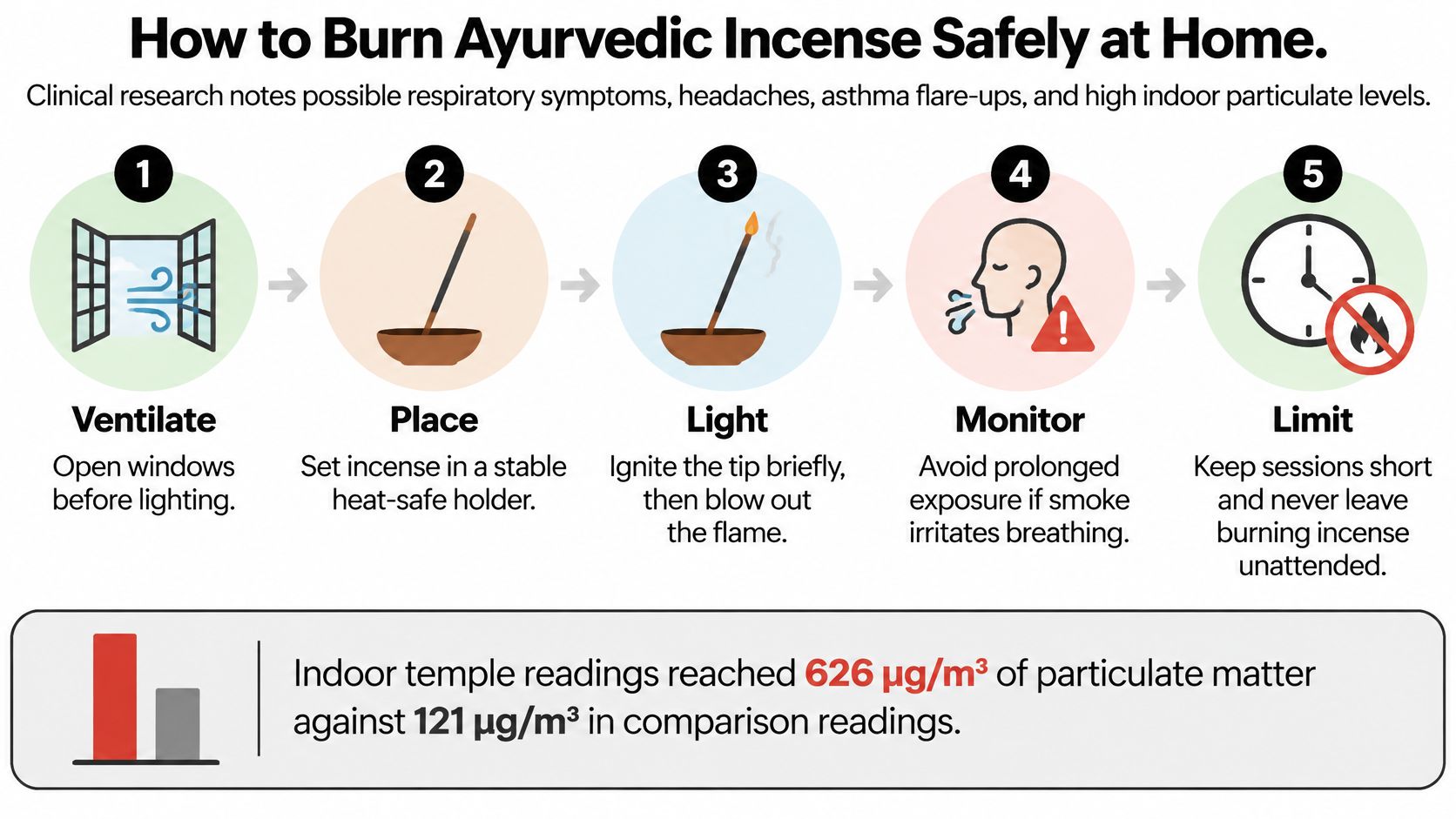
A routine beats a vague warning. The Nature Index summary of health impacts from incense burning reports that burning one gram of incense can generate roughly 45 mg of particulate matter, compared with about 10 mg from a cigarette, and cites indoor temple measurements of 626 µg/m³ particulate matter versus 121 µg/m³ outdoors. The same summary links incense exposure with respiratory symptoms, allergic airway inflammation, headaches, and asthma exacerbation. Emissions vary by product and conditions, so a traditional label changes the recipe, not the physics of combustion.
The infographic below summarizes the key steps, so you can keep it near your burner as a quick reminder.
A Seven Step Burn Routine
Pick a large, ventilated room: Don't use a bedroom or small enclosed space, because smoke concentrates where air can't move.
Create a path out: Open a window or door on the far side and run a fan pushing air outward, so fresh air replaces smoky air.
Place the burner carefully: Set it on a noncombustible surface, away from curtains and your breathing zone, near the open window.
Burn one stick at a time: Keep sessions short instead of lighting several sticks together, since each stick adds emissions.
Move sensitive people out first: Children, pets, and anyone with asthma, allergies, or heart or lung conditions shouldn't sit in the smoke path.
Choose outdoors or skip burning: When someone at home is sensitive, outdoor use avoids the indoor buildup entirely.
Extinguish fully: Confirm the ember is out and empty ash into a noncombustible container, because hidden embers can keep smoldering.
A printable version helps the routine happen. Our concise incense safety guidance covers the same basics in a format you can share with family, staff, or studio clients. Post the steps where the burner lives, not in a drawer. People follow instructions they can see at the moment they're holding a lighter.
Ventilation lowers exposure. It doesn't make combustion harmless.
Finish with a readiness check before you call the session done. The air should clear within minutes after you extinguish the stick. No one should leave the room with a headache, cough, or irritated eyes or throat. If symptoms appear, stop, ventilate, and change the setup rather than repeating it and hoping your body adjusts. A shorter burn in a bigger, better-ventilated room is the fix, not willpower.
Lower-Exposure Options and Shared Spaces
The lowest-exposure scent is the one you don't burn. Diffusers and essential oils used in ventilated spaces avoid combustion particles, but they still release volatile compounds. You'll still want fresh air, modest amounts, and attention to headaches or irritation, especially around children and pets.
What Each Option Can and Cannot Do
Non-burning fragrance: Avoids smoke and ash, but scent strength can build in a closed room.
Ventilation during burning: Moves particles and gases out, but doesn't prevent them from forming.
Air cleaners: Capture particles more effectively than gases, so they're a partial measure, not permission to burn longer.
Shorter, single-stick sessions: Reduce total emissions at the source, which is the most reliable control you have.
Shared spaces need rules because one person's ritual becomes everyone else's air. At home, keep incense out of bedrooms and nurseries, and avoid it entirely when a household member has asthma or allergies. Small homes need extra restraint, and our guide to the best incense approach for small apartments explains how room size changes the decision.
For yoga studios, clinics, and shops, set a maximum number of sticks per session. Post burn instructions at the burner, train staff to ventilate before and after use, and keep burners away from mats, treatment tables, counters, and other shared breathing areas. Don't let a welcoming scent drift into a problem for the client who arrived with sensitive airways.
Worship spaces deserve the same practical care. Enclosed sanctuaries with many sticks, lamps, and people can accumulate smoke quickly, so active ventilation matters as much as tradition. Retailers can help by printing a consistent burn routine on packaging and shelf cards, since customers otherwise receive scattered advice. Clear instructions protect the experience you're trying to create.
Choose and Test Your First Ayurvedic Incense
Start small. Buy a test pack, not a bulk order, and choose a product with named botanicals, a scent you enjoy, and stated stick weight, burn time, and test data where available. A small pack lets your nose and your room give you evidence before you commit.
Run a One Week Test
Pick one scent and one room: Keep conditions steady so you can tell what changed.
Burn one stick per session: Use a large, ventilated room and the full routine each time.
Keep a short log: Note scent, room, burn time, and any headache, cough, or eye or throat irritation.
Stop when symptoms appear: Extinguish the stick, ventilate, and treat that result as useful information, not a failure.
If you're new to comparing scents and construction, our guide to good incense sticks helps you judge burn quality, ash, and fragrance clarity during the test. Write down whether the scent stays pleasant after extinguishing, since lingering smoke often smells different from the first minute.
Our Sonavi Nature's Collection comes in 25-gram packs of approximately 12 sticks at $3.50, with scents including Rosemary, Lavender, Sandal, Vanilla, Palo Santo, and 7 Chakras. Sonavi releases light aromatic smoke and fine particulates like all incense, so the same one-stick routine applies. The small pack suits a one-week test because you can evaluate one fragrance without buying a large quantity first.
Your next action is simple. Pick one scent, one room, and one burn time for the first week. Let the log decide whether it earns a place in your home, studio, or shop.
FAQs for Ayurvedic Incense
1. How should Ayurvedic incense sticks be stored to preserve their fragrance?
Store Ayurvedic incense sticks in a cool, dry location away from direct sunlight, humidity, and strong competing odors. Keep them in an airtight container or sealed package to help preserve their original fragrance and prevent moisture from affecting the sticks.
2. Can different Ayurvedic incense fragrances be burned in the same session?
Different fragrances can be used during separate sessions, but combining multiple burning sticks increases the total amount of smoke released. For a more controlled experience, try one fragrance at a time rather than burning several varieties simultaneously.
3. What is the difference between masala incense and charcoal-based incense?
Masala incense is traditionally made by combining aromatic ingredients such as wood powders, herbs, spices, and resins into a paste. Charcoal-based incense uses charcoal as part of its combustible base. Both can contain additional binders and fragrance ingredients, and their actual composition varies by manufacturer.
4. Does the thickness of an incense stick affect how long it burns?
Yes. Stick thickness, density, composition, and moisture content can all influence burning time. Thicker or more densely packed sticks may burn differently from thinner sticks, even when they have similar lengths. Check the manufacturer's stated burn time rather than relying on appearance alone.
5. Why does Ayurvedic incense sometimes smell different after it has been extinguished?
Fragrance can change as an incense stick burns because different aromatic compounds are released at different temperatures. Residual smoke, heated ingredients, and lingering combustion odors can also influence the scent after extinguishing. This is why the fragrance experienced during burning may differ from the original scent of an unburned stick.
Browse small packs, traditional botanical scents, burners, and ash catchers at Aroma Incense Warehouse, then start with a single scent you can test carefully for one week. Choose a ventilated room, burn one stick at a time, and let your own comfort guide your next order.


