

What Is a Pendulum Used For? Complete Guide to Spiritual & Scientific Applications

You're probably here because you saw a pendulum in a crystal shop, on a healer's table, or hanging from someone's hand and thought, what is a pendulum used for, really? It looks simple. A small weight, a chain, a gentle swing. Yet people talk about it in two very different ways. Some treat it like a spiritual tool for guidance. Others know it as one of the most important instruments in the history of science.
Both views exist for a reason.
A pendulum has helped people measure time with remarkable accuracy, demonstrate that Earth rotates, test materials in industry, and steady tall buildings. It's also used in personal practices like dowsing, meditation, and reflective yes-or-no questioning. If you've felt curious but also a little cautious, that's a healthy place to begin. A grounded approach leaves room for wonder without skipping over how motion works.
For many people, pendulums sit in the same personal toolkit as breathwork, journaling, incense, or quiet ritual. If that broader practice speaks to you, this short read on the power of incense in meditation pairs well with pendulum work because both invite focus through simple, repeatable action.
Table of Contents
What Is a Pendulum and Why Is It So Captivating - A small object with two identities - Why people feel drawn to it
The Pendulum in Science and Timekeeping - From swinging weight to reliable clock - Why pendulums keep such steady time - A tool for showing hidden motion - Scientific and industrial uses that still matter
Using a Pendulum for Divination and Inner Guidance - How people use pendulums in spiritual practice - The ideomotor effect and why people still find meaning in it - A balanced way to work with a pendulum
How to Use a Pendulum A Step-by-Step Guide - Before you begin - A beginner practice you can try today - How to ask better questions
How to Choose and Care for Your Pendulum - Choosing by material and feel - Simple care and cleansing habits - What shops and practitioners often keep nearby
Advanced and Surprising Uses for Pendulums Today - Pendulums inside skyscrapers - Other technical uses most people never hear about
What Is a Pendulum and Why Is It So Captivating
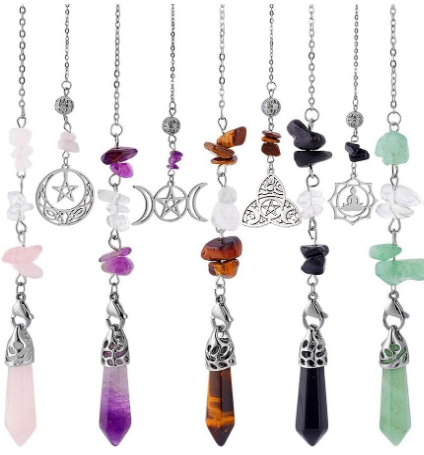
A pendulum is, at its most basic, a weight suspended from a fixed point so it can swing
freely. That's all. It can be a brass bob on a chain, a crystal point on a cord, or a giant steel sphere inside a building. The form changes, but the underlying idea stays the same.
What captures people is the contrast between its simplicity and its range.
A first-time buyer might pick up an amethyst pendulum because it feels calming or beautiful. A physics student might look at the same object and think about gravity, motion, and repeating cycles. A meditation teacher might use it to help a client slow down and focus on one clear question. A museum visitor might stand under a giant pendulum and watch it reveal something about the planet itself.
A small object with two identities
Pendulums live in two worlds at once.
In one world, they belong to science, engineering, and measurement. In the other, they belong to ritual, symbolism, and self-inquiry. That doesn't mean every use carries the same kind of evidence. It means the same physical object can serve very different human needs.
A pendulum is often less about the object itself and more about what kind of attention you bring to it.
That's why people can ask the same question, “What is pendulum used for?”, and mean very different things. One person wants to know how clocks worked. Another wants to know if a pendulum can help with intuition. Both questions are valid.
Why people feel drawn to it
The motion is part of the appeal. A swinging pendulum feels orderly and soothing. It gives your eyes something steady to follow. It also turns subtle movement into visible movement, which is one reason it has become such a meaningful object in both laboratories and spiritual spaces.
If you've ever felt intrigued by one, you're responding to something real. Not necessarily magic in every case, and not “just your imagination” either. Often it's the meeting point between body, mind, symbol, and motion.
The Pendulum in Science and Timekeeping
A clockmaker in the 1600s needed a way to make time less slippery. A loose estimate was not enough for astronomy, navigation, or daily schedules. The pendulum helped solve that problem by turning gravity and motion into a steady rhythm people could count on.
From swinging weight to reliable clock
One of the clearest historical uses of a pendulum is timekeeping. According to the history of the pendulum clock, Christiaan Huygens built the first successful pendulum clock in 1656, drawing on Galileo Galilei's earlier observation of a swinging lamp in 1584. That improvement reduced daily clock error from 15 minutes to about 15 seconds and set the standard for accurate timekeeping for centuries.

That matters because better clocks changed more than the clocks themselves. More reliable time helped sailors estimate position, helped astronomers compare observations, and helped cities coordinate work and transport with fewer errors.
Why pendulums keep such steady time
A pendulum works like a metronome shaped by gravity. Once it starts swinging, it repeats a pattern. For small swings, that pattern stays regular enough to measure.
Huygens later described that timing mathematically with T = 2π√(L/g). You do not need the formula to grasp the practical lesson. The swing time depends mainly on two things:
Length: a longer pendulum swings more slowly
Gravity: stronger gravity shortens the period slightly
Stable conditions: a consistent setup helps keep the rhythm predictable
This is one place where science and spiritual use meet. In both settings, the pendulum makes subtle forces visible. In a lab, that force may be gravity, impact, or ground motion. In reflective practice, the movement can help a person notice tiny muscle responses, attention shifts, or emotional hesitation. If you stock pendulums in a wellness or metaphysical shop, this balanced explanation builds trust because it respects physics without dismissing personal meaning.
A tool for showing hidden motion
Pendulums also reveal things that are hard to see directly.
The Foucault pendulum is a classic example. Since 1851, it has offered a visible demonstration of Earth's rotation, as described by the Smithsonian's account of the Foucault pendulum. The floor seems still, but over time the swing plane appears to shift. What you are really seeing is Earth turning beneath the pendulum.
That lesson is useful beyond museums. It shows why pendulums are so compelling across different traditions. A simple hanging weight can make an invisible process feel concrete.
Scientific and industrial uses that still matter
Pendulums are still used in technical fields today:
Use | How it helps |
|---|---|
Material testing | Pendulum impact testers such as Charpy or HIT machines measure how materials behave under sudden force |
Seismology | Pendulum-based instruments help detect and record ground motion |
Gravimetry and guidance | Specialized pendulum systems support measurement and orientation |
In plastics testing, manufacturers use pendulum impact testers to compare how samples fracture under dynamic load. ZwickRoell's overview of pendulum impact testers for plastics describes HIT systems used for this kind of controlled impact testing.
For shop owners, this scientific background can also improve how you present pendulums to customers. A product card, workshop, or display can explain that a pendulum has a long history in measurement and observation, then gently note that many people also use it for ritual and self-reflection. That approach pairs well with other grounding practices, such as sage smudging for health, energy, and purification, because it gives customers context instead of hype.
It also helps to name the ideomotor effect clearly. Small unconscious movements in the hand can influence a pendulum's motion. For a skeptical reader, that explains why a pendulum may respond without requiring a paranormal claim. For a spiritually inclined reader, it offers a practical way to understand how inner states show up through the body. If your audience wants to explore that side with care, a good starting point is this guide to intuitive self-care.
So if someone asks what a pendulum is used for in science, the answer is simple. It helps people measure regular motion, demonstrate hidden forces, and observe patterns that would otherwise stay easy to miss.
Using a Pendulum for Divination and Inner Guidance

You are sitting with two choices in front of you. Neither feels fully right, and your mind keeps looping through the same arguments. In that moment, a pendulum can serve as a small, visible way to slow down and notice what is happening inside you.
That helps explain why pendulums remain so appealing in spiritual practice. People use them to ask yes-or-no questions, pause before a decision, check in during meditation, or bring structure to a personal ritual. The object is simple, but the experience can feel surprisingly revealing.
How people use pendulums in spiritual practice
A pendulum often shows up in everyday practice as a tool for:
Yes or no questions such as “Is this the right choice for me right now?”
Decision support when thoughts feel tangled or emotionally charged
Meditation or ritual check-ins to create focus and intention
Symbolic body awareness during chakra or energy work
A reflective pause before acting on impulse
Some practitioners understand those answers as guidance from spirit, higher self, or subtle energy. Others see the pendulum as a way to make unconscious preferences easier to notice. Both views start from the same lived experience. The pendulum gives your attention a focal point, much like watching ripples on water can help you notice a breeze you could not see directly.
If you're building a broader intuition practice, a thoughtful guide to intuitive self-care can help you notice how inner signals show up beyond divination tools.
The ideomotor effect and why people still find meaning in it
A balanced explanation includes the ideomotor effect. This is the tendency for small, unconscious muscle movements to follow thoughts, expectations, or emotional cues. With a pendulum, those tiny movements travel through the fingers and hand, and the hanging weight makes them easier to see.
That distinction is important because it changes the question. Instead of asking only whether an outside force is moving the pendulum, you can also ask what your body may be expressing before your conscious mind has put it into words.
This does not mean someone is pretending or forcing the result. In many cases, the movement is subtle enough that the person holding the pendulum does not notice they are initiating it. The pendulum works a bit like a handwriting sample for the nervous system. Small internal signals become visible patterns.
For a skeptical reader, this offers a grounded mechanism. For a spiritually inclined reader, it does not have to remove meaning from the practice. It may describe how inner states move through the body during a focused ritual.
A balanced way to work with a pendulum
Respect and critical thinking can sit in the same room.
You might hold all three of these ideas at once:
Scientific lens: unconscious muscle motion can guide the swing
Reflective lens: the response may reveal fear, desire, tension, or preference
Spiritual lens: the ritual can help a person feel centered, receptive, and connected
Used this way, a pendulum is less like an authority handing down perfect answers and more like a conversation partner that helps you listen carefully.
That balanced framing can also help retailers present pendulums responsibly. A product page or shelf sign can explain that some customers use pendulums for reflection, divination, or ritual, while others appreciate them as tools that make subtle inner responses easier to observe. Clear language builds more trust than exaggerated claims.
Some shops also pair pendulums with grounding tools that support intentional practice. For customers who like to begin with ritual preparation, sage smudging for health, energy, and purification can be presented as one way people create a calm, focused space before using a pendulum.
A pendulum does not need to predict your life to be useful. It can help you pause, notice, and choose with more awareness.
How to Use a Pendulum A Step-by-Step Guide
A beginner doesn't need a perfect ritual. You need a calm hand, a clear question, and enough patience to observe before jumping to conclusions.
Before you begin
Many people like to start with a simple reset. Sit down somewhere quiet. Rest both feet on the floor if that feels grounding. Take a few breaths before you touch the pendulum.
Some practitioners cleanse the pendulum first. Others hold it in their palm for a moment and set an intention. If you're spiritually inclined, that intention might be protection or clarity. If you're more practical, it might just be “I want an honest read of my own inner response.”

A beginner practice you can try today
Use this sequence the first few times. Keep it simple.
Hold the pendulum loosely Pinch the top of the chain or cord between your thumb and finger. Let the weight hang freely. Keep your elbow supported if your arm gets shaky.
Ask to see your yes Stay still and say, either aloud or in your mind, “Show me yes.” Watch the motion without trying to force it.
Ask to see your no Repeat with “Show me no.” The direction might be side to side, front to back, or circular. What matters is consistency for you.
Check for maybe or unclear Some people also ask for a signal that means uncertainty, not now, or unclear.
Test with known questions Ask easy questions you already know the answer to. “Is my name ___?” or “Am I sitting down?” helps you observe without emotional pressure.
Move to one real question Keep it short and specific. Ask one thing at a time.
Here's a video demonstration that many beginners find useful after reading the basic steps.
Don't grip tightly. A tense hand creates noisy movement and makes interpretation harder.
How to ask better questions
A pendulum works best with clear, closed questions. Vague wording often produces vague motion.
Try this comparison:
Less helpful | More helpful |
|---|---|
Should I change my life? | Is this a good week to begin applying for new roles? |
Tell me what to do | Would choosing option A support my current goal? |
Is this person bad for me? | Do I feel settled and safe when I think about this relationship? |
A few grounding habits help:
Ask one question at a time.
Avoid loaded wording when you already want one answer.
Stop when you feel tired or upset.
Write down your question and result if you want to spot patterns later.
Close the session with a thank you, a breath, or a moment of stillness.
The pendulum is most useful when you treat it as a prompt for awareness, not a replacement for judgment.
How to Choose and Care for Your Pendulum
The “right” pendulum usually feels comfortable, balanced, and easy to work with. Some people choose by appearance first. Others care most about weight, chain length, or material. Both approaches are fine if the tool feels usable in your hand.
Choosing by material and feel
Different materials create different experiences.
Crystal pendulums are popular in spiritual settings because people often like matching the stone to an intention. Amethyst is commonly associated with intuition. Clear quartz is often chosen for clarity. Rose quartz is frequently connected with tenderness or heart-centered reflection. Whether you treat those meanings as energetic, symbolic, or both, they can help shape your ritual.
Metal pendulums tend to feel steady and responsive. Brass and copper are common choices because they usually have a clean swing and enough weight to show subtle movement clearly.
Wood pendulums can feel warmer and simpler. Some people prefer them for an earthy, less ornate experience.
A practical checklist can help more than spiritual language alone:
Weight: enough to swing clearly, not so heavy it feels awkward
Shape: pointed or rounded, depending on your preference
Grip: chain or cord that feels easy to hold
Balance: a centered hang, without twisting too much
Personal response: you want a tool you'll use
Simple care and cleansing habits
Care is partly physical and partly energetic, depending on your worldview.
Physically, keep your pendulum dry when needed, store it so the tip doesn't chip, and untangle the chain gently. Energetically, many people like to cleanse it after an emotionally heavy session or when it starts to feel dull, sticky, or unfocused.
Common methods include:
Moonlight for a gentle reset
Smoke cleansing with incense or sage
Resting it on selenite
Quiet intention and breathwork
If you use smoke cleansing with crystals, this guide on how to cleanse crystals with sage gives a straightforward overview of the process.
What shops and practitioners often keep nearby
A pendulum often works best as part of a small ritual setup rather than a standalone object tossed in a drawer.
People commonly pair pendulums with a cloth, a journal, a small dish, incense, or a cleansing stone. If you also enjoy keeping meaningful crystal pieces in your space, something decorative like exquisite amethyst decor for home can make a reading corner feel more intentional without turning it into clutter.
A well-cared-for pendulum usually gets used more often because it feels ready when you are.
Advanced and Surprising Uses for Pendulums Today
The pendulum is old, but it isn't outdated. Engineers still utilize pendulum principles in unexpected applications.
Pendulums inside skyscrapers
One of the best examples sits inside Taipei 101. In structural engineering, physical pendulums can work as tuned mass dampers that counter building sway. According to this engineering reference on physical pendulums and tuned mass dampers, Taipei 101 uses a 730-ton steel pendulum suspended from the 92nd floor, and it can reduce building acceleration by up to 40% during typhoons.
That's an extraordinary answer to the question of what a pendulum is used for. The same basic principle that creates a gentle swing in your hand can help a massive structure stay steadier under stress.
Other technical uses most people never hear about
Pendulums also appear in less visible technical fields. Some specialized systems use pendulum principles in inertial guidance and gravimetry. According to Britannica's summary of pendulum uses, compound and Schuler pendulums play roles in inertial navigation systems, while gravimeters use pendulum principles to measure Earth's gravitational acceleration with precision exceeding 0.5% variation across the globe.
That wider view matters. It keeps the pendulum from being boxed into a single identity.
If your personal practice leans toward chakra work, you may enjoy pairing reflective tools with scent. A simple chakra incense guide with scents for each chakra can complement that style of ritual without claiming the pendulum itself does all the work.
The Pendulum A Tool for Every Path
A pendulum can reveal very different things depending on how it's used. In science, it has shown people how to measure time more accurately and how to observe physical truth through motion. In engineering, it helps manage force and stability. In personal practice, it can support self-reflection, ritual, and decision-making.
That range is what makes the pendulum so enduring.
For some people, it's a physical instrument. For others, it's a spiritual companion. For many, it's both a symbolic and practical object. The healthiest approach is usually the most grounded one. Respect the experience. Stay honest about the mechanism. Let the tool support awareness rather than replace your own discernment.
Notes for retailers
If you stock pendulums in a gift shop, wellness studio, or metaphysical space, customers usually need context as much as they need the item itself.
A few practical merchandising ideas work well:
Build beginner sets with a pendulum, a small cleansing item, and a short instruction card.
Group by intention such as clarity, calm, grounding, or intuition, instead of displaying every style without guidance.
Pair with adjacent tools like journals, cloths, or incense that naturally fit the ritual.
Train staff to answer common questions about yes/no use, care, and the ideomotor effect in respectful language.
Offer a simple display setup so shoppers can see how a pendulum fits into an actual practice.
For stores that serve meditation-focused customers, accessories like a meditation cushion set can sit naturally near pendulum displays because both support quiet, intentional routines.
A well-presented pendulum doesn't need exaggerated claims. It needs a clear explanation, a thoughtful context, and enough trust for the customer to explore it in their own way.
Frequently Asked Questions
1. Can anyone learn to use a pendulum? Yes. Most people can learn to use a pendulum with practice. Beginners often start by asking simple yes-or-no questions and observing consistent movement patterns before using it for personal reflection.
2. What is the best material for a pendulum? There isn't one "best" material. Crystal pendulums are popular for spiritual practices, while brass and copper pendulums are often preferred for their balanced weight and smooth movement.
3. Can a pendulum predict the future? There is no scientific evidence that pendulums can predict future events. Many people instead use them as tools for mindfulness, intuition, and self-reflection rather than fortune telling.
4. How often should you cleanse a crystal pendulum? Many practitioners cleanse their pendulum after emotionally intense sessions or before beginning a new practice. Common methods include moonlight, incense smoke, selenite, or setting a clear intention.
5. Is there a difference between a dowsing pendulum and a regular pendulum? Physically, they're very similar. The difference is how they're used. A dowsing pendulum is intended for spiritual, intuitive, or divination practices, while scientific pendulums are designed for measurement and demonstration.
If you're stocking pendulums, incense, fragrance oils, sage, burners, or meditation accessories for personal use or resale, Aroma Warehouse is a practical place to browse. Their selection supports both individual rituals and retail-ready product mixes, which makes it easier to build thoughtful bundles for wellness spaces, gift shops, and metaphysical stores.


